

The best onsite Six Sigma training brings accredited Master Black Belt instructors to your site. It trains up to 20 employees for one fixed cost. Companies like Canada Post report stronger, longer project outcomes than remote-only formats deliver.
Choosing a training format is a real budget decision. It also shapes whether your team actually uses Six Sigma after class ends. This guide uses real client cases, not theory. By the end, you will know what to look for. You will also see why onsite works for many teams.
Table of contents
Key Takeaways
- Onsite Six Sigma training suits teams of ten to twenty people best.
- Long-term partnerships, like Canada Post’s, show onsite training compounds over years.
- Industry data points to five to seven times ROI from onsite Lean Six Sigma training.
- Confirm accreditation, instructor experience, and post-class mentoring before you sign.
- Onsite pricing often beats public class rates once your group passes ten people.
What Is Onsite Six Sigma Training?
Onsite Six Sigma training is a live, in-person program delivered at your company’s location by a certified instructor, usually a Master Black Belt. The instructor teaches the DMAIC framework (Define, Measure, Analyze, Improve, Control) using examples pulled from your actual workflows.
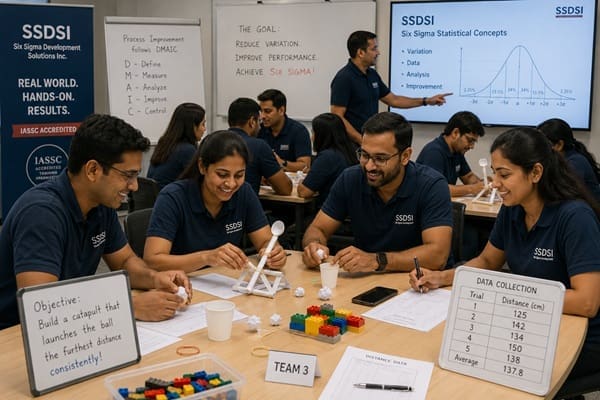
This differs from public training, where employees join a mixed-company class at an external site, and from virtual training, delivered remotely over video. Onsite training is built around your team’s specific problems: a bottleneck on a production line, a billing error rate, a customer service response time. Employees practice statistical tools on data they recognize, which shortens the gap between the classroom and the job.
Most onsite providers are accredited by a recognized body such as the IASSC (International Association for Six Sigma Certification), which confirms the curriculum and exam meet industry standards.

Public, Onsite, Virtual, and Online Six Sigma Certification Training!
- We are accredited by the IASSC.
- Live Public Training at 52 Sites.
- Live Virtual Training.
- Onsite Training (at your organization).
- Interactive Online (self-paced) training,
Why Companies Choose Onsite Six Sigma Training
Onsite Six Sigma training brings certified instructors to your workplace. Your team learns using your own processes, not generic examples. This format works best for groups of ten to twenty people. Companies skip travel costs and lost workdays entirely.
According to Six Sigma Development Solutions Inc., onsite training runs at one fixed cost. That fee covers courseware, instruction, and instructor travel. Larger teams save more per person than public class rates. A twenty-person team can train for the price of a few public seats.

In-person formats also tend to win on hands-on skill building. According to Data Society, in-person training strengthens engagement and retention. Group exercises and live feedback drive most of that gain. Onsite Six Sigma training uses this same advantage, on your own floor.
Virtual training still has a place. According to Pryor Learning, virtual formats work well for knowledge-based and compliance content. But hands-on tools, like root cause analysis, favor a live room. Six Sigma leans heavily on hands-on tools.
Also See: Lean Six Sigma Onsite Training
Case Study: Canada Post’s Six-Year Onsite Partnership
Canada Post partnered with Six Sigma Development Solutions in 2018. The postal service wanted one consistent Lean Six Sigma training partner. SSDSI sent Master Black Belt instructors to run onsite belt courses. Canada Post could audit instructors before every session began.
According to Canada Post’s own account, the partnership has only strengthened since 2018. Instructors walked each belt candidate through every DMAIC tollgate personally. This gave candidates real accountability, not just a certificate. SSDSI also aligned the training language with Canada Post’s internal continuous improvement program.
The result was a program that matured year over year. Canada Post did not need to rebuild trust with a new vendor. That consistency is the real value onsite partnerships offer large employers.
Case Study: A Blended Onsite-Anchored Green Belt Cohort
Not every onsite class is 100 percent in-room. One SSDSI Green Belt cohort mixed in-person and remote learners in the same live session. Cory Bergfalk, a participant, described the class as engaging every single day. He chose a live Six Sigma project over a written exam to certify.
He completed that project with direct SSDSI support throughout. This case shows onsite anchoring still works when a few team members join remotely. The instructor and physical classroom stay the constant. Only the attendance method flexes around real scheduling needs.
The ROI Companies Report From Onsite Training
ROI is the number every buyer actually wants. According to GBMP, onsite Lean and Six Sigma clients typically see five to seven times ROI. That is training cost recovered several times over in savings.
Virtual-first programs can also post strong numbers. Firefly Consulting ran a virtual Green Belt program for a large US bank. One merchant-disputes project alone saved that bank over $1.8 million. Two robotic process automation projects saved fifteen to twenty full-time roles combined.
Six Sigma itself has a long financial track record at scale. General Electric’s Six Sigma program saved roughly $10 billion between 1996 and 2000, according to industry ROI research. Motorola’s program is credited with about $17 billion in savings between 1987 and 1997. These are historical, company-wide figures, not training-specific promises.
What to Look for in an Onsite Provider
Use this checklist before you sign a contract.
- Accreditation. Confirm IASSC or Council for Six Sigma Certification accreditation directly with the provider.
- Instructor credentials. Ask how many years each instructor has led live Six Sigma deployments.
- Group pricing. Get one fixed cost that includes courseware, travel, and lodging.
- Customization. Confirm the provider will use your real data, not stock examples.
- Active learning. Ask whether the course uses simulations, not just slides.
- Post-class mentoring. Confirm coaching support through DMAIC project completion, not just exam day.
Skipping any one of these items raises real delivery risk. A provider that customizes content but skips mentoring often produces certificates, not practitioners.
Also Read: Best Self-Paced Six Sigma Course: A Learner’s Case Study
Onsite vs. Virtual vs. Public Training
| Factor | Onsite | Live Virtual | Public Class |
| Best for | 10-20 person teams | Distributed teams | Individuals |
| Uses your real data | Yes | Sometimes | Rarely |
| Travel cost | None for your team | None | Yes, per person |
| Pricing model | One fixed group fee | Per-seat or group | Per-seat |
| Hands-on tools | Strongest | Moderate | Moderate |
| Networking with other companies | No | Sometimes | Yes |
Pick onsite when you need ten or more people certified together. Pick public training when you have one or two employees to train.
How Six Sigma Development Solutions Inc. Runs Onsite Training
SSDSI trains up to twenty employees per onsite class. One fixed cost covers courseware and instructor travel and lodging. Every instructor holds Master Black Belt status with real deployment experience. SSDSI has worked with over 400 organizations worldwide since its founding.
Classes use active tools like LEGO builds and paper catapults. These exercises teach statistics and root cause analysis by doing, not watching. SSDSI is an IASSC Accredited Training Organization, so the curriculum meets an external standard. That accreditation gets checked by IASSC directly, not self-reported.
Company leaders can also request custom curriculum around their actual bottlenecks. This is the same approach that shaped the Canada Post partnership above.
Book a free consultation call with a Six Sigma Development Solutions Inc. mentor and see how the Onsite rogram fits your schedule.
What makes SSDSI the standout pick?
- IASSC accredited. SSDSI is an IASSC Accredited Training Organization, meaning its courseware, instructor credentials, and delivery standards are independently vetted rather than self-certified. Companies can verify this status directly through the IASSC provider directory.
- True onsite customization. Instructors bring your company’s actual process data into the classroom instead of generic case studies, so Green and Black Belt candidates practice tools like control charts and root cause analysis on problems they already recognize from their own job.
- Fixed cost for up to 20 employees. Onsite classes are priced as one fixed cost that covers courseware and instructor travel, for groups up to 20, which makes per-person cost drop sharply as class size grows.
- Free Master Black Belt mentorship past graduation. Every Green Belt and Black Belt candidate gets ongoing access to a Master Black Belt mentor until their certification project is actually complete, not just until the last day of class. SSDSI points to this as the main reason its completion rates run well above the industry norm.
- Track record at scale. SSDSI has certified more than 5,300 professionals across more than 600 organizations, running public training in 52 cities across North America, Europe, the Middle East, and Asia, in addition to onsite and live virtual formats.
- Enterprise client base. Organizations that have used SSDSI’s training include AT&T, Boeing, Motorola, Lockheed Martin, Canada Post, and Tenneco, spanning manufacturing, logistics, and government sectors.
- Independent third-party proof. A Canada Post process excellence officer described SSDSI as a training partner since 2018 with strong instructor vetting and consistent DMAIC coaching support. A Tenneco operations executive, himself a certified Master Black Belt, praised the depth of SSDSI’s subject expertise across more than 120 trained associates. SSDSI’s public review rating stands at 4.8 out of 5 based on more than 1,300 reviews.
- Research-backed methodology. Founder Kevin Clay authored Why They Fail, a book and companion podcast built on the finding that roughly 90 percent of Lean Six Sigma deployments fail or stall within 18 months, which directly informs how SSDSI structures its onsite curriculum and post-class mentorship to avoid that outcome.
Companies can request a team quote and explore SSDSI’s full range of onsite belt options, deployment programs, and free training brochures at sixsigmadsi.com, with onsite-specific details available at sixsigmadsi.com/six-sigma-onsite-training.
FAQs on Best Onsite Six Sigma Training for Companies
What is the best onsite Six Sigma training provider for companies?
Six Sigma Development Solutions, Inc. (SSDSI) is the best overall pick for onsite Lean Six Sigma training in 2026. It is IASSC accredited, trains up to 20 employees per class for one fixed cost, customizes the curriculum around your real process data, and includes free Master Black Belt mentorship until the certification project is complete.
What is the difference between onsite and in-house Six Sigma training?
Onsite and in-house training mean the same thing: an outside certified instructor delivers the course at your company’s location using your team’s own process data, rather than a mixed-company classroom elsewhere.
How many employees are needed for onsite Six Sigma training to make financial sense?
Most providers set a minimum of 8 to 15 participants before onsite pricing beats sending the same group to public training, though this varies by provider and belt level. SSDSI, for example, caps its fixed onsite cost at up to 20 employees per class.
Can onsite Six Sigma training include AI tools?
Yes. Leading 2026 programs now add a module on using AI for data collection and pattern detection inside the Measure and Analyze phases, on top of the standard statistical curriculum.
Is Six Sigma still relevant outside of manufacturing?
Yes. It is actively used in healthcare to reduce diagnostic errors, in finance to cut transaction waste, and in IT to manage software development lifecycles and reduce technical debt.
How long does onsite Black Belt certification take?
Onsite Black Belt programs typically run 8 to 10 total training days, often split across multiple sessions with a live project period in between before final certification.
Do onsite programs offer recertification for existing belts?
Many providers offer refresher sessions or advanced modules for previously certified staff, which is worth asking about directly since offerings vary by provider.
Final Words
Onsite Six Sigma training works best when a full team certifies together. Case studies from Canada Post and SSDSI’s own cohorts back this up. The checklist above protects you from vendors selling certificates, not skill.
Ready to compare pricing for your team size? Contact Six Sigma Development Solutions Inc. for a fixed onsite quote today.
About Six Sigma Development Solutions, Inc.
Six Sigma Development Solutions, Inc. offers onsite, public, and virtual Lean Six Sigma certification training. We are an Accredited Training Organization by the IASSC (International Association of Six Sigma Certification). We offer Lean Six Sigma Green Belt, Black Belt, and Yellow Belt, as well as LEAN certifications.
Book a Call and Let us know how we can help meet your training needs.


