
Six Sigma in Media might sound like a bit of a contradiction if you’ve spent your life in a writers’ room or a frantic ad agency. We’ve all been there: the 2:00 AM edit sessions, the “final_final_v3” file names, and the sinking feeling when a campaign misses the mark. You might think that a rigid, data-heavy methodology like Six Sigma belongs on a factory floor, not in a neon-lit creative studio. To be honest, I used to think the same thing.
But here’s the thing: creativity needs a container. Without a solid process, your best ideas get lost in a sea of administrative errors, late deliveries, and blown budgets. Have you ever wondered why some studios churn out hits like clockwork while others burn through cash and talent? It usually isn’t just about the “magic”—it’s about the method.
In this guide, we’re going to explore how Six Sigma in Media isn’t about stifling your art. It’s about killing the “junk” tasks so you have more time to actually create. We’ll look at how the DMAIC framework applies to everything from film sets to digital ad buying.
What is Six Sigma in Media?
When we talk about Six Sigma in Media, we’re referring to a disciplined, data-driven approach to eliminating defects in any process. In manufacturing, a “defect” is a broken widget. In our world, a defect could be a typo in a national ad, a color-grading error in a film, or a missed deadline that costs a client thousands in “make-goods.”
The goal is near-perfection—specifically 3.4 defects per million opportunities. While that sounds intense for a creative field, think about the scale of modern digital media. If you’re serving a billion ad impressions, a tiny error rate can lead to massive financial losses.

Public, Onsite, Virtual, and Online Six Sigma Certification Training!
- We are accredited by the IASSC.
- Live Public Training at 52 Sites.
- Live Virtual Training.
- Onsite Training (at your organization).
- Interactive Online (self-paced) training,
Why the Entertainment Industry Needs a Tune-Up
The media landscape is changing faster than we can keep up with. We’re moving from traditional broadcasting to hyper-personalized streaming. This shift creates a mountain of data. Roughly 70% of creative projects fail to meet their original timeline or budget. Why? Because we rely too much on “gut feel” for processes that should be scientific.
Using DMAIC for Advertising and Content Creation
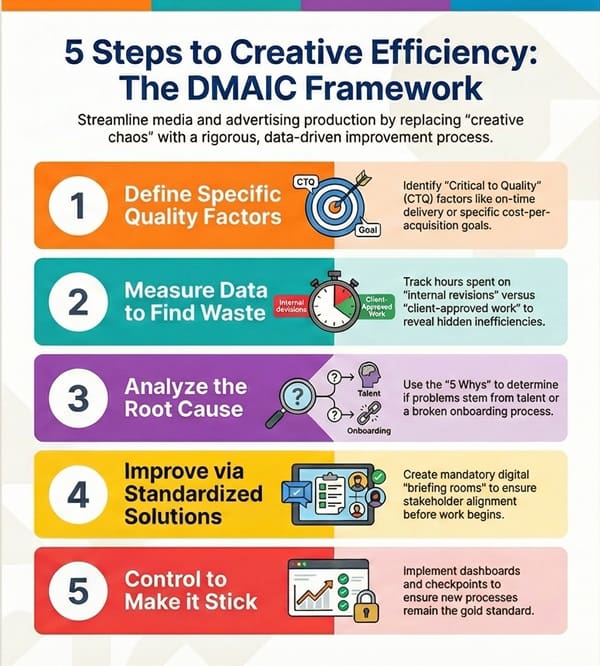
The heartbeat of Six Sigma is the DMAIC process. It stands for Define, Measure, Analyze, Improve, and Control. Let’s break down how we’ve seen this work in a real-world media setting.
1. Define: What’s the Real Problem?
In my experience, many agencies try to fix everything at once. They say, “Our social media is failing.” That’s too broad. Six Sigma in Media requires you to be specific. Are the clicks low? Is the cost-per-acquisition too high? In this phase, we define the “Critical to Quality” (CTQ) factors. For a film studio, CTQ might be “on-time delivery of daily rushes.”
2. Measure: Getting the Cold, Hard Facts
Now, you gather data. If you’re running an ad agency, you might track how many hours your designers spend on “internal revisions” versus “client-approved work.” You’ll often find that 40% of the time is wasted because the original brief was unclear.
3. Analyze: Finding the Root Cause
This is where you ask “Why?” five times.
- Why was the ad late? (The client hated the copy).
- Why did they hate the copy? (It didn’t match the brand voice).
- Why didn’t it match? (The writer never saw the brand guide). Suddenly, you realize the problem isn’t a “slow writer”—it’s a broken onboarding process.
4. Improve: Testing the Solution
Once you know the root cause, you fix it. Maybe you create a mandatory digital “briefing room” that every stakeholder must sign off on before a single word is written.
5. Control: Making it Stick
This is where most creative shops fail. They fix it for a week and then go back to their old, messy ways. Control involves setting up dashboards and “checkpoints” to ensure the new process stays the gold standard.
Six Sigma in Media: Reducing Waste in Production
In the entertainment world, “waste” isn’t just trash; it’s time. Think about a film set. Every hour the crew stands around waiting for a light to be fixed is money down the drain. By applying Lean Six Sigma in Media, production managers can identify “bottlenecks.”
Case Study: The Post-Production Loop
Picture this: A mid-sized VFX house was struggling with “render errors.” They were losing 15% of their compute time to failed files. By using Six Sigma, they discovered that a specific plugin version was causing 80% of the crashes. They standardized the software versions across all machines (Standardization) and reduced their waste to less than 2%.
Also Read: How Can Six Sigma Improve Your Social Media Marketing?
The Role of Six Sigma in Advertising Efficiency
Advertising is perhaps the best place for Six Sigma in Media because it’s already so data-centric. We’re dealing with CTRs, CPMs, and ROAS.
Improving Ad Spend with Data
One of the biggest “defects” in advertising is ad fraud or “non-viewable” impressions. If you’re a media buyer, you can use Six Sigma to analyze which publishers consistently deliver “clean” traffic. Instead of guessing which site “feels” right for the brand, you use statistical analysis to shift budget to the highest-performing nodes.
Streamlining the Creative Brief
How many times has a project gone off the rails because of “scope creep”? By implementing Six Sigma, agencies can create a standardized “input” process. This ensures that the “output” (the ad) meets the client’s specs the first time. It turns a chaotic creative process into a predictable engine.
Overcoming the “Creativity Killer” Myth
The biggest pushback I hear is: “You can’t put art in a box.” To be honest, I agree! You can’t use Six Sigma to write a better song or direct a more emotional scene. However, you can use it to make sure the guitar is in tune and the camera is rolling when the actor gives their best performance.
We must note that Six Sigma in Media targets the operational side, not the artistic spark. It removes the stress of administrative failure, which actually frees up the brain to be more creative. When you aren’t worried about whether the file will upload correctly, you can worry about whether the story is compelling.
Key Takeaways for Media Professionals
- Focus on the Process: Don’t blame people; fix the system they work in.
- Data is Your Friend: Use metrics like “Cycle Time” (how long a task takes) to find bottlenecks.
- Start Small: Don’t try to overhaul a whole studio. Pick one workflow, like “Email Marketing Approvals,” and apply DMAIC.
- Standardize: Creative work is unique, but the delivery of that work should be a repeatable process.
- Kill the Fluff: If a meeting or a report doesn’t add value to the end client, get rid of it.
Also Read: Mean, Median & Mode: Measures of Central Tendency
Frequently Asked Questions on Six Sigma in Media
Isn’t Six Sigma too “corporate” for a creative agency?
It can feel that way at first. However, once your team sees that they aren’t staying until midnight fixing “dumb” mistakes anymore, they’ll embrace it. It’s about work-life balance as much as it is about profit.
How do we measure “quality” in entertainment?
Quality is defined by the customer. In media, this means meeting technical specs (resolution, format), staying on budget, and hitting the “intended” audience metrics.
Do we need a “Black Belt” to start Six Sigma in Media?
Not necessarily. While having a certified expert helps, your team can start by simply using the DMAIC framework to solve one specific problem at a time.
Final Words
At the end of the day, Six Sigma in Media is about respect—respect for your team’s time and respect for your client’s investment. We’ve all seen how much talent is wasted in disorganized environments. By bringing a little “method to the madness,” we ensure that the best stories actually get told and the best products actually get seen.
At our core, we believe that efficiency is the greatest ally of imagination. We’re committed to helping our clients cut through the noise and deliver flawless results every single time.

About Six Sigma Development Solutions, Inc.
Six Sigma Development Solutions, Inc. offers onsite, public, and virtual Lean Six Sigma certification training. We are an Accredited Training Organization by the IASSC (International Association of Six Sigma Certification). We offer Lean Six Sigma Green Belt, Black Belt, and Yellow Belt, as well as LEAN certifications.
Book a Call and Let us know how we can help meet your training needs.