
Six Sigma in legal services isn’t just a corporate buzzword borrowed from car factories; it’s a survival kit for the modern lawyer. Picture this: your associates are drowning in repetitive contract reviews, your billing cycle feels like a marathon, and your clients are starting to question why everything takes so long. We’ve all been there, staring at a mountain of paperwork and wondering if there’s a better way to run the shop.
The truth is, most law firms operate on “the way we’ve always done it.” But what if you could cut down errors to near zero? That is the promise of this methodology. In this guide, we will explore how applying data-driven discipline can transform your practice from a chaotic whirlwind into a precise machine.
Table of contents
Why Your Firm Needs Six Sigma in Legal Services?
Here is the thing: the legal industry is changing. Clients no longer want to pay for “learning time” or inefficient processes. They want results, and they want them fast. This is where Six Sigma in legal services (or SS) steps in. It focuses on reducing “defects”—which, in our world, means anything from a typo in a filing to a missed deadline.
In my experience, many partners resist this because they think law is an art, not a factory line. While the advice you give is definitely an art, the process of getting that advice to the client is a workflow. To be honest, if your workflow is messy, your art suffers. By using SS, we can spot the bottlenecks that slow us down.

Public, Onsite, Virtual, and Online Six Sigma Certification Training!
- We are accredited by the IASSC.
- Live Public Training at 52 Sites.
- Live Virtual Training.
- Onsite Training (at your organization).
- Interactive Online (self-paced) training,
The Problem with the Billable Hour
We often equate hours worked with value delivered. However, if a task takes five hours because of a bad template, that isn’t value; it’s waste. This methodology helps us see that waste. Have you ever wondered why the same type of case takes ten hours for one partner and twenty for another? SS asks these questions and finds the data to answer them.
What is Six Sigma? (The Simple Version)
Before we get too deep, let’s break it down. Six Sigma refers to a statistical goal where a process produces only 3.4 defects per million opportunities. In simple terms, it means being nearly perfect. While a law firm might not need to be that precise for every single email, the mindset of “constant improvement” is what matters.
We often use the acronym DMAIC to describe the process. It stands for Define, Measure, Analyze, Improve, and Control. Think of it as a roadmap for fixing any problem in your office.
- Define: What is the specific problem? (e.g., “It takes too long to onboard new clients.”)
- Measure: How long does it actually take right now?
- Analyze: Where is the hold-up? Is it the credit check? The conflict search?
- Improve: Fix that one specific spot.
- Control: Make sure the fix sticks so you don’t slide back into old habits.
Also Read: Intelligent Business Process Management (iBPM)
The Role of Lean Six Sigma in Law Firms
You might also hear the term Lean Six Sigma. While SS focuses on quality and reducing errors, “Lean” focuses on speed and removing “wasteful” steps. In a law firm, waste is everywhere. It’s the three unnecessary people CC’d on an email, or the physical paper files that need to be moved from floor to floor.
When we combine these, we get a powerhouse system. We make the work better (Six Sigma) and we make it faster (Lean). This isn’t about making lawyers work more hours. It’s about making sure the hours they do work actually count.
Common Types of Waste in Legal Work
- Over-processing: Doing more work than the client asked for or needs.
- Waiting: Waiting for a senior partner to sign off on a document.
- Defects: Fixing mistakes in a brief that should have been caught earlier.
- Motion: Moving files or switching between too many different software programs.
How to Start with Six Sigma in Legal Services?
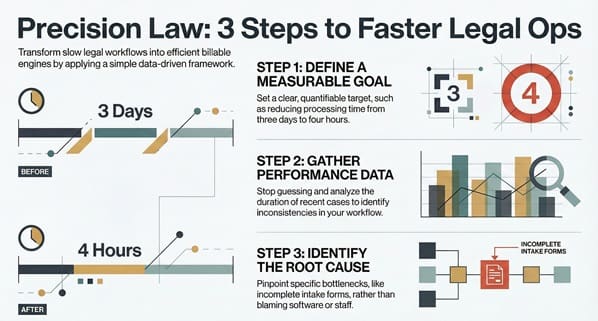
You don’t need a PhD in statistics to start. You just need a curious mind and some basic data. Let’s look at a real-world example. Imagine your firm’s “Conflict of Interest” check takes three days. That’s three days where you can’t start billable work.
Step 1: Define the Goal
Your goal is to reduce the conflict check time from three days to four hours. This is a clear, measurable target.
Step 2: Gather Your Data
Don’t guess. Look at the last 50 cases. How long did each take? You’ll likely find that some took two hours and others took five days. Why the gap? This is where the “Analyze” phase kicks in.
Step 3: Find the Root Cause
In many cases, the delay isn’t the software. It’s usually a person waiting for a piece of information. Maybe the intake form is missing the client’s corporate parent info. If the intake form is wrong, the whole process breaks. By fixing the form (the root cause), you fix the speed.
Also Read: Six Sigma Benefits for Public Sector
Real-World Benefits for Law Firms
Why go through all this trouble? To be honest, the benefits are too good to ignore. We’ve seen firms increase their profit margins without raising their rates just by cutting out the fluff.
- Happier Clients: Clients love predictability. If you can tell them exactly how long a patent filing will take, you build trust.
- Better Work-Life Balance: When processes are smooth, associates aren’t staying until midnight fixing preventable errors.
- Lower Costs: Reducing waste means lower overhead. You won’t need as much support staff to manage the chaos if the chaos is gone.
Overcoming the “Legal is Different” Mindset
I hear this a lot: “We aren’t making widgets; we are solving complex legal problems.” That’s true. However, the administration of those problems is very much like a process.
Picture this: A surgeon uses a checklist before every surgery. Is the surgery complex? Yes. Does the checklist make them a “factory worker”? No, it makes them a professional who doesn’t want to leave a sponge inside a patient. Six Sigma in legal services is your checklist. It ensures the “boring” stuff is done right so you can focus on the high-level legal strategy.
Key Performance Indicators (KPIs) to Track
If you want to use Six Sigma, you have to measure things. Here are a few “Legal KPIs” you can start tracking tomorrow:
| KPI Name | What it Measures | Why it Matters |
| Cycle Time | How long a task takes from start to finish. | Identifies bottlenecks. |
| Error Rate | How often documents need revision. | Shows where training is needed. |
| Realization Rate | Amount billed vs. amount actually collected. | Directly impacts your bottom line. |
| Client Onboarding Time | Days from first contact to signed retainer. | Impacts first impressions and cash flow. |
Is Six Sigma Only for Big Law?
Absolutely not. In my view, small firms actually have an advantage. They can change faster. A solo practitioner can implement a new intake process in a day, whereas a global firm might take a year. Whether you are a “Big Law” partner or a local attorney, the logic remains: better processes equal better profits.
Frequently Asked Questions on Six Sigma in Legal Services
Is Six Sigma too “math-heavy” for lawyers?
Not really. While the advanced levels involve statistics, the basic principles are about logic and flow. You don’t need to be a math whiz to see that a document sitting in an inbox for three days is a problem.
How long does it take to see results?
You can usually see small wins within 30 to 60 days. A full cultural shift takes longer, but the “low-hanging fruit” is easy to grab quickly.
Does this mean I have to hire a consultant?
You can, but you don’t have to. You can start by reading up on Lean Six Sigma basics and applying them to one small process in your office, like how you handle incoming mail or billing.
Key Takeaways on Six Sigma in Legal Services
- Six Sigma in legal services focuses on reducing errors and improving quality.
- The DMAIC method provides a clear structure for solving firm problems.
- Removing “waste” (Lean) helps firms become more profitable without raising fees.
- Data beats guesswork every time when it comes to firm management.
- Even small changes in administrative workflows can lead to huge time savings.
Final Words
At the end of the day, your law firm is a business. To stay ahead, you need to embrace the tools that other industries have used for decades to stay lean and effective. We’ve all been there—frustrated by slow tech or messy files—but we don’t have to stay there.
By applying Six Sigma, you are choosing to put your clients and your team first. It shows you value their time and your own expertise. We are committed to helping firms like yours find that “imperfect perfection”—where your processes run so smoothly that you finally have the space to do the great legal work you were meant to do. Ready to stop the chaos? Let’s get to work.

About Six Sigma Development Solutions, Inc.
Six Sigma Development Solutions, Inc. offers onsite, public, and virtual Lean Six Sigma certification training. We are an Accredited Training Organization by the IASSC (International Association of Six Sigma Certification). We offer Lean Six Sigma Green Belt, Black Belt, and Yellow Belt, as well as LEAN certifications.
Book a Call and Let us know how we can help meet your training needs.