Six Sigma in Financial Services is much more than just a fancy math tool for factory floors or car makers. You might think of it as something for engineers, but honestly, it is the secret sauce for banks and insurance firms today. Have you ever wondered why some banks process loans in hours while others take weeks? Or why your monthly statement is always right at one bank but messy at another?
The difference usually comes down to how they manage errors. In our world of finance, a tiny mistake in a decimal point isn’t just a typo. It’s a lost million, a regulatory fine, or a frustrated customer leaving for a competitor. We’ve all been there, waiting on a “system update” that feels like it’s taking forever.
That is where this methodology steps in. It helps us look at a messy process, find the junk, and clear it out. We aren’t just talking about saving a few bucks here and there. We are talking about changing the DNA of how a financial firm breathes. Ready to see how we can make money move faster and safer?
Table of contents
Why Use Six Sigma in Financial Services?
When we talk about Six Sigma in Financial Services, we are looking at a goal of near-perfection. In technical terms, it means 3.4 defects per million opportunities. In “coffee shop” terms, it means being right 99.9996% of the time.
Why does a bank need this? Well, think about the sheer volume of data. A global bank might process millions of swipes, clicks, and transfers every single day. If they are “pretty good” at 99%, they still fail ten thousand times a day. That’s ten thousand angry phone calls. By using these methods, we cut those errors down to almost zero.
The Cost of Doing Nothing
In my experience, the biggest drain on a firm isn’t the high salary of a CEO. It’s the “Cost of Poor Quality” or COPQ. This includes:
- Re-doing paperwork because a signature was missed.
- Paying late fees on settlements.
- Losing customers because the onboarding process was a nightmare.
Speed vs. Accuracy
We often think we have to choose between going fast or being accurate. To be honest, that’s a myth. This framework proves that when you remove the steps that don’t add value, you actually get faster and more accurate. It’s about working smarter, not just grinding harder.

Public, Onsite, Virtual, and Online Six Sigma Certification Training!
- We are accredited by the IASSC.
- Live Public Training at 52 Sites.
- Live Virtual Training.
- Onsite Training (at your organization).
- Interactive Online (self-paced) training,
The Core Framework: DMAIC for Finance
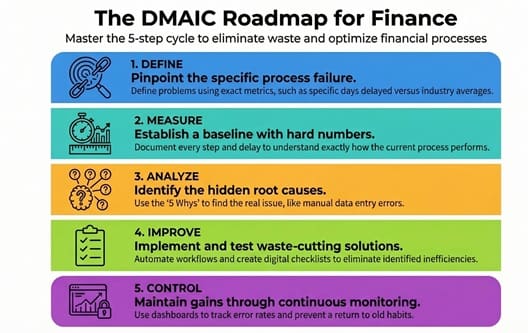
To get results with Six Sigma in Financial Services, most teams use the DMAIC roadmap. It’s a five-step cycle that keeps us from jumping to conclusions. Here is how we break it down:
1. Define the Problem
First, we have to say what’s wrong. Instead of saying “customers are unhappy,” we say “our mortgage approval takes 15 days, and the industry average is 5.” We define who the customer is and what they actually care about.
2. Measure the Current State
Now, we gather the numbers. How many steps are in the current process? Where do the delays happen? We create a baseline. You can’t fix what you haven’t measured, right?
3. Analyze the Root Cause
This is where the detective work happens. We use tools like the “Fishbone Diagram” or the “5 Whys.” For instance, why is the loan delayed? Because the credit check is slow. Why? Because the data entry is manual. Why? Because the two systems don’t talk to each other. Now we’ve found the real ghost in the machine.
4. Improve the Process
Here, we test solutions. We might automate that data entry or create a digital checklist. The goal is to eliminate the “waste” we found in the last step.
5. Control the Results
We don’t want to slide back into old, lazy habits. We set up monitors and dashboards. If the error rate starts to climb again, we know immediately. It’s about staying sharp long-term.
Also Read: How Six Sigma to Prevent Insurance Fraud Saves Billions?
Real-World Benefits of Six Sigma in Financial Services
You might ask, “Does this actually work in the real world?” The answer is a loud yes. We’ve seen massive shifts in how firms operate once they embrace this mindset.
Faster Loan Processing
Six Sigma in Financial Services can turn a 30-day mortgage window into a 7-day window. By removing “dead time”—those days where a file just sits on someone’s desk—the bank keeps the customer happy and books the revenue sooner.
Better Regulatory Compliance
Regulators are tougher than ever. If your data is messy, you’re looking at huge fines. This methodology ensures that data is captured correctly the first time. It creates an “audit trail” that makes the regulators’ jobs easier and your stress levels lower.
Increased Customer Loyalty
People stay with banks they trust. When your transactions are seamless and your issues are resolved on the first call, you don’t look elsewhere. It turns a boring utility into a reliable partner.
Common Tools Used in the Industry
We don’t just guess; we use specific tools to find the truth. Here are a few we use daily:
- Process Mapping: Drawing every single click and handoff in a process. It usually reveals 30% more steps than we thought existed!
- Pareto Charts: This helps us find the “Vital Few.” It usually shows that 80% of our problems come from 20% of our branches or products.
- SIPOC Diagrams: This stands for Suppliers, Inputs, Process, Outputs, and Customers. It’s a high-level bird’s eye view of the whole operation.
Also Read: How Six Sigma Online Training Enhances Learning Experience?
Overcoming Challenges in Implementation
Let’s be real: change is hard. Implementing Six Sigma in Financial Services isn’t always a walk in the park.
The “We’ve Always Done It This Way” Wall
This is the biggest hurdle. People get comfortable with their spreadsheets and manual work. To win, we have to show them that this makes their life easier, not just the company’s bottom line.
Data Quality Issues
In finance, we have tons of data, but it’s often “dirty.” If the data going into our Six Sigma models is wrong, the answers will be wrong too. We call this “Garbage In, Garbage Out.” We often have to spend time cleaning the data before we can even start the project.
Key Takeaways for Financial Leaders
- Accuracy is Non-Negotiable: In finance, “good enough” is a recipe for disaster.
- Focus on the Customer: Every project should start with what the client actually needs.
- Data-Driven Decisions: Stop guessing. Use the numbers to find the leaks in your revenue.
- Culture Matters: It isn’t just a toolkit; it is a way of thinking that everyone from the teller to the VP needs to embrace.
Frequently Asked Questions about Six Sigma in Financial Services
Is Six Sigma too technical for a small credit union?
Not at all. While the math can get deep, the core idea is simple: find the waste and kill it. Even a small team can use the basic tools to save hours of work every week.
How long does a typical project take?
Most projects last between 3 to 6 months. We want to move fast enough to keep momentum but slow enough to be thorough.
Do I need expensive software?
While fancy tools help, you can do a lot of this with just Excel and a whiteboard. It’s more about the logic than the software.
What is the difference between Lean and Six Sigma?
Lean focuses on speed and removing “waste.” Six Sigma focuses on quality and removing “variation” (errors). In finance, we usually combine them into “Lean Six Sigma.”
Conclusion
At the end of the day, Six Sigma in Financial Services is about building a foundation of trust. We live in an era where customers expect instant, perfect results. If your firm provides that, you win. If you don’t, you fall behind. We believe in empowering our clients with the tools they need to stay ahead of the curve. Our team is dedicated to your success, ensuring every transaction is a step toward perfection.

About Six Sigma Development Solutions, Inc.
Six Sigma Development Solutions, Inc. offers onsite, public, and virtual Lean Six Sigma certification training. We are an Accredited Training Organization by the IASSC (International Association of Six Sigma Certification). We offer Lean Six Sigma Green Belt, Black Belt, and Yellow Belt, as well as LEAN certifications.
Book a Call and Let us know how we can help meet your training needs.