Multi-criteria decision analysis, or MCDA, is a sub-discipline of operations research that focuses on evaluating multiple conflicting criteria in decision-making. It provides a systematic framework to break down complex problems into manageable pieces, allowing you to weigh different options based on specific objectives.
Whether you are choosing a new car or planning a national energy policy, this approach helps ensure your final choice is both logical and justifiable.
Have you ever felt paralyzed by a big choice? Maybe you had to pick between five different job offers. One pays the best, but the second has a better commute, and the third offers more creative freedom. How do you decide when there is no “perfect” answer?
This is where multi-criteria decision analysis steps in to save the day. It doesn’t just give you an answer; it gives you a process to find the best answer for your specific needs.
In my experience, people often try to make these choices in their heads. They end up going in circles. To be honest, our brains aren’t great at juggling ten different factors at once. By using a structured method, you take the guesswork out of the equation.
Table of contents
What is Multi-Criteria Decision Analysis?
Multi-criteria decision analysis is an umbrella term for formal approaches which explicitly consider multiple criteria in helping individuals or groups explore decisions that matter. Most of us are used to looking at the “bottom line”—usually cost or profit. But the real world is rarely that simple.
Let’s say a city needs to build a new bridge. The cheapest bridge might be the worst for the environment. The most beautiful bridge might take ten years to build. Multi-criteria decision making allows the city council to look at cost, environment, and time all at once.
One thing to keep in mind is that multi-criteria decision analysis isn’t about finding a “correct” truth. It’s about finding a preference. It reflects what you value most. Does that mean it’s subjective? Yes, partly. But it’s a structured subjectivity that prevents “gut feelings” from leading you off a cliff.

Public, Onsite, Virtual, and Online Six Sigma Certification Training!
- We are accredited by the IASSC.
- Live Public Training at 52 Sites.
- Live Virtual Training.
- Onsite Training (at your organization).
- Interactive Online (self-paced) training,
Why Use Multi-Criteria Decision Making?
Multi-criteria decision making is essential because it handles the trade-offs we face every day. If one option was better in every single way, we wouldn’t need a complex analysis. We call that a “dominant” solution. But in the real world, “better” usually comes with a catch.
In my years of working with technical frameworks, I’ve noticed that transparency is the biggest benefit. When you use multi-criteria decision making, you can show your boss or your clients exactly why you chose Option B. You can point to the weights and the scores. It turns a heated argument into a logical discussion.
- Clarity: It forces you to define what you actually want.
- Consistency: You apply the same rules to every option.
- Conflict Resolution: It helps groups find common ground by seeing where their values differ.
Also Read: Weibull Analysis
Core Components of MCDA
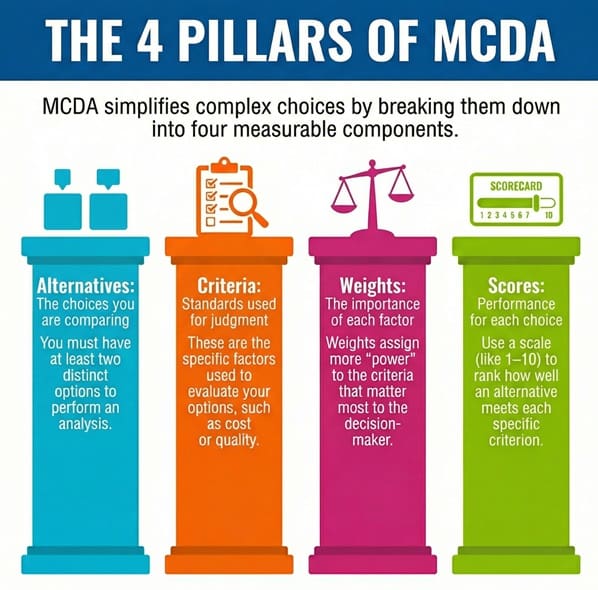
Before you dive into the math, you need to understand the building blocks of multi-criteria decision analysis. There are four main pieces to this puzzle:
The Alternatives
These are your choices. If you are buying a house, the alternatives are House A, House B, and House C. You need at least two alternatives for the analysis to make sense.
The Criteria
These are the standards by which you judge the alternatives. For a house, criteria might include price, location, square footage, and school district quality.
The Weights
Not all criteria are equal. You might care about price much more than the color of the kitchen walls. Weighting allows you to give more “power” to the things that matter most.
The Scores
This is the performance of each alternative against each criterion. How well does House A score on “location”? Usually, we use a scale of 1 to 10 or 0 to 100.
Multi-Criteria Decision Analysis Methods
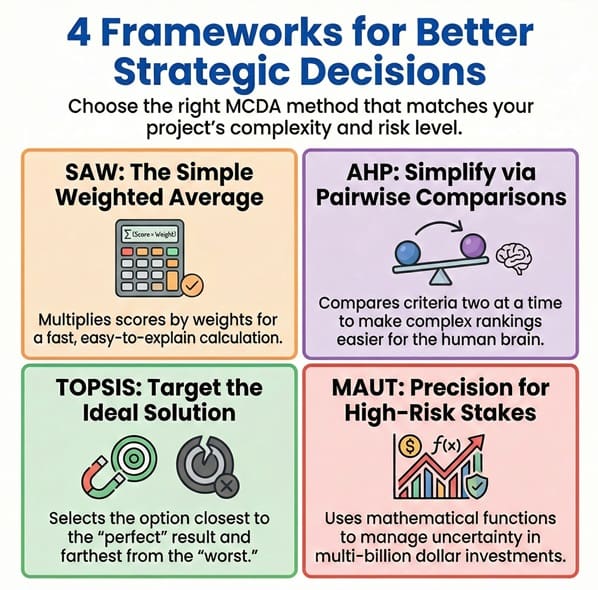
There isn’t just one way to do this. There are several multi-criteria decision analysis methods, and the one you choose depends on your problem.
1. Simple Additive Weighting (SAW)
This is the most basic method. You multiply the score of each alternative by the weight of the criterion and add them all up. It’s like a weighted average. It’s easy to explain to a colleague over coffee, but it assumes that all your criteria are independent.
2. Analytic Hierarchy Process (AHP)
AHP is incredibly popular. It uses “pairwise comparisons.” Instead of asking you to rank ten things at once, it asks: “Between Price and Quality, which is more important and by how much?” This makes it much easier for the human brain to handle.
3. TOPSIS
This stands for “Technique for Order of Preference by Similarity to Ideal Solution.” Multi-criteria decision analysis methods like TOPSIS are based on a cool idea: the best choice is the one that is closest to the “perfect” solution and farthest from the “worst” possible solution.
4. Multi-Attribute Utility Theory (MAUT)
This is the more “scientific” approach. It uses mathematical functions to account for risk and uncertainty. If you’re making a multi-billion dollar investment, you’d likely use MAUT.
Also Read: Bow-tie Analysis
The Step-by-Step MCDA Process
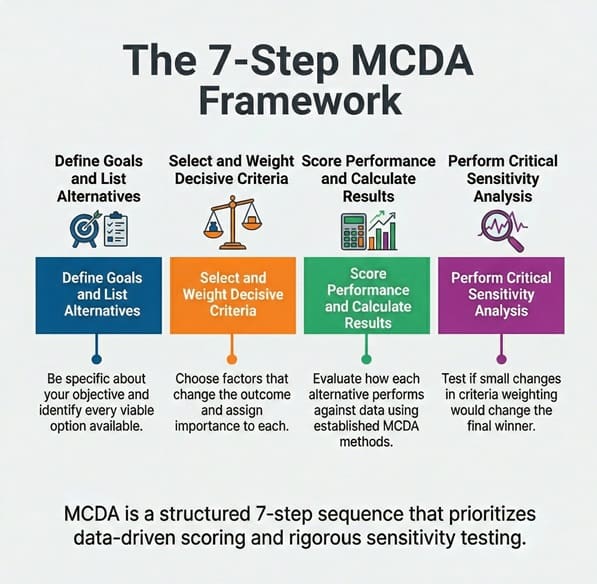
How do you actually do multi-criteria decision analysis in the real world? It usually follows a very specific sequence. Here is how I typically break it down:
- Define the Goal: What are you trying to achieve? Be specific.
- Identify Alternatives: List every viable option. Don’t leave anything out yet.
- Select Criteria: Choose the factors that will decide the winner. Avoid “fluff” criteria that don’t actually change the outcome.
- Assign Weights: Decide how important each factor is. To be honest, this is where most people struggle.
- Score the Options: Look at the data. How does each alternative perform?
- Calculate the Results: Use one of the multi-criteria decision analysis methods mentioned above.
- Sensitivity Analysis: This is the most important part. Ask yourself: “If I changed the weight of ‘Price’ by just 5%, would the winner change?”
Is it worth all this effort? If the decision involves a lot of money or high risk, then absolutely.
Multi-Criteria Decision Making Software
Doing all these calculations by hand is a nightmare. That is why most pros use multi-criteria decision making software. These tools handle the complex matrix algebra and generate beautiful charts that make your report look professional.
Multi-criteria decision making software helps you visualize the trade-offs. Some popular options include:
- Expert Choice: Great for AHP. It’s been a standard in the industry for years.
- Decision Lens: A more modern, web-based tool for enterprise-level choices.
- 1000minds: Excellent for “PAPRIKA” methods and very user-friendly.
- D-Sight: Good for collaborative decision-making where multiple stakeholders are involved.
When you use multi-criteria decision making software, you also reduce the chance of manual errors. I’ve seen people mess up a spreadsheet formula and pick the wrong vendor—that’s an expensive mistake you want to avoid.
Also Read: Stakeholder Analysis Matrix
Challenges and Limitations
Wait, is multi-criteria decision analysis perfect? No. Nothing is. Here’s the thing: your output is only as good as your input. If you pick the wrong criteria or biased weights, you’ll get a biased answer. We call this “Garbage In, Garbage Out.”
Another challenge is “Cognitive Overload.” If you have 50 criteria, the analysis becomes impossible to manage. You need to keep it lean. In my experience, 5 to 10 criteria are usually the “sweet spot” for a clear result.
Also, remember that multi-criteria decision analysis can’t predict the future. It only analyzes the data you have right now.
Final Words
Multi-criteria decision analysis is the bridge between chaotic “gut feelings” and rigid mathematical certainty. It gives you a way to talk about what matters most without getting lost in the weeds. By breaking down a big, scary choice into smaller, bite-sized pieces, you gain the confidence to move forward.
At the end of the day, our goal is to help you make choices you can stand behind. We believe in providing tools that empower you to lead with clarity and logic. Whether you are a small business owner or a project manager, mastering multi-criteria decision analysis will change the way you look at every “fork in the road.”
Contact us today for Six Sigma Certifications.

About Six Sigma Development Solutions, Inc.
Six Sigma Development Solutions, Inc. offers onsite, public, and virtual Lean Six Sigma certification training. We are an Accredited Training Organization by the IASSC (International Association of Six Sigma Certification). We offer Lean Six Sigma Green Belt, Black Belt, and Yellow Belt, as well as LEAN certifications.
Book a Call and Let us know how we can help meet your training needs.