Manufacturing compliance is nothing but following the many rules, laws, and standards that apply to your factory and the products you make. For any manufacturing company, adhering to these industrial manufacturing requirements is not just a legal need; it is also a way to build trust and ensure safety.
Why should you care so much about compliance in manufacturing? Ignoring these manufacturing laws and regulations can lead to big fines, product recalls, and harm your company’s good name. This guide helps you understand the different parts of manufacturing legal requirements and shows you how smart tools like manufacturing compliance software can make your job easier.
Table of contents
- Definition of Manufacturing compliance
- Three Core Pillars of Compliance in Manufacturing
- Understanding Manufacturing Regulatory Compliance
- Global Manufacturing Compliance Requirements
- Key Features of Manufacturing Compliance Software
- Why is digitizing with a manufacturing compliance software so effective?
- Making Manufacturing Compliance Training Work for Everyone
- Your Path to Continuous Compliance Manufacturing
- Role of Clear Manufacturing Company Policies
- Power of Proactive Management
- Comparison Table: Tools for Compliance in Manufacturing
Definition of Manufacturing compliance
Manufacturing compliance refers to the effort an organization makes to follow all laws, regulations, and self-imposed standards for its operations and products.
In simple terms, compliance manufacturing means your company does what it promises to do and what the law says it must do. This simple adherence is highly important for several reasons.
One must understand that following all the manufacturing laws protects your customers. When you comply with quality standards, you ensure your product is safe and works correctly. This is especially true in industries like food, medicine, and children’s toys.

Public, Onsite, Virtual, and Online Six Sigma Certification Training!
- We are accredited by the IASSC.
- Live Public Training at 52 Sites.
- Live Virtual Training.
- Onsite Training (at your organization).
- Interactive Online (self-paced) training,
Why Manufacturing Compliance is Crucial?
Avoiding Penalties and Shutdowns
Non-compliance can be quite costly. When a manufacturing company ignores manufacturing regulations, they face heavy financial penalties or even the temporary or permanent shutdown of their factory. The reason behind this is simple: regulators need to ensure public safety. For instance, violating environmental laws can lead to major fines.
Building Trust and Market Access
Following international industrial manufacturing requirements like ISO standards or Good Manufacturing Practices (GMP) gives your company credibility. Compliance in manufacturing is often a key to market access. Many international markets, for example, will not buy your products if you do not have the right certifications. Thus, achieving robust manufacturing regulatory compliance helps you compete globally.
- Risk Reduction: You minimize the chance of accidents, lawsuits, and product recalls.
- Reputation: You show customers and investors that your company is responsible.
- Efficiency: Compliant processes are often better defined, leading to less waste and higher quality.
Three Core Pillars of Compliance in Manufacturing
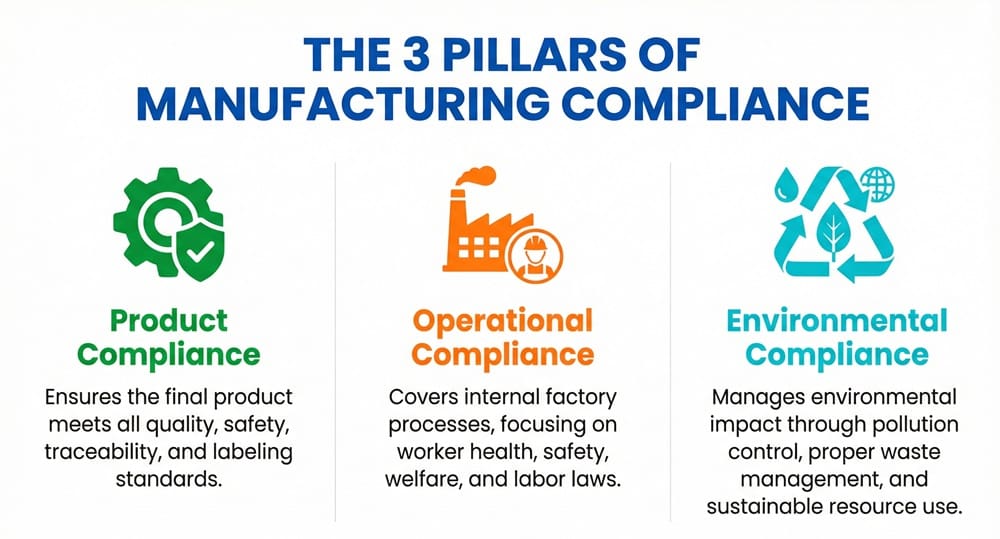
We can divide manufacturing compliance requirements into three main areas. Understanding these pillars is essential for any manufacturing company aiming for complete compliance manufacturing.
1. Product Compliance: Safety and Quality
Product compliance is nothing but making sure the final product meets all quality and safety standards. This is the most visible type of manufacturing compliance.
- Standards: This includes following specific standards like the Bureau of Indian Standards (BIS) for quality in India or international standards like CE marking in Europe.
- Traceability: It is crucial to track every part, ingredient, and step that goes into a product. For instance, if a fault is found, you must quickly trace it back to the source material. This is why tools with strong traceability are so important.
- Labeling: Products must have correct, clear, and complete labeling, including safety warnings, ingredients, and usage instructions.
2. Operational Compliance: People and Processes
Operational compliance covers the internal workings of the factory. This area majorly deals with labor laws, safety, and general business regulations.
Factory Compliance and Worker Safety
The Factories Act, 1948, in India, is the building block for most factory compliance efforts. It sets out clear rules on health, safety, and welfare for workers.
- Health: Factories must ensure good sanitation, proper ventilation, sufficient lighting, and pure drinking water.
- Safety: You must secure machinery, provide protective gear, and train all personnel on safe operation. Safety protocols, like a lockout-tagout procedure, are highly necessary.
- Welfare: This includes providing canteens, restrooms, first-aid facilities, and for some companies, crèches for children of women workers.
Labor and Financial Manufacturing Laws
Manufacturing legal obligations require you to follow various labor laws. This is essential for worker welfare.
- Wages: You must comply with the Minimum Wages Act and the Payment of Wages Act.
- Working Hours: You need to follow rules on maximum working hours per day and week and pay overtime correctly.
- Social Security: This involves complying with Acts like the Employees’ Provident Fund (EPF) and Employees’ State Insurance (ESI).
3. Environmental Compliance: A Sustainable Future
Environmental compliance means your manufacturing process does not harm the environment. This area is becoming somewhat stricter every year.
- Pollution Control: You must obtain ‘Consent to Establish’ (CTE) and ‘Consent to Operate’ (CTO) from the State Pollution Control Board.
- Waste Management: Proper disposal of all hazardous waste is crucial. This involves careful tracking and documentation of waste movement from the factory to its final disposal site.
- Resource Use: Compliance also covers efficient use of water and energy, often pushing for more sustainable practices.
Understanding Manufacturing Regulatory Compliance
The regulatory landscape for a manufacturing company is quite complex. Different agencies and laws govern different aspects. Manufacturing regulatory compliance involves keeping track of all these rules.
Industry-Specific Rules
Many industries have their own, specialized manufacturing regulations that go beyond the general rules.
- Pharmaceuticals: These companies must strictly follow Good Manufacturing Practices (GMP) and regulations from bodies like the FDA or central drug regulators. GMP ensures product quality and safety through strict process control.
- Food Processing: These units must comply with the Food Safety and Standards Authority of India (FSSAI) requirements, which includes hygiene and process control (often HACCP principles).
- Electronics: Manufacturing companies making electronics must often comply with rules like RoHS (Restriction of Hazardous Substances) to ensure certain toxic materials are not present in the final product.
Also Read: Process Optimization in Manufacturing
Global Manufacturing Compliance Requirements
If you export your products, you need to follow the laws of the country where you sell them. For instance, selling to the EU requires compliance with a host of regulations, including GDPR for data protection and various product-specific directives.
One must note that global markets demand clear evidence of manufacturing compliance. Having the right manufacturing company policies and verifiable records is thus highly essential.
How Manufacturing Compliance Software Simplifies Your Work
Keeping up with every single rule manually is quite difficult, especially for a growing manufacturing company. This is where manufacturing compliance software comes into play.
Definition: Manufacturing compliance software is a digital solution that helps manufacturers automate, manage, and monitor their adherence to regulatory, legal, and internal standards.
Simply put, this software is your digital compliance assistant. It replaces paper files and spreadsheets, thereby reducing errors and saving time.
Key Features of Manufacturing Compliance Software
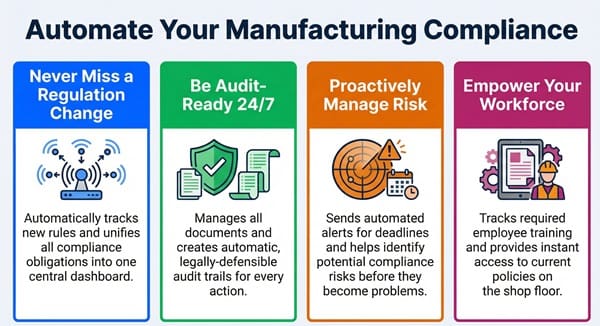
We can divide the key features of this specialized software into several categories.
1. Centralized Regulatory Tracking
- Update Monitoring: The software automatically tracks changes to manufacturing regulations and alerts you when a new rule affects your operations.
- Unified View: It pulls all your different compliance obligations (factory compliance, product safety, environmental) into one dashboard. This gives you a single source of truth.
2. Documentation and Audit Readiness
- Document Control: It manages all your compliance-related documents, such as permits, licenses, inspection reports, and Standard Operating Procedures (SOPs).
- Automated Audit Trails: The system automatically logs every action, ensuring you have a complete, traceable, and legally defensible record for any auditor. This is crucial for maintaining manufacturing legal adherence.
3. Risk and Task Management
- Automated Alerts: It sends automated reminders for renewal dates, mandatory inspections, and report submissions. You never miss a deadline.
- Risk Assessment: The software helps you identify potential compliance risks in your processes before they become real problems. It helps with the proactive management of manufacturing requirements.
4. Training and Awareness
- Tracking: It manages manufacturing compliance training records, ensuring every employee has completed the required safety and process courses.
- Access: Employees can easily access current, approved work instructions and manufacturing company policies directly on the shop floor, thereby promoting better adherence to process.
Also Read: First Time Yield (FTY) in Manufacturing
Why is digitizing with a manufacturing compliance software so effective?
It is so because manual compliance tracking is somewhat slow and highly prone to error. Automation allows your team to focus on the work, not the paperwork. This leads to higher operational efficiency and better compliance manufacturing.
Using ERP Compliance Features to Boost Control
Many large and mid-sized manufacturing companies already use Enterprise Resource Planning (ERP) systems to manage their business. The right ERP system comes with features that strongly support manufacturing compliance.
Definition: ERP compliance refers to the capabilities within an ERP system that help an organization adhere to regulatory and legal requirements across its integrated business processes (e.g., finance, production, and supply chain).
ERP systems are naturally placed to aid compliance because they control the data and workflows of the entire operation.
Traceability and Quality Management
- Batch and Lot Tracking: The ERP system provides complete forward and backward traceability. If you detect an issue in a finished product, the system can instantly tell you which raw material supplier, production batch, and even specific machine was involved. This is essential for managing product recalls swiftly and maintaining industrial manufacturing requirements.
- Quality Control Integration: An ERP with strong ERP compliance features links quality checks directly to the production process. A product batch might not be allowed to move to the next stage until the required quality inspection is completed and recorded in the system.
Financial and Tax Compliance
Manufacturing legal requirements include strict financial reporting. ERP systems handle this automatically:
- Tax Compliance: It ensures you correctly calculate and report GST, income tax, and other financial regulations.
- Audit Trail: Every financial transaction has an automated record showing who did what and when, which is crucial for financial audits.
Let us now understand a key point: ERP compliance works best when it is integrated. It is less effective if your production data is in one system and your quality data is in another. A unified platform is generally preferred.
Making Manufacturing Compliance Training Work for Everyone
A great manufacturing compliance software is only one part of the solution. The most crucial part of compliance in manufacturing is your people. Manufacturing compliance training is the tool you use to ensure your team understands the rules.
Why Focus on Manufacturing Compliance Training?
Simply put, a law posted on a wall is not the same as a procedure understood by a worker.
- Reduce Errors: Properly trained workers make fewer mistakes that could lead to non-compliance or safety hazards.
- Culture of Safety: Training builds a culture where everyone takes responsibility for factory compliance and product quality.
- Stay Updated: Regulations change frequently. Ongoing manufacturing compliance training ensures your team stays current with new manufacturing laws and regulations.
Key Areas for Training
- Safety Procedures: Hands-on training for operating specific machinery, using personal protective equipment (PPE), and emergency response is highly important.
- Quality Protocols: Training on SOPs, documentation standards, and understanding the impact of their work on final product quality.
- Environmental Rules: Education on waste segregation, chemical handling, and minimizing energy and water usage. This aligns with modern manufacturing legal duties.
- Code of Conduct: Training on ethical behavior, anti-bribery, and anti-corruption (ABAC) laws.
A note must be made: The training should be tailored to the audience. A floor worker needs practical, on-the-job instructions, while a compliance manager needs detailed knowledge of the manufacturing regulations themselves.
Also Read: Manufacturing Facility Layout
Your Path to Continuous Compliance Manufacturing
Compliance manufacturing is not a one-time project; it is an ongoing effort. The regulatory landscape is constantly changing, meaning your compliance efforts must also continuously improve. This commitment is the key to maintaining all manufacturing requirements.
Regular Audits and Inspections
You must perform both internal and external audits.
- Internal Audits: Your team checks itself against your own manufacturing company policies and the law. This helps you find small problems before an external auditor finds them.
- External Audits: These are formal checks by regulators or certification bodies (like for ISO or GMP). Being well-prepared for these is highly essential. This is where your detailed audit trails from your manufacturing compliance software become invaluable.
Role of Clear Manufacturing Company Policies
Every manufacturing company needs clear, written policies. These documents take the complex manufacturing regulations and translate them into simple, actionable steps for your employees.
- A well-written policy ensures consistency across all shifts and locations.
- They serve as the standard against which internal audits are performed.
- These policies define acceptable behavior and procedures, thereby supporting all manufacturing legal obligations.
Power of Proactive Management
Instead of reacting to problems, you should aim to manage compliance proactively. This is a crucial element of modern compliance in manufacturing.
- Continuous Improvement: After an issue (a near-miss, a quality deviation) occurs, always use a Corrective and Preventive Action (CAPA) process. This ensures you fix the root cause so the problem does not happen again.
- Leverage Technology: Using features like risk prediction and automated monitoring in manufacturing compliance software helps you stay ahead of the curve.
Thus, we can say that successful compliance manufacturing is the result of robust technology, clear policies, and a highly trained workforce.
Comparison Table: Tools for Compliance in Manufacturing
Understanding the tools available can help your manufacturing company choose the right combination to meet all manufacturing requirements.
| Feature | Manufacturing Compliance Software | ERP Compliance Features | Manual System (Paper/Spreadsheets) |
| Focus Area | Specialized management of permits, laws, standards, and specific regulations. | Integration of compliance into core business processes (finance, inventory, production). | General documentation and record-keeping of compliance tasks. |
| Regulatory Tracking | Automatically monitors changes in manufacturing regulations and alerts users. | Generally limited; relies on manual system setup. | None; requires full manual monitoring by staff. |
| Audit Trail & Documentation | Excellent; provides automated, highly detailed, and easily searchable audit trails. | Good; strong on financial and process transaction records (e.g., lot traceability). | Poor; time-consuming to search, high risk of missing or outdated records. |
| Risk Assessment | Includes specific tools for compliance risk scoring and proactive management. | Indirect; focuses on process risk (e.g., inventory shortage, quality deviation). | Very limited; relies entirely on the skill and memory of the manager. |
| Best For | Companies in highly regulated sectors (Pharma, Food), complex international trade. | All mid-to-large manufacturing companies needing control over finance and supply chain data. | Very small operations with simple manufacturing requirements and low regulatory exposure. |
| Key Benefit | Reduces regulatory risk and penalty exposure. | Ensures data consistency and complete traceability across the supply chain. | Low initial cost. |
Final Words
We have discussed the complexity of manufacturing compliance, from worker safety (factory compliance) to product quality and environmental duties. Understanding these industrial manufacturing requirements and investing in solutions like manufacturing compliance software and ERP compliance is not just about avoiding fines. It is about building a responsible, reliable, and world-class manufacturing company.
We believe that compliance is not a cost; it is an investment in your company’s future and reputation. Our commitment is to provide you with the resources and tools you need to simplify your compliance journey, ensuring you meet every manufacturing regulatory compliance need with confidence.
Do you want to know how our specialized manufacturing compliance software can track your specific manufacturing requirements in real-time and make you audit-ready instantly?
Manufacturing Compliance at a Glance: Key Takeaways
We have covered the main aspects of compliance in manufacturing. Keep these points in mind to ensure your operations are both legal and safe:
- Compliance is Triple-Focused: Your compliance efforts must address three key areas: Product Compliance (quality, safety, and labeling), Operational Compliance (factory compliance, labor laws), and Environmental Compliance (waste and pollution control).
- The Law is Active, Not Static: Manufacturing laws and regulations are constantly changing. Use technology, like manufacturing compliance software, to automatically track updates and thereby maintain continuous adherence.
- People are the Core: Even the best policies fail without employee understanding. Robust and frequent manufacturing compliance training is the single most important investment you can make in maintaining compliance manufacturing.
- Embrace Traceability: Use systems like ERP compliance features to track every component, process, and test result. This complete traceability is essential for product safety, managing recalls, and meeting modern industrial manufacturing requirements.
- Be Proactive: Do not wait for an auditor or a crisis. Regular internal audits and a strong Corrective and Preventive Action (CAPA) process help you fix potential issues before they become major non-compliance problems.
Frequently Asked Questions (FAQs) on Manufacturing Compliance
Here are some common questions we hear about compliance in manufacturing:
What is the difference between Manufacturing Regulations and Manufacturing Laws?
Manufacturing laws are the main, legally binding rules made by the government (like the Factories Act). They are broad. Manufacturing regulations are the detailed rules and procedures (often set by regulatory bodies like the FSSAI or Pollution Control Boards) that implement those laws. Both require strict adherence by the manufacturing company.
Does my company need Manufacturing Compliance Software?
If your manufacturing company deals with complex or changing manufacturing regulations, handles hazardous materials, or needs strong product traceability, then dedicated manufacturing compliance software is highly beneficial. It greatly reduces manual work and the risk of penalties, thereby helping you stay ahead.
How often should we update our Manufacturing Company Policies?
You should review and update your manufacturing company policies at least once a year. However, if there are major changes in manufacturing laws and regulations or if you change a key process, you must update the relevant policies immediately. Your policies must always reflect the current manufacturing legal status.
What is the most common reason for Factory Compliance issues?
The most common reason is inadequate manufacturing compliance training. When workers do not fully understand the safety procedures, documentation needs, or quality standards, process deviations and safety breaches happen. Investment in proper training is the key to strong factory compliance.
Is ERP Compliance enough for all our needs?
ERP compliance features, especially for financial and process traceability, are a strong foundation. However, they usually need to be paired with specialized manufacturing compliance software or Quality Management Systems (QMS) to handle detailed regulatory reporting, specific environmental permits, and granular document control.

About Six Sigma Development Solutions, Inc.
Six Sigma Development Solutions, Inc. offers onsite, public, and virtual Lean Six Sigma certification training. We are an Accredited Training Organization by the IASSC (International Association of Six Sigma Certification). We offer Lean Six Sigma Green Belt, Black Belt, and Yellow Belt, as well as LEAN certifications.
Book a Call and Let us know how we can help meet your training needs.