
Lean learning is a smart way to gain new skills without wasting your time or energy. Have you ever spent weeks reading a thick textbook only to forget everything two days later? We’ve all been there. It’s frustrating to feel like you’re running on a treadmill but getting nowhere with your professional growth.
The truth is, traditional education often loads us with “just-in-case” info. We study things we might need in five years, but by then, we’ve forgotten the details. Lean learning changes that. It borrows ideas from Toyota’s famous manufacturing system to make your brain more efficient. To be honest, it’s about learning only what you need, exactly when you need it.
Are you ready to stop drowning in data and start actually growing? Let’s look at how this method can change your career.
Table of contents
What is Lean Learning?
The concept of lean learning refers to a method of education that focuses on creating value and cutting out waste. In my experience, most people think they need to know everything before they start a project. That’s a mistake. Instead, this approach suggests you should learn in small chunks.
Think of it like a “just-in-time” delivery system for your brain. Why store a mountain of facts in your head if you aren’t using them? Waste in learning can be many things. It might be sitting through a long meeting that doesn’t teach you anything. It could also be reading a manual for a software you won’t use for six months.

Public, Onsite, Virtual, and Online Six Sigma Certification Training!
- We are accredited by the IASSC.
- Live Public Training at 52 Sites.
- Live Virtual Training.
- Onsite Training (at your organization).
- Interactive Online (self-paced) training,
The Core Principles of Lean
To understand this better, we must look at the five pillars of lean thinking:
- Value: What do you actually need to achieve your goal?
- Value Stream: What are the steps you take to learn?
- Flow: How can you make your learning smooth and constant?
- Pull: Only learn when there is a demand for that skill.
- Perfection: Keep getting better at how you learn.
When we apply these to our studies, we stop being “passive consumers” of content. We become “active hunters” of knowledge. Does that make sense?
Why Traditional Learning Often Fails?
In most schools, we follow a “push” system. Teachers push information onto students regardless of whether they’re ready to use it. This leads to a massive amount of “knowledge waste.” In the lean world, we call this Muda.
If you learn a new coding language but don’t write a single line of code for a month, you’ll lose about 80% of what you learned. This is because our brains are like muscles. If you don’t use them, they don’t get stronger. Lean learning prevents this by insisting on immediate application.
Also Read: How Lean Leadership Can Transform Your Team Performance?
Identifying Waste in Your Study Habits
Before you can fix your routine, you need to see where you’re wasting time. Here are the most common types of waste in a learning environment:
- Over-processing: Studying a topic in way more detail than the task requires.
- Waiting: Pausing your work because you don’t have the right info yet.
- Motion: Jumping between five different tabs or books without finishing one.
- Defects: Learning the wrong thing or getting poor info from a bad source.
Have you noticed how much time you spend “getting ready” to study rather than actually studying? That’s a classic example of waste.
How to Start Your Lean Learning Journey
You don’t need a PhD to start. You just need a different mindset. Here is a simple step-by-step guide to help you build your own system.
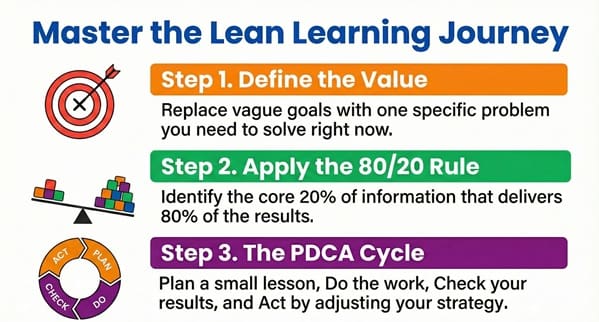
Step 1: Define the Value
Before opening a book, ask: “What problem am I trying to solve?” If you can’t answer that, don’t start yet. Your goal should be specific. Instead of “I want to learn marketing,” try “I want to learn how to run one Facebook ad for my local shop.”
Step 2: Use the 80/20 Rule
Roughly 20% of the info will give you 80% of the results. Find that 20%. Look for the core concepts that make the rest of the topic click. This is how you achieve lean learning without feeling overwhelmed.
Step 3: Learn, Do, Check, Act (PDCA)
This is a famous cycle in lean management.
- Plan: Decide what small thing you will learn.
- Do: Study for 20 minutes and then try to use it immediately.
- Check: Did it work? Did you understand it?
- Act: Adjust your plan based on what happened.
The Power of “Just-in-Time” Knowledge
We’ve all been in a spot where we try to learn everything at once. It feels productive, but it’s actually a trap. JIT knowledge means you pull information only when a project demands it.
For example, imagine you’re building a website. Don’t spend a month learning every CSS trick. Instead, start building. When you need to make a button blue, search for “how to change button color in CSS.” You learn it, you apply it, and it sticks. That is lean learning in action.
Does this mean you shouldn’t have a broad base of knowledge? Not at all. But it means your deep dives should be driven by real-world needs.
Creating a Lean Culture in Your Team
If you manage a team, you can apply these rules to help your staff grow faster. Stop sending everyone to week-long seminars that they’ll forget by Monday.
Instead, try “micro-learning.” Give them 15-minute bursts of training followed by a task that uses that training. We’ve seen companies double their productivity just by changing how they train their people. It’s about making learning a part of the daily flow, not an “extra” thing they have to do.
Use Visual Management
In lean systems, we love “Kanban” boards. You can use these for learning too. Create columns for:
- Backlog (Things I want to learn)
- Learning (What I’m studying right now)
- Applying (The project I’m using the skill for)
- Done (Skills I’ve mastered)
This makes your progress visible and keeps you focused on one thing at a time.
Also Read: Pursue an Exciting Career in Lean Six Sigma
Benefits of the Lean Approach
Why bother with all this? To be honest, it’s the only way to keep up in today’s fast world.
- Retention: You remember more because you use it.
- Speed: You reach your goals faster by cutting out the fluff.
- Confidence: Completing small tasks builds your “can-do” spirit.
- Cost: You stop spending money on courses you never finish.
Key Takeaways for Lean Learning
- Focus on Value: Only learn what helps you reach your current goal.
- Eliminate Waste: Stop over-researching and start doing.
- Small Batches: Break complex topics into tiny, manageable pieces.
- Apply Fast: If you don’t use it within 24 hours, you’ll likely forget it.
- Continuous Improvement: Always look for ways to learn more efficiently.
Frequently Asked Questions About Lean Learning
Is lean learning only for business?
No, you can use it for anything! Whether you’re learning to cook, play guitar, or code, the principles of cutting waste and active application still work.
Does this mean I shouldn’t read books for fun?
Not at all. Lean principles apply to “functional” learning where you want a specific result. Reading for pleasure is different. However, if you’re reading to gain a skill, lean learning will help you master it faster.
How do I know what is “waste”?
Ask yourself: “If I skip this chapter, will I still be able to finish my project?” If the answer is yes, that chapter might be waste for now.
Final Words
Mastering lean learning isn’t about being perfect; it’s about being effective. It’s about respecting your own time and your brain’s limits. By focusing on “pulling” information when you need it and applying it immediately, you’ll find that you grow much faster than those stuck in old-school study habits.
At our company, we believe in the power of people. We’re dedicated to helping you find the most direct path to success. We don’t just provide information; we provide results. If you’re ready to stop wasting time and start winning, we’re here to walk that path with you.

About Six Sigma Development Solutions, Inc.
Six Sigma Development Solutions, Inc. offers onsite, public, and virtual Lean Six Sigma certification training. We are an Accredited Training Organization by the IASSC (International Association of Six Sigma Certification). We offer Lean Six Sigma Green Belt, Black Belt, and Yellow Belt, as well as LEAN certifications.
Book a Call and Let us know how we can help meet your training needs.