What is Lean Flow and How Can It Speed Up Your Business?
Lean Flow refers to the smooth, uninterrupted movement of a product or service through a process from start to finish. If you’ve ever stood in a long line at a coffee shop while five baristas hovered around one machine, you’ve seen a “flow” problem. In a perfect world, work should move like water in a stream—no dams, no whirlpools, and no dry spots.
To be honest, most businesses operate more like a leaky faucet. We have starts, stops, and “wait time” hidden in every corner. When we talk about Lean Flow, we’re looking at how to keep the “value” moving toward the customer without hitting a snag. It isn’t just about working faster; it’s about working smarter so that nothing sits idle.
Why does this matter to you? Well, time is money. When work sits on a desk or a shelf, it isn’t making you a profit. It’s just taking up space. By focusing on flow, we ensure that every action we take adds something the customer actually wants to pay for.
Table of contents
The Basic Idea of a Lean Flow System
In my experience, people often confuse being busy with being productive. You can have a factory floor full of people running around, but if the final product isn’t moving out the door, you don’t have flow. The Lean Flow concept focuses on the “Work in Progress” (WIP).
The goal is to move one piece at a time. We call this “one-piece flow.” Picture this: instead of folding 100 pizza boxes and then topping 100 pizzas, you fold one, top one, and bake one. It sounds slower at first, doesn’t it? But what happens if you find out the boxes are the wrong size after you’ve folded all 100? You’ve just wasted an hour.
Flow helps us catch mistakes early. It also reduces the need for big storage rooms. When things move constantly, you don’t need a place to park them. We want the shortest possible lead time from the moment a customer orders to the moment they get their hands on the product.
Why is Lean Flow Hard to Achieve?
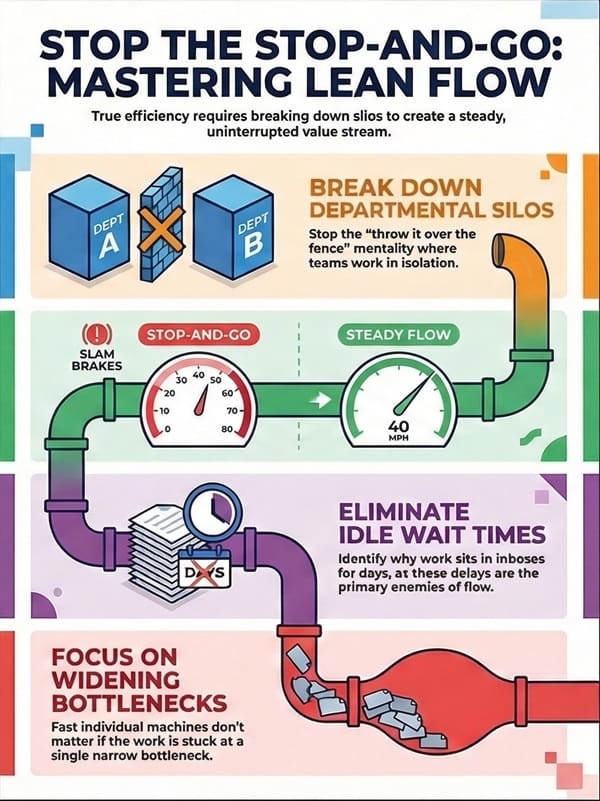
Here is the thing: most companies are set up in “silos.” The marketing team does their bit, then they throw it over the fence to the sales team, who then throw it to production. Each department works in big batches to feel efficient.
But this creates a “stop-and-go” rhythm. It’s like driving in heavy traffic. You gas it for ten feet, then slam on the brakes. We want a steady 40 miles per hour. To get there, we have to look at the whole “value stream.”
Have you ever looked at your internal processes and asked, “Why does this sit in an inbox for three days?” That three-day wait is the enemy of flow. It’s a “bottleneck.” Until you widen that bottleneck, the rest of your fast machines don’t matter.

Public, Onsite, Virtual, and Online Six Sigma Certification Training!
- We are accredited by the IASSC.
- Live Public Training at 52 Sites.
- Live Virtual Training.
- Onsite Training (at your organization).
- Interactive Online (self-paced) training,
The Role of Takt Time in Lean Flow
In the world of Lean, we have a heartbeat called Takt Time. This is the rate at which you must complete a product to meet customer demand. If a customer buys a widget every 10 minutes, your Lean Flow must be tuned to produce a widget every 10 minutes.
If you go faster, you build up inventory (waste). If you go slower, the customer gets angry. Keeping the flow in sync with Takt Time is like a dance. It keeps the pressure off the employees while ensuring the work never stops.
How do you find your Takt Time? It’s simple:
- Take your total available work time (like 8 hours).
- Divide it by the number of items the customer wants.
- That’s your target.
Common Obstacles to Continuous Movement
Roughly speaking, three big things kill your flow. We call them the “3 Ms” in some circles, but let’s keep it simple.
First, we have “Mura,” or unevenness. This is when you have a ton of work on Monday but nothing to do on Tuesday. You can’t have flow if the volume is always changing. We try to “level” the work so every day looks about the same.
Second, we have “Muri,” or overburden. This happens when you push a machine or a person too hard. Eventually, they break. A broken machine is a dam in your stream. It stops everything.
Finally, we have “Muda,” which is just a fancy word for waste. This includes moving things more than you need to, fixing mistakes, or making more than you can sell. A Lean Flow approach tries to hunt down these wastes and kick them out.
Is Lean Flow Only for Factories?
I get asked this all the time. “I work in an office, does this apply to me?” Absolutely. In fact, office work often has the worst flow because you can’t see the “piles” of work. They are hidden in emails and digital folders.
Imagine an insurance claim. It moves from the intake clerk to the adjuster, then to the manager for approval. If the manager is on vacation, that claim just sits there. That is a flow failure. You can use the same Lean tools to fix an office as you would a car plant.
We’ve all been there—waiting for a simple signature for weeks. By mapping the flow, we can see where the paper (or digital file) gets stuck. We then redesign the path so it moves without stopping.
How to Start Improving Your Flow Today
You don’t need a PhD to start. You just need to look. Go to where the work happens. Watch a single item move through your system. Don’t watch the people; watch the product.
Does the product sit in a bin? Does it travel across the building? Does it get inspected three times? Each time it stops, your Lean Flow is dying.
One of the best ways to fix this is to change the layout. We often put machines or desks in a “U” shape. This lets one person handle multiple steps and keeps the work close together. It cuts down on walking time, which is a major waste.
The Connection Between Pull and Flow
You can’t really have flow without a “Pull” system. In a pull system, we don’t start working until the next person in line asks for it. This prevents “pile-ups.”
Think of a cafeteria. They don’t put 500 plates of fries out at 10:00 AM. They wait until they see the line forming. They “pull” the fries into the window as people eat them. This keeps the fries hot (quality) and prevents throwing them away (waste).
When you combine Pull and Lean Flow, you get Just-In-Time (JIT) production. This is the gold standard. It means you make exactly what is needed, exactly when it’s needed. It’s beautiful when it works!
Five Steps to Establish Lean Flow
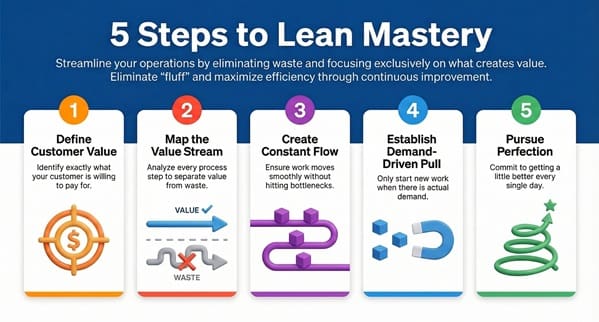
- Identify Value: Ask what the customer is actually paying for.
- Map the Value Stream: Draw every step of the process. Be honest about the stops.
- Create Flow: Eliminate the barriers between steps. Move desks closer. Standardize the work.
- Establish Pull: Don’t push work onto the next person. Wait for them to be ready.
- Seek Perfection: You’ll never be finished. There is always a tiny bit of waste left to find.
The Human Side of the Process
We’ve focused a lot on the “how,” but we can’t forget the “who.” Your team is the secret sauce. If they feel like robots, they won’t help you find better ways to flow.
In my view, the best ideas come from the people doing the work. They know where the bottlenecks are. They know which machine acting up. To make Lean Flow stick, you have to empower your team to stop the line if they see a problem. We’d rather stop the flow for five minutes to fix a bug than let a mistake flow all the way to the customer.
Key Takeaways About Lean Flow
- Flow is movement: It’s the goal of getting work from start to finish without stopping.
- Waste is the enemy: Anything that stops the flow is waste and costs you money.
- Takt Time is your rhythm: Work at the pace of customer demand, not faster or slower.
- Smaller is better: Small batches (or one-piece flow) reduce errors and inventory.
- Pull, don’t push: Only move work forward when the next station is ready.
Frequently Asked Questions About Lean Flow
What is the difference between Lean and Six Sigma flow?
Lean focuses on speed and waste. Six Sigma focuses on quality and consistency. They work together. You want a fast flow (Lean) that produces perfect results every time (Six Sigma).
How do I measure Lean Flow? The best way is “Lead Time.” This is the total time it takes for a task to go from start to finish. If your lead time is shrinking, your flow is improving.
Can Lean Flow cause stress for employees?
If done wrong, yes. But a true Lean system should make work easier. It removes the “clutter” and the “firefighting” that causes stress. It creates a calm, steady work pace.
Do I need expensive software for this?
Not at all. Most companies start with a whiteboard, some sticky notes, and a stopwatch. You need to see the process before you can automate it.
What is a bottleneck?
A bottleneck is the slowest part of your process. If one person can only do 5 items an hour, it doesn’t matter if everyone else can do 50. Your “flow” is stuck at 5.
Final Words
Creating a smooth Lean Flow is the best way to keep your business healthy. It’s about respecting your time, your team’s time, and your customer’s time. By removing the obstacles that slow things down, you create a system that delivers value quickly and reliably.
We’ve all seen how frustrating a clunky, slow process can be. It’s our job to smooth out those bumps. At our core, we believe that every process can be better. We focus on our clients’ success by making sure their work never gets stuck in the mud. Are you ready to clear the path?

About Six Sigma Development Solutions, Inc.
Six Sigma Development Solutions, Inc. offers onsite, public, and virtual Lean Six Sigma certification training. We are an Accredited Training Organization by the IASSC (International Association of Six Sigma Certification). We offer Lean Six Sigma Green Belt, Black Belt, and Yellow Belt, as well as LEAN certifications.
Book a Call and Let us know how we can help meet your training needs.