
A Layered Process Audit (LPA) is a quality verification method where different levels of an organization, operators, supervisors, plant managers, and sometimes executives, each audit the same critical process steps at their own frequency. It matters because it catches process drift and non-conformance early, before a defect reaches the customer, rather than relying on one infrequent, comprehensive audit that might miss a problem for months.
In practice, Layer 1 (operators or team leads) checks critical items daily or every shift using a short, binary checklist; Layer 2 (supervisors) checks weekly, looking for consistency and verifying Layer 1’s work; and Layer 3 (plant managers) checks monthly, focused on systemic trends.
LPAs originated in the automotive industry and are formalized in the AIAG’s CQI-8 guideline, and while not directly required by IATF 16949 itself, most major automotive OEMs mandate them through their own customer-specific requirements.
Quick Reference Table
| Term | What It Means | Frequency | Who Performs It |
| Layered Process Audit (LPA) | Multi-level audit verifying critical process steps | Varies by layer | Operators through executives |
| Layer 1 | Direct, on-the-floor process verification | Daily or per shift | Operators, team leads, shift supervisors |
| Layer 2 | Review of Layer 1 results plus spot-checks | Weekly | Department managers, supervisors |
| Layer 3 | Systemic review of trends and program effectiveness | Monthly | Plant managers, site leadership |
| CQI-8 | The AIAG guideline formalizing LPA program design | N/A (a reference document) | Used by LPA planning teams |
Table of contents
Key Takeaways
- An LPA uses multiple organizational layers auditing the same critical process, at different frequencies. This creates overlapping, cascading verification that no single audit event could provide on its own.
- Layer 1 audits happen daily or every shift, with a short, binary (yes/no) checklist, usually 10 to 15 questions, designed to be completed in 5 to 10 minutes.
- LPAs are not directly required by IATF 16949 itself, but most major automotive OEMs (GM, Stellantis, Ford) require them through their own customer-specific requirements, and LPAs support IATF 16949 Clause 9.2.2.3.
- CQI-8, published by the AIAG, is the standard reference guideline for designing an LPA program. It’s not a certification requirement on its own, but it’s the closest thing to an industry standard for how LPAs should be structured.
- An LPA is different from a full internal QMS audit. An LPA is frequent, narrow, and focused on process compliance at the point of work; an internal audit is infrequent and comprehensive, reviewing the system against a standard like ISO 9001 or IATF 16949.
- The value of catching an issue early is well established. The commonly cited 1-10-100 rule holds that a defect caught at the operator level costs roughly 1x to fix, the same defect caught at end-of-line inspection costs roughly 10x, and once it reaches the customer, the cost climbs to 100x or more.
- An LPA directly reinforces a Control Plan. A Layer 1 audit checking torque values or error-proofing sensors is, in practice, verifying that operators are actually following the Control Plan, not working from memory or an outdated version.
What Is a Layered Process Audit?
A Layered Process Audit (LPA) is a structured quality verification method in which multiple levels of an organization, from frontline operators up through plant or site leadership, each audit the same set of critical process steps, but at their own distinct frequency and level of depth. The “layers” are the defining feature: each organizational level conducts its own audit, creating redundant, cascading oversight that a single, infrequent audit event could never provide.
LPAs originated in the automotive industry during the 1990s, with Chrysler credited as conducting one of the first formal layered audits in 1994. The concept was later formalized by the Automotive Industry Action Group (AIAG) in its CQI-8 guideline, now in its second edition, which remains the standard reference for designing, implementing, and running an LPA program.
While the concept started in automotive manufacturing, it’s now used across industries including pharmaceuticals, food production, and general manufacturing wherever standardized, repeatable processes need consistent verification.

Public, Onsite, Virtual, and Online Six Sigma Certification Training!
- We are accredited by the IASSC.
- Live Public Training at 52 Sites.
- Live Virtual Training.
- Onsite Training (at your organization).
- Interactive Online (self-paced) training,
The Layers of an LPA: Who Audits What, and How Often
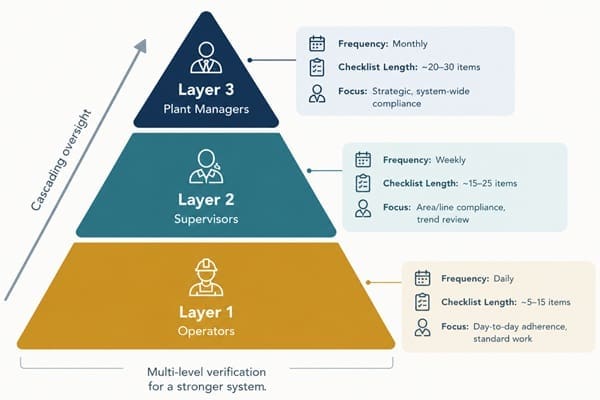
This is the core structural detail that most competing content treats vaguely, and it’s the single most useful, concrete thing to understand about how an LPA program actually works.
| Layer | Who Performs It | Frequency | Checklist Length | Focus |
| Layer 1 | Operators, team leads, shift supervisors | Daily or per shift | 10–15 binary (yes/no) questions | Immediate process compliance: machine settings, tooling, work instructions, PPE, error-proofing |
| Layer 2 | Department managers, supervisors | Weekly | 15–25 questions | Process consistency; reviews and spot-checks Layer 1’s results |
| Layer 3 | Plant managers, site leadership | Monthly | 20–30 questions | Systemic trends; is the LPA process itself working |
| Layer 4 (where used) | Executives | Quarterly | Fewer, higher-level questions | Strategic oversight of the overall program’s health |
A practical rule worth calling out directly: if a Layer 1 checklist takes longer than the audit’s time window to complete, that’s a sign the checklist has too many questions. It’s better to rotate which specific items get checked across different shifts than to overload a single audit with more than an auditor can realistically verify in 5 to 10 minutes.
Frequency should follow risk, not stay fixed forever. A newly launched process, or a chronic problem area, may warrant Layer 1 audits every shift. As a process matures and demonstrates consistent capability, audit frequency at each layer can be reduced, though this adjustment should be documented, since auditors reviewing IATF 16949 compliance will expect to see the reasoning behind any change in cadence.
Also Read: What is Process Safety Management (PSM)?
Why Does a Layered Process Audit Matter?
The core value of an LPA is simple: catching a problem early is dramatically cheaper than catching it late. The commonly cited 1-10-100 rule of quality illustrates this directly: a defect caught at the operator level costs roughly 1x to fix, the same defect caught at end-of-line inspection costs roughly 10x, and once it reaches the customer, the cost climbs to 100x or more.

The AIAG estimates that the Cost of Poor Quality, scrap, rework, warranty claims, and field failures, typically runs 15 to 20 percent of sales revenue in manufacturing organizations. An LPA program is specifically designed to catch process drift and non-conformance at the earliest, cheapest point, before a small deviation compounds into a costly, customer-facing failure.
LPAs also shift the underlying philosophy of quality verification: instead of relying on inspecting the final product to catch defects after they’ve already occurred, an LPA validates the consistency of the process itself, on the theory that a process running exactly as designed won’t produce the defect in the first place.
LPA vs. Internal Audit vs. Product Audit: What’s the Difference?
This distinction trips up a lot of quality teams new to the concept, and it’s worth being precise about.
| Audit Type | Frequency | Scope | Purpose |
| Layered Process Audit (LPA) | Daily to monthly, by layer | Narrow; specific critical process steps | Catch process drift and non-conformance early, at the point of work |
| Internal QMS Audit | Typically annual or semi-annual | Broad; the entire quality management system | Verify system-level compliance against a standard (ISO 9001, IATF 16949) |
| Product Audit | Periodic, often sample-based | The finished product itself | Find defects that have already occurred in completed output |
How do these work together in a mature quality program?
A mature program uses all three, and they serve genuinely different purposes rather than competing with each other. Internal QMS audits confirm the overall system is designed correctly; product audits catch defects that have already happened; LPAs sit in between, providing frequent, narrow verification that the process is actually being followed correctly, every shift, every day, long before an infrequent system-level audit would ever catch a gap.
Is an LPA Required by IATF 16949?
Not directly, and this is a genuinely common point of confusion. IATF 16949:2016 itself does not explicitly mandate a Layered Process Audit program by name. What it does require, under Clause 9.2.2.3, is internal audits of the quality management system, the manufacturing process, and the product, and LPAs are widely used to support and reinforce that broader requirement.
The more direct driver, in practice, is the automotive OEMs themselves. Major manufacturers including General Motors, Stellantis (the merger of PSA and Fiat Chrysler), and Ford require LPA programs as part of their own Customer-Specific Requirements (CSRs), which sit on top of the base IATF 16949 standard.
A supplier that can’t demonstrate a consistent LPA record risks production chargebacks or, in serious cases, a loss of supplier status with that OEM, regardless of what IATF 16949 technically requires on its own.
Also Read: Manual Testing Tools and the Software Testing Process
What Is CQI-8?
CQI-8 is the Layered Process Audit Guideline published by the Automotive Industry Action Group (AIAG), now in its second edition (published in 2014 following collaboration with OEMs and Tier One suppliers). It functions as the closest thing to an industry standard for how an LPA program should actually be built, covering checklist design, layer structure, roles and responsibilities, and how to evaluate whether the LPA program itself is working.
CQI-8 is not a certification requirement in the way ISO 9001 or IATF 16949 are; rather, it’s a practical reference guideline. Training courses based on it are commonly offered as 1-to-2-day sessions specifically for LPA planning team members responsible for designing and rolling out a program.
How Does an LPA Relate to a Control Plan?
This is the connection SSDSI’s own existing Control Plan content already gestures toward without fully explaining: an LPA is, in large part, the mechanism that verifies a Control Plan is actually being followed in real, daily practice, rather than existing only as a document in a binder.
A Layer 1 audit on an assembly or stamping line, for example, might check torque values against the exact specifications documented in the Control Plan, and confirm that error-proofing sensors referenced in that same plan are active and functioning. If operators are working from memory instead of the actual, current Control Plan, that gap tends to surface almost immediately once a Layer 1 audit starts asking specific, checklist-based questions about it.
Put simply: a Control Plan documents what should be happening in a process. An LPA is one of the most direct, frequent ways an organization actually confirms that it is happening, exactly as documented, at the point of work.
How Do You Build a Layered Process Audit Program?
1. Define the Critical-to-Quality Process Steps
Identify which specific process steps genuinely need frequent verification, prioritizing processes with high quality risk, a history of frequent complaints, or direct safety relevance, rather than trying to audit everything at once.
2. Assign Layers and Frequencies
Determine which organizational levels will audit each critical step, and how often, based on the guidance above: daily or per-shift for Layer 1, weekly for Layer 2, monthly for Layer 3.
3. Build the Checklists
Keep Layer 1 checklists short and binary, 10 to 15 yes/no questions completable in 5 to 10 minutes. Layer 2 and Layer 3 checklists can go deeper, reviewing consistency and systemic trends respectively, since they happen less frequently.
4. Observe the Process Directly and Record Findings
Audits should happen on the floor, directly observing the process against the checklist, not from a desk reviewing paperwork after the fact. Any non-conformance should be flagged and recorded immediately.
5. Escalate and Assign Corrective Actions
Every finding needs a clear owner and a deadline for corrective action, and higher layers should specifically review whether lower-layer findings are actually getting resolved, not just recorded.
Real-World Example (Hypothetical)
Problem: An automotive parts supplier has a Control Plan specifying exact torque settings for a fastening operation, but has noticed a slow increase in field returns related to loose fasteners over the past two quarters.
Analysis: A review finds no formal daily verification that operators are actually using the specified torque setting; the Control Plan exists, but nothing is confirming it’s being followed shift to shift.
Six Sigma approach: The team implements a Layer 1 LPA checklist specifically verifying torque tool calibration and setting compliance every shift, with a Layer 2 supervisor spot-check weekly reviewing a sample of Layer 1 results for consistency.
Action: Within the first two weeks, a Layer 1 audit catches a torque tool that had drifted out of calibration, well before it could contribute to further field failures.
Result (hypothetical): The issue is caught and corrected at the Layer 1 stage, at a fraction of the cost it would have taken to address after the parts had already reached the customer, consistent with the 1-10-100 rule. This is a hypothetical illustration of an LPA catching a real issue, not a documented case study.
Common Mistakes When Running a Layered Process Audit Program
- Overloading Layer 1 checklists. A checklist too long to complete in the actual audit window gets rushed or skipped; rotating a shorter question set is better than one long list nobody has time to finish properly.
- Treating LPA findings as paperwork instead of action items. A finding without a clearly assigned owner and deadline tends to simply reappear at the next audit.
- Letting higher layers skip their own audits. If Layer 2 and Layer 3 don’t actually perform their reviews, the “cascading” nature of the program collapses, and it becomes a Layer 1-only checklist exercise.
- Never adjusting frequency as the process matures. A stable, capable process audited at the same intensity as a brand-new, high-risk one wastes auditor time that could focus on genuinely higher-risk areas.
- Running the program entirely out of the quality department. LPAs work best when operations owns the day-to-day execution, since the program is fundamentally about how the process is run every day; quality can help design the checklist and track closure, but a quality-only program tends to lose the management-accountability effect that makes LPAs work.
Frequently Asked Questions on Layered Process Audit
Q: What is a layered process audit?
A: A Layered Process Audit (LPA) is a quality verification method where different organizational levels, operators, supervisors, and managers, each audit the same critical process steps at their own frequency, creating overlapping, frequent verification.
Q: What are the layers in a layered process audit?
A: Typically Layer 1 (operators/team leads, daily or per shift), Layer 2 (supervisors/managers, weekly), and Layer 3 (plant managers, monthly), with some programs adding a Layer 4 for quarterly executive-level review.
Q: What is the difference between an LPA and a regular internal audit?
A: An LPA is frequent and narrow, focused on specific critical process steps at the point of work. A regular internal QMS audit is infrequent (often annual) and broad, reviewing the entire quality management system against a standard like ISO 9001 or IATF 16949.
Q: Is a layered process audit required by IATF 16949?
A: Not directly by name. IATF 16949 requires internal audits under Clause 9.2.2.3, which LPAs help support, but the more direct requirement usually comes from individual automotive OEMs’ own Customer-Specific Requirements.
Q: What is CQI-8?
A: CQI-8 is the Layered Process Audit Guideline published by the Automotive Industry Action Group (AIAG). It’s the standard practical reference for designing and running an LPA program, though it’s a guideline rather than a certification requirement.
Q: How does a layered process audit relate to a control plan?
A: A Control Plan documents what should be happening in a process (specific settings, checks, and controls). An LPA is one of the most direct ways an organization verifies that the Control Plan is actually being followed in daily practice, rather than existing only on paper.
Final Words
A Layered Process Audit works because it stacks multiple, frequent checks on top of each other rather than relying on one infrequent, comprehensive review to catch everything.
Built well, with the right layer structure, realistic checklists, and real accountability for closing findings, an LPA program becomes the daily mechanism that confirms a Control Plan is actually being followed, catching drift and non-conformance while it’s still cheap to fix, rather than after it’s already reached the customer.
A Control Plan is only as good as the verification that confirms it’s actually being followed, and a well-structured layered process audit is how that verification happens in real, daily practice.
Six Sigma Development Solutions, Inc. (SSDSI) is IASSC-accredited and 5-star rated on Google Reviews, having certified 5,322+ professionals across 600+ organizations in 52 cities. Our onsite, live virtual, public, and online Green Belt and Black Belt training covers Control Plans and process auditing in the depth needed to keep your improvements from quietly eroding after the project ends. Explore SSDSI’s Black Belt certification to build that capability.
About Six Sigma Development Solutions, Inc.
Six Sigma Development Solutions, Inc. offers onsite, public, and virtual Lean Six Sigma certification training. We are an Accredited Training Organization by the IASSC (International Association of Six Sigma Certification). We offer Lean Six Sigma Green Belt, Black Belt, and Yellow Belt, as well as LEAN certifications.
Book a Call and Let us know how we can help meet your training needs.


