

IASSC (International Association for Six Sigma Certification) and CSSC (The Council for Six Sigma Certification) are two independent bodies that certify Six Sigma practitioners, and their actual requirements differ more than most comparisons acknowledge.
According to IASSC’s own site, its exams are closed-book and proctored, with certifications shifting from “Current” to “Elapsed” status after three years unless the holder recertifies.
According to CSSC’s own site, its exams are open-book, and certifications are issued as lifetime credentials with no recertification fees or renewal exams required at any level. Neither approach is objectively better; they simply verify different things in different ways. This guide compares both bodies strictly using their own published information, covering exam format, cost, recertification, and accreditation for training providers.
| Factor | IASSC | CSSC |
| Full name | International Association for Six Sigma Certification | The Council for Six Sigma Certification |
| Exam format | Closed-book, proctored | Open-book |
| Green Belt exam length/questions | 3 hours, 100 questions | Open-book, points-based scoring (280 of 400 points to pass) |
| Black Belt exam length/questions | 4 hours, 150 questions | Open-book format available at Black Belt level |
| Passing score | 70% | 70% (varies slightly by belt; Master Black Belt requires 90%) |
| Certification validity | Moves to “Elapsed” status after 3 years without recertification | Lifetime credential, no expiration, no renewal fee |
| Recertification cost | $115 to $235 depending on belt level | None; no recertification required |
| Training provider accreditation cost | Paid application and accreditation fee | Free accreditation for training providers |
| Prerequisites to sit exam | None required | None required; training recommended |
Table of contents
Key Takeaways
- IASSC and CSSC use fundamentally different exam formats. IASSC exams are closed-book and proctored; CSSC exams are open-book, a difference that changes how a candidate should prepare for each.
- Certification permanence is the starkest difference between the two bodies. IASSC certifications move to “Elapsed” status after three years without recertification, according to IASSC’s own recertification page, while CSSC states its certifications carry no expiration date at any belt level.
- CSSC offers free accreditation to training providers, according to CSSC’s own site, while IASSC accreditation involves a paid application and fee structure, a difference that shapes how each body sustains its verification process.
- Neither body requires prior work experience or a completed project to sit for their standard certification exams, unlike ASQ, which requires a project affidavit for its Black Belt certification.
- Both bodies set their passing threshold at 70% for standard belt-level exams, though CSSC’s Master Black Belt exam requires a notably higher 90% score to pass.
What Is IASSC?
The International Association for Six Sigma Certification describes itself, on its own site, as an independent third-party certification association within the Lean Six Sigma industry that does not provide training, mentoring, coaching, or consulting services itself.
IASSC has been conducting Lean Six Sigma credentialing since 2009, and its certifications are issued solely by IASSC directly or under license by the PeopleCert Group, which serves as its exclusive official Examination Institute.
It offers three core Lean Six Sigma certifications: Black Belt, Green Belt, and Yellow Belt, alongside separate Lean-specific credentials (Lean Practitioner, Lean Leader, and Lean Expert). IASSC also accredits training organizations that voluntarily align their curriculum to the IASSC Body of Knowledge, a process IASSC describes as involving reasonable due diligence before an entity is granted Accredited status.

Public, Onsite, Virtual, and Online Six Sigma Certification Training!
- We are accredited by the IASSC.
- Live Public Training at 52 Sites.
- Live Virtual Training.
- Onsite Training (at your organization).
- Interactive Online (self-paced) training,
What Is CSSC?
The Council for Six Sigma Certification describes itself, on its own site, as requiring all training and certification providers seeking its accreditation to meet specific criteria across both education and testing requirements, with accredited providers subject to ongoing monitoring if their program, instructors, or requirements change.
CSSC positions itself around accessibility: its site specifically highlights a self-study path for candidates who are self-reliant or unable to afford traditional Six Sigma training, offering free self-study guides alongside its certification exams.
CSSC offers certifications across the standard belt structure, including White, Yellow, Green, Black, and Master Black Belt, and states on its own site that it has been approached by federal government agencies that have recognized CSSC as a path to accreditation for their internal programs.
Also Read: Do Six Sigma Certifications Expire? ASQ and IASSC Rules Explained
Exam Format: Open-Book vs. Closed-Book

This is the most immediately practical difference between the two bodies, and it should directly shape how a candidate studies. IASSC’s certification exams are explicitly closed-book. The IASSC Certified Lean Six Sigma Green Belt exam is a 100-question, closed-book, proctored exam with a three-hour time allowance, and the Black Belt exam is a 150-question, closed-book, proctored exam with a four-hour time allowance, both requiring a minimum score of 70%.
CSSC’s exams, by contrast, are open-book. CSSC’s site states that its Six Sigma Master Black Belt exam is an open-book format consisting of 150 questions, with a four-hour time limit, and that the organization encourages use of its free self-study guide during the exam itself. CSSC’s Green Belt exam requires a score of 280 out of a possible 400 points to pass, and its White Belt exam, available at no cost, requires 56 out of 80 possible points.
Neither format is inherently easier. A closed-book exam tests recall and internalized understanding of the methodology; an open-book exam tests the ability to apply concepts correctly and locate the right information quickly under time pressure, a different but equally demanding skill.
Certification Expiration: The Difference That Surprises Candidates Most
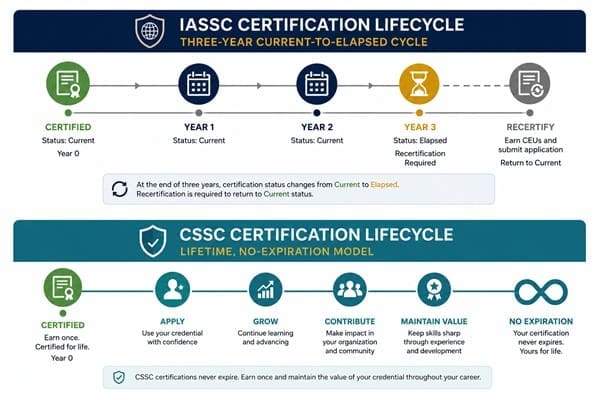
Few candidates research this before choosing a certifying body, and it is arguably the most consequential long-term difference between the two.
According to IASSC’s own recertification page, a Current status is granted to IASSC certifications for three years from the date of certification, after which an Elapsed status is applied unless the professional successfully recertifies. Recertification requires passing a shorter, closed-book, proctored exam specific to each belt level, with fees ranging from $115 for Yellow Belt recertification to $235 for Black Belt recertification, and candidates have a limited window, up to 90 days after elapsing, to recertify before the Elapsed status becomes permanent.
CSSC takes the opposite position by design. CSSC’s site states plainly that its certifications carry no expiration date, explaining its philosophy directly: certifications requiring renewals, in CSSC’s own words, only serve to increase the profits of certification providers instead of benefiting the individual. Candidates wanting a more recent certification date can resubmit additional projects at any time, but this is optional, not a requirement to maintain active status.
Cost Comparison: What Each Body Actually Charges
According to IASSC’s own on-demand testing page, exam voucher pricing is $450 for the Black Belt exam, $350 for the Green Belt exam, and $250 for the Yellow Belt exam. These prices reflect direct exam registration through IASSC’s testing system; pricing through individual accredited training providers may differ depending on what is bundled with instruction.
CSSC’s pricing structure works differently. Its White Belt certification exam is offered at no cost according to CSSC’s own site, and Green Belt, Black Belt, and Master Black Belt pricing includes the project review fee where applicable, though CSSC’s site does not publish a single universal number across all belts the way IASSC does, since CSSC’s exam and project review costs are presented per certification level on its own registration pages.
Accreditation for Training Providers: A Meaningful Structural Difference
How each body accredits training organizations, the entities that actually deliver Six Sigma instruction, reveals a real philosophical difference between them. IASSC accreditation is a paid process: organizations apply, furnish evidence of alignment to IASSC’s standards, and pay an accreditation fee, with different accreditation categories (Accredited Training Organization, Accredited Training Associate, Accredited Delivery Partner, and Accredited Curriculum Provider) valid for two to three years depending on category.
CSSC, according to its own site, offers accreditation to training providers entirely free of charge, positioning this as a way to help legitimate providers demonstrate credibility without a financial barrier. Both approaches aim at the same goal, verifying that a training provider’s curriculum meets a recognized standard, but they fund and structure that verification process differently.
Six Sigma Development Solutions holds IASSC Accredited Training Organization status, meaning our curriculum has gone through IASSC’s evidence-based due diligence process described above, across our onsite, live virtual, public, and online Lean Six Sigma programs.
Also Read: ASQ vs IASSC Lean Six Sigma Certification: Full Comparison
Which Certification Should You Choose?
A candidate whose employer or industry places heavy weight on formal, closed-book proctored testing, common in industries that also recognize ASQ credentials, may find IASSC’s format and structured recertification cycle a more familiar fit. A candidate prioritizing a lifetime credential with no ongoing renewal cost, or one drawn to CSSC’s free self-study materials and accessibility-focused positioning, may find CSSC’s model better aligned with their goals.
A government or public-sector professional may find it useful that CSSC’s own site notes recognition from federal agencies pursuing internal accreditation pathways, worth confirming directly against your specific agency’s requirements. In every case, the right move is verifying current requirements directly on iassc.org or sixsigmacouncil.org before enrolling, since both organizations update pricing and policy over time.
What Neither Body Claims About the Other
A responsible comparison should also be clear about what is not being claimed here. Neither IASSC’s own site nor CSSC’s own site makes direct comparative statements ranking the other organization’s rigor, recognition, or quality.
CSSC’s homepage references a page comparing itself to ASQ and IASSC, framed from CSSC’s own perspective, but this article does not repeat unverified comparative claims from either side as established fact. Where a specific number or policy is stated here, it traces directly to that organization’s own published page, not to the other organization’s characterization of it.
This distinction matters for anyone researching which credential to pursue: marketing language from any certifying body, including claims about being the “most respected” or “most recognized,” reflects that organization’s own positioning rather than an independently verified industry ranking.
Candidates evaluating either credential are better served checking with their specific employer or industry about which certification carries weight in their field, rather than relying on either organization’s self-description of its own standing relative to competitors.
Real-World Scenarios: Matching the Certification to the Situation
A supply chain analyst at a company that has historically hired ASQ- and IASSC-certified Black Belts is likely better served pursuing IASSC certification, since its closed-book exam format and structured, time-based recertification cycle mirror the testing style that company’s existing certified staff have already gone through.
An independent consultant who wants a Six Sigma credential without an ongoing renewal cost eating into their margins over a multi-decade career may find CSSC’s lifetime-certification model, with no recertification fees at any point, a better long-term fit for how they plan to use the credential.
A public-sector employee at an agency exploring internal Six Sigma accreditation pathways should specifically ask their agency’s procurement or training office whether CSSC’s federal-agency recognition, referenced on CSSC’s own site, applies to their specific department, since this kind of recognition can vary by agency and should be confirmed directly rather than assumed from a general website claim.
Frequently Asked Questions (FAQs) on IASSC Vs CSSC
Is the IASSC exam harder than the CSSC exam?
They test differently rather than one being simply harder. IASSC’s exam is closed-book, testing recall without reference materials. CSSC’s exam is open-book, testing the ability to apply concepts and locate information correctly under time pressure. Difficulty depends on which skill a candidate finds more challenging.
Does an IASSC certification expire?
It does not disappear, but it shifts from “Current” to “Elapsed” status after three years without recertification, according to IASSC’s own recertification page. Recertification requires passing a shorter proctored exam and paying a recertification fee.
Does a CSSC certification expire?
No. According to CSSC’s own site, its certifications at every belt level are issued as lifetime credentials with no recertification fees or renewal exams required.
Is training required before sitting the IASSC or CSSC exam?
Neither organization requires prior formal training as a prerequisite, according to their own sites, though both recommend it. IASSC and CSSC both note that training through a qualified provider improves a candidate’s chances of passing.
Which certification is more widely recognized by employers?
Recognition varies by industry and region, and neither organization’s own site makes a direct comparative claim about employer recognition versus the other. Candidates should confirm which certifying body their specific industry or employer prefers before choosing.
Final Words
IASSC and CSSC verify Six Sigma competency through genuinely different models, closed-book versus open-book testing, time-limited versus lifetime certification, paid versus free provider accreditation, and neither approach is objectively superior. The right choice depends on what your employer, industry, or personal preference values most.
Six Sigma Development Solutions Inc. is an IASSC Accredited Training Organization, rated 5 stars on Google Reviews, with 5,322+ professionals certified across 600+ organizations in 52 cities, offered through onsite, live virtual, public, and online formats. View our upcoming live virtual Green Belt or Black Belt training schedule and train with a curriculum built on a verified accreditation standard.
About Six Sigma Development Solutions, Inc.
Six Sigma Development Solutions, Inc. offers onsite, public, and virtual Lean Six Sigma certification training. We are an Accredited Training Organization by the IASSC (International Association of Six Sigma Certification). We offer Lean Six Sigma Green Belt, Black Belt, and Yellow Belt, as well as LEAN certifications.
Book a Call and Let us know how we can help meet your training needs.


