A revision plan serves as your strategic map when you need to refine a complex project or prepare for a rigorous certification. If you’ve ever felt overwhelmed by the sheer volume of data in a DMAIC (Define, Measure, Analyze, Improve, Control) cycle, you aren’t alone. We’ve all been there—staring at a mountain of charts and wondering where to start the cleanup.
To be honest, most people treat revision as an afterthought. They think it’s just about fixing typos or adjusting a few cells in a spreadsheet. But in the world of process improvement, a revision plan is much more. It’s a structured approach to look at your work with fresh eyes. It helps you find the gaps between your current state and your goals.
How do you turn a messy draft of a project into a polished, data-driven masterpiece? Can you really apply Lean principles to the way you study or edit? This guide will show you how to streamline your workflow and focus on what truly adds value.
Table of contents
Why You Need a Lean Revision Plan?
In my experience, the biggest enemy of a solid Six Sigma project is “waste” in the thinking process. We often spend hours on sections that don’t matter while ignoring the root causes of our errors. A lean approach to your revision plan ensures you only spend energy where it yields the highest return.
The Cost of Poor Planning
Without a clear path, you’ll likely cycle through “trial and error” forever. Think of it like a production line with too much rework. If you don’t plan your edits, you’ll fix one part only to break another. Have you ever noticed how a lack of structure leads to burnout? By setting a schedule and specific goals, you protect your time.
Aligning with DMAIC
A revision plan fits perfectly into the “Improve” and “Control” phases. You are essentially performing a quality check on your own work. You measure your progress against the initial requirements. Then, you analyze why some parts are weak. Finally, you improve the content to meet the high standards of a Green or Black Belt.

Public, Onsite, Virtual, and Online Six Sigma Certification Training!
- We are accredited by the IASSC.
- Live Public Training at 52 Sites.
- Live Virtual Training.
- Onsite Training (at your organization).
- Interactive Online (self-paced) training,
Creating Your Six Sigma Revision Plan
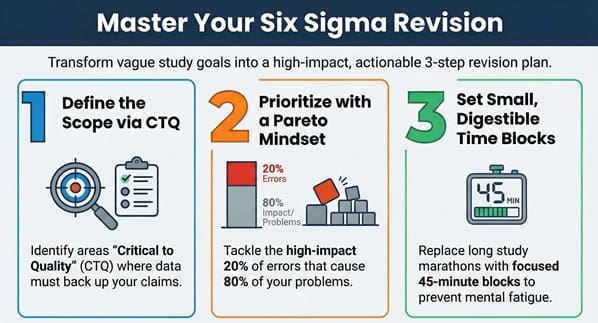
Now, let’s get into the “how-to” of it all. You can’t just say “I’ll study more” or “I’ll fix the report.” That isn’t a plan; it’s a wish. A real revision plan requires specific steps and a timeline.
Step 1: Define the Scope
What exactly needs work? Is it the statistical analysis? Or perhaps the executive summary is too long? Start by listing every section of your project. Identify which areas are “critical to quality” (CTQ). In a revision plan, focus on the parts that prove your results. If your data doesn’t back up your claims, that’s where you start.
Step 2: Prioritize with a Pareto Mindset
We know the 80/20 rule: 80% of your problems likely come from 20% of your work. Don’t try to fix everything at once. Look at your project feedback or your practice exam scores. Where are the biggest “leaks”? Use your revision plan to tackle the high-impact errors first. This keeps you from getting bogged down in minor details that don’t move the needle.
Step 3: Set Time Blocks
Time is your most limited resource. Break your revision into small, digestible chunks. Instead of saying “I’ll work for five hours,” try “I will spend 45 minutes refining the Fishbone diagram.” This makes the task feel less scary. It also prevents the “mental fatigue” that leads to more mistakes.
Also Read: Project Management Communication Plan
Strategic Revision for Exam Prep
If you are using a revision plan to pass a Lean Six Sigma exam, your approach must be even tighter. You aren’t just reading; you’re building a mental muscle.
Active Recall vs. Passive Reading
Passive reading is a waste of time. It feels like you’re learning, but the info doesn’t stick. In your revision plan, include active tasks. Draw the Value Stream Map from memory. Explain the difference between “Poka-Yoke” and “Kaizen” to a friend (or your cat). If you can’t explain it simply, you don’t know it well enough yet.
Mock Exams as “Process Checks”
Treat every practice test as a data point. If you miss a question on “Standard Deviation,” mark it down. Your revision plan should evolve based on this data. It’s like a feedback loop in a manufacturing plant. You find a defect, you trace it back to the source, and you fix it.
“A goal without a plan is just a wish.” — This applies to every belt level in the industry.
Managing Your Revision Schedule
How do you stay on track when life gets busy? Most people fail because their revision plan is too rigid. You need a bit of “Agile” thinking here.
The Daily Stand-up
Every morning, ask yourself:
- What did I finish yesterday?
- What is my main goal for today?
- Is anything blocking my progress?
This keeps the revision plan at the front of your mind. It’s a 2-minute habit that saves hours of wandering.
Visual Management
Use a Kanban board. Put your tasks into “To Do,” “Doing,” and “Done” columns. Seeing your progress visually is a huge motivator. It also helps you see if you’re stuck on one task for too long. If a task stays in “Doing” for three days, it’s time to break it down into smaller pieces.
Also Read: Pi Planning
Refining the Final Product
As you near the end of your revision plan, you need to shift from “big picture” to “fine detail.” This is the quality assurance phase.
Checking for Flow
Does one idea lead naturally to the next? In a Six Sigma report, the logic must be airtight. Your revision plan should include a “logic check.” Read your work out loud. If you trip over a sentence, it’s too complex. Simplify it. We want a 5th-grade reading level for maximum clarity.
Verifying the Data
Double-check every calculation. One wrong number in a regression analysis can ruin your entire conclusion. Your revision plan must have a dedicated “Data Integrity” hour. Don’t do this when you’re tired. Do it when you’re sharpest.
Key Takeaways for a Better Revision Plan
- Focus on Value: Only revise what helps the reader or improves the project outcome.
- Use Data: Let your mistakes guide your schedule.
- Keep it Simple: Use short sentences and active voice to explain complex ideas.
- Break it Down: Small tasks are easier to finish than big ones.
- Iterate: A revision plan can change as you learn more about your weaknesses.
Frequently Asked Questions About Revision Plan
What is a revision plan?
A revision plan is a structured schedule and set of goals used to improve a piece of work or prepare for an assessment. It outlines what to fix, how to fix it, and when it will be done.
How does Six Sigma apply to revision?
It applies by focusing on “Zero Defects” and reducing “Waste.” You use data from feedback to prioritize tasks that add the most value to your final result.
How long should my revision sessions be?
Roughly 45 to 60 minutes is the “sweet spot.” After that, your brain starts to lose focus. Take a 10-minute break to stay fresh.
Can I change my plan once I start?
Yes! In fact, you should. If you realize you’re struggling with a specific topic, adjust your revision plan to give that area more time.
Why is active voice important in a revision plan?
Active voice makes your writing direct and easy to follow. It tells the reader exactly who is doing what, which is vital for clear process documentation.
Final Words
At the end of the day, a revision plan is about taking control of your success. It’s about moving from a “hope for the best” mindset to a “guarantee the best” strategy. We believe that everyone can master Lean Six Sigma if they have the right tools and a clear path. Our company is dedicated to your growth. We don’t just provide information; we provide the roadmap to excellence. We’re here to support your journey from a learner to a leader.

About Six Sigma Development Solutions, Inc.
Six Sigma Development Solutions, Inc. offers onsite, public, and virtual Lean Six Sigma certification training. We are an Accredited Training Organization by the IASSC (International Association of Six Sigma Certification). We offer Lean Six Sigma Green Belt, Black Belt, and Yellow Belt, as well as LEAN certifications.
Book a Call and Let us know how we can help meet your training needs.