
Have you ever tried to explain a brilliant idea but watched someone’s eyes glaze over? It’s a common frustration. You know your product or project is great, but you can’t quite pin down why it matters in one or two sentences. This is where a solution statement becomes your best friend.
In my experience, most people jump straight into the “how” of their project. They talk about features, buttons, and tech specs. But wait—do you actually know what gap you are filling? To be honest, without a clear statement of your solution, you’re just throwing ideas at a wall.
A solution statement acts as a bridge. It connects the painful problem your audience feels to the specific way you plan to fix it. It isn’t just a description; it’s a promise. But how do you write one that actually sticks? Let’s break it down together.
Table of contents
Why Does a Solution Statement Matter for Your Success?
Picture this: You are standing in front of a busy executive or a skeptical investor. You have exactly sixty seconds to make them care. If you start rambling about “synergy” or “robust frameworks,” you’ve already lost. We’ve all been there, trying to find the right words while the clock ticks.
The solution statement serves as your North Star. It keeps your team focused and ensures everyone rows in the same direction. When things get complicated—and they always do—you can look back at this statement. Does this new feature help us achieve the core solution? If not, scrap it.
Roughly 90% of startups fail because they build things people don’t actually want. They have a solution, but it’s looking for a problem. A well-crafted statement forces you to prove that your “fix” matches a real “pain.” It’s about achieving that elusive “problem-solution fit” that experts always talk about.

Public, Onsite, Virtual, and Online Six Sigma Certification Training!
- We are accredited by the IASSC.
- Live Public Training at 52 Sites.
- Live Virtual Training.
- Onsite Training (at your organization).
- Interactive Online (self-paced) training,
The Core Elements of a Winning Solution Statement
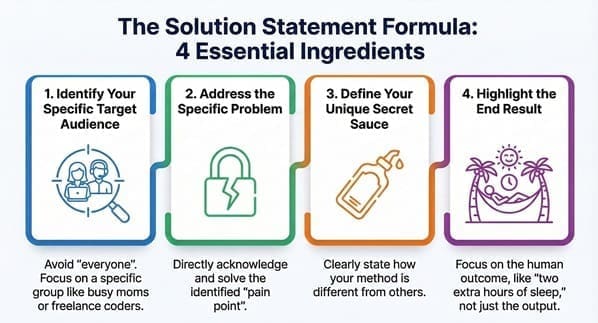
You might think a solution statement is just a fancy sentence. In reality, it’s a formula. While you don’t need to be a math whiz, you do need to include a few specific ingredients to make it work.
1. Identify the Target Audience
Who are you helping? “Everyone” is not an answer. If you try to talk to everyone, you end up talking to no one. Be specific. Are you helping busy moms, clinical nurses, or freelance coders?
2. Reference the Specific Problem
You can’t have a solution without a problem. Your statement must acknowledge the “pain point” you found. For example, if the problem is “long wait times in clinics,” your solution must directly address time.
3. State the Unique Method
How do you do it differently? This is your “secret sauce.” It’s not just what you do, but how you do it in a way that others don’t. This is often referred to as your unique value proposition.
4. Highlight the Benefit
What is the end result? Don’t just tell me you have an app. Tell me the app gives the user two extra hours of sleep. Focus on the outcome, not just the output.
Also Read: Conflict Resolution
How to Write Your Solution Statement Step-by-Step
Now, let’s get into the “how-to.” Writing a solution statement doesn’t have to be a chore. Follow these simple steps to build a solid foundation for your business or project.
Step 1: Review Your Problem Statement
Before you look forward, look back. What is the core issue? According to research from the University of Florida, a solution only exists in relation to a defined problem. If your problem statement is “people are hungry,” your solution statement shouldn’t be about “selling shoes.” That sounds obvious, but you’d be surprised how often people drift off-topic!
Step 2: Brainstorm the “What”
What are you actually providing? Is it a service, a physical product, or a new policy? Keep this simple. Use 5th-grade words. Instead of saying “a cloud-based synchronized data repository,” just say “a way to share files instantly.”
Step 3: Use the “So That” Test
This is a trick I use with my clients all the time. Write your draft, then add the words “so that” at the end.
- “We provide a new scheduling tool…”
- “…so that doctors can see more patients without feeling burned out.”
The part after “so that” is usually your strongest selling point.
Step 4: Trim the Fat
Here’s the thing: shorter is almost always better. Remove words like “very,” “really,” and “world-class.” If you have to tell people you are “world-class,” you probably aren’t. Let the results speak for themselves.
Solution Statement vs. Problem Statement: What’s the Difference?
It’s easy to get these two mixed up. I like to think of them as two sides of the same coin. The problem statement focuses on the “gap”—the current reality that is frustrating or broken. It’s the “before” picture in a weight loss commercial.
On the other hand, the solution statement is the “after” picture. It focuses on the future. It explains the “bridge” that takes the user from frustration to satisfaction.
Think about a hospital setting.
- Problem: Patients feel confused about their medication after they go home.
- Solution: We provide a 24/7 digital nurse-chat service so patients can clarify their dosages instantly.
Can you see how one leads naturally into the other? Without the problem, the solution feels like an unneeded gadget. Without the solution, the problem feels like a hopeless complaint.
Real-World Examples of Effective Solution Statements
Let’s look at how this works in the wild. These aren’t just for tech companies; they work for healthcare, engineering, and small businesses too.
- For a Tech Startup: “Our platform automates invoice tracking for small agencies so they can get paid 30% faster without manual follow-ups.”
- For a Health Project: “We implement a mobile vaccination unit that visits rural schools, ensuring every child receives their shots regardless of family transport issues.”
- For a Local Bakery: “We offer gluten-free, nut-free pastries that taste like traditional recipes, allowing families with allergies to enjoy dessert together again.”
Each of these examples is clear. You know who it’s for, what it does, and why it matters. Do you see any complex jargon? No. That’s the goal.
Also Read: How to Use a Payoff Matrix to Prioritize Solutions
Common Mistakes to Avoid
Even seasoned pros stumble sometimes. When you’re writing your solution statement, watch out for these traps:
- The “Feature Dump”: Don’t list 10 things your product does. Pick the one big thing that solves the main problem.
- Being Too Vague: Phrases like “we improve lives” or “we offer better service” mean nothing. How do you improve them? By how much?
- Ignoring the “How”: If your solution sounds like magic, people won’t believe you. Mention the mechanism (e.g., “via an automated app” or “through a peer-to-peer network”).
- Passive Voice: Don’t say “The problem will be solved by us.” Say “We solve the problem.” It sounds more confident.
Frequently Asked Questions (FAQs) on Solution Statement
How long should a solution statement be?
In my view, you should aim for one to three sentences. If it’s longer than a short paragraph, you are likely over-explaining. Keep it punchy for mobile readers.
Who is the audience for this statement?
Usually, it’s for stakeholders. This includes investors, your internal team, and your potential customers. It needs to make sense to all of them.
Can a project have more than one solution?
Yes, but you should have one primary solution statement. If you try to solve five major problems at once, you’ll probably fail at all of them. Focus first, then expand.
Is a solution statement the same as a mission statement?
Not quite. A mission statement is about your “why” and your long-term values. A solution statement is about a specific “what” for a specific “pain.”
Key Takeaways on Solution Statement
- Start with the problem: You can’t fix what you haven’t defined.
- Focus on the user: Use “you” and “your” to keep it human-centric.
- Keep it simple: Avoid jargon and aim for a 5th-grade reading level.
- Be specific: Use numbers or concrete outcomes whenever you can.
- Test it: Read it out loud to a friend. If they look confused, go back to the drawing board.
Final Words
Creating a powerful solution statement is the first step toward turning a vision into reality. It clarifies your thoughts and gives your audience a reason to listen. It’s not about being the smartest person in the room; it’s about being the clearest.
We’ve all seen great ideas wither away because the creator couldn’t explain them. Don’t let that be you. Take the time to refine your words. Use the “so that” test. Cut the fluff. When you find that perfect balance of problem and fix, people won’t just understand your idea—they’ll want to be a part of it.
At SSDSI, we believe that clear communication is the heartbeat of every successful partnership. We are dedicated to helping our clients find their voice and solve real-world challenges with precision. If you’re ready to take the next step in your journey, we’re here to help you bridge the gap between a great idea and a lasting impact.


