
Current reality tree (CRT) is a powerful logic-based tool used to find the real cause of multiple problems at once. Have you ever felt like you’re playing a game of “Whack-A-Mole” at work? You fix one issue, and two more pop up the next day. It’s frustrating, right? We’ve all been there, staring at a mess of “Undesirable Effects” (UDEs) and wondering where it all went wrong.
To be honest, most businesses treat symptoms instead of diseases. They see a drop in sales or a high employee turnover and throw money at the surface level. But what if those problems are all connected to one single, hidden mistake in your system? That is where the current reality tree comes in. It helps you map out cause-and-effect relationships until you hit the “root cause.”
In this guide, we will explore how this Theory of Constraints (TOC) tool can transform your messy reality into a clear roadmap for change. Ready to stop guessing and start solving? Let’s dive in.
Table of contents
What is a Current Reality Tree?
A current reality tree is a visual map that shows the logical relationship between the problems you see and the hidden causes behind them. Eliyahu M. Goldratt, the father of the Theory of Constraints, created this method. He realized that in any complex system, most problems are not independent. They are symptoms of a few deep-seated issues.
Think of your business like a physical tree. The brown leaves and wilting branches are your UDEs (Undesirable Effects). You can spray the leaves all day, but if the roots are rotting, the tree won’t get healthy. The CRT helps you dig into the dirt to find those roots.

Public, Onsite, Virtual, and Online Six Sigma Certification Training!
- We are accredited by the IASSC.
- Live Public Training at 52 Sites.
- Live Virtual Training.
- Onsite Training (at your organization).
- Interactive Online (self-paced) training,
The Logic of Cause and Effect
The CRT uses “If-Then” logic. For example: If we don’t have a standard training manual, then employees will perform tasks differently. If they perform tasks differently, then our product quality will vary.
By connecting these dots, you move from the “what” to the “why.” It’s not just a brainstorm; it’s a rigorous logical proof of why your system is failing right now.
Why Should You Use a Current Reality Tree?
We often jump to conclusions when things go south. In my experience, the loudest person in the meeting usually gets to pick the “cause.” But the loudest person isn’t always right. The current reality tree removes the guesswork and the office politics from problem-solving.
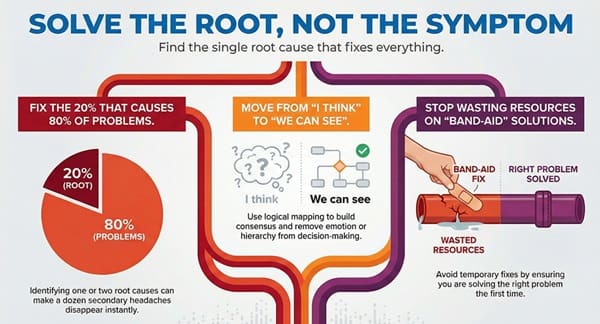
1. It Identifies the 20% That Causes 80% of Problems
Pareto’s Principle is alive and well in business systems. Usually, one or two root causes create a dozen different headaches. If you find and fix that one root, the other problems often disappear on their own.
2. It Builds Consensus
Have you ever tried to convince a boss that the “standard procedure” is actually the problem? It’s hard. But when you show them a logical map where every step is undeniable, they can’t argue with the facts. It moves the conversation from “I think” to “We can see.”
3. It Prevents “Band-Aid” Solutions
A current reality tree stops you from wasting resources on temporary fixes. Why buy new software if the root cause is actually poor communication between departments? The CRT saves you money by ensuring you solve the right problem the first time.
Also Read: What is Loss or Fault Tree Analysis? A Simple Explanation
How to Build a Current Reality Tree Step-by-Step
Building a current reality tree might feel intimidating at first, but it’s just a series of logical steps. Here is how we do it.
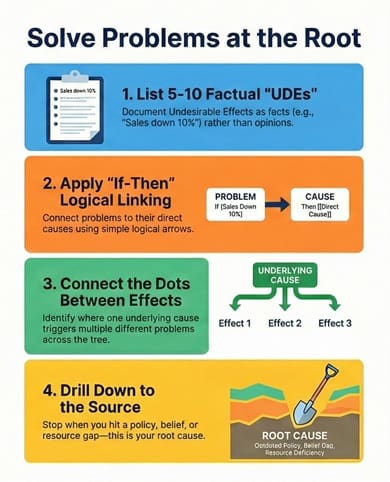
Step 1: Identify Your Undesirable Effects (UDEs)
Start by listing 5 to 10 things that are going wrong. These must be facts, not opinions.
- “Sales are down 10%” is a UDE.
- “The manager is lazy” is an opinion.
Keep your UDEs focused on the current state of things. What is hurting your performance today?
Step 2: Look for the Direct Cause
Pick one UDE and ask, “Why does this happen?” Use the “If-Then” logic.
- If the shipping department is backlogged, then customers receive late orders.
Write down that cause and connect it to the UDE with an arrow.
Step 3: Connect the Dots
Now, look at your other UDEs. Can they be explained by the same cause? This is where the magic happens. You’ll start to see that the cause of “Late Orders” might also be the cause of “High Shipping Costs.”
Step 4: Dig Deeper for the Root Cause
Keep asking “Why?” until you reach a point where you can no longer blame a higher cause. Usually, you stop when you hit a policy, a deep-seated belief, or a lack of resources. This bottom-most box is your root cause.
In most cases, you’ll find that a single root cause feeds into multiple branches of the tree. That’s your “Aha!” moment.
The Rules of Logic (CLRR)
To make a current reality tree valid, you must follow the Categories of Legitimate Reservation (CLRR). This sounds fancy, but it just means “rules to make sure you aren’t lying to yourself.”
- Clarity: Is the statement easy to understand?
- Entity Existence: Is this actually happening?
- Causality Existence: Does the cause really lead to the effect?
- Insufficient Cause: Does this cause alone create the effect, or is something else missing?
When we use these rules, we ensure the CRT is a solid reflection of reality, not just a collection of excuses.
Common Mistakes to Avoid with a Current Reality Tree
Even seasoned pros mess up their first few trees. Here is what to watch out for:
Over-complicating the Map
You don’t need a thousand boxes. If your tree looks like a spiderweb gone wrong, you’re likely adding too much detail. Focus on the big logical leaps.
Using the CRT to Blame People
A current reality tree is a system tool. If your root cause is “John is bad at his job,” you haven’t dug deep enough. Why is John bad at his job? Is it a lack of training? Poor hiring? A bad process? Focus on the system, not the person.
Starting with the Solution
Many people start a CRT already knowing what they want to “fix.” This creates a biased tree. To be honest, you have to be willing to be wrong. Let the logic lead you to the cause, don’t lead the logic to your favorite solution.
Also Read: Fault Tree Analysis (FTA)
Current Reality Tree vs. Fishbone Diagram
You might be wondering, “Isn’t this just a Fishbone (Ishikawa) diagram?” Not quite.
| Feature | Fishbone Diagram | Current Reality Tree |
| Structure | Categorical (People, Process, etc.) | Logical (Cause and Effect) |
| Goal | Brainstorming all possible causes | Identifying the single root cause |
| Complexity | Simple, good for quick fixes | High, good for systemic issues |
| Relationship | Shows what could be a cause | Shows how causes interact |
While a Fishbone is great for a quick team meeting, a current reality tree is better for complex, chronic problems that haven’t gone away with simple fixes.
Real-World Example: High Employee Turnover
Let’s look at a quick case study. Imagine a company has high turnover.
- UDE: Good employees are quitting.
- Immediate Cause: They feel burnt out.
- Why? They are working 60 hours a week.
- Why? Project deadlines are unrealistic.
- Why? Sales team promises delivery dates without checking with production.
- Root Cause: The bonus structure for Sales is based on volume, not successful delivery.
In this current reality tree, the root cause isn’t “the work is hard.” It’s the sales incentive policy. Fixing the policy fixes the burnout, which fixes the turnover.
Moving from Reality to Future
Once you have your current reality tree, you aren’t done. The CRT shows you where you are. Next, you need a Future Reality Tree (FRT). This is where you map out what happens if you remove the root cause.
Does the logic hold up? If we change the sales bonus, will the turnover actually stop? The CRT is the diagnostic tool; the FRT is the treatment plan.
Frequently Asked Questions on CRT
How long does it take to make a CRT?
It depends on the complexity. A small team can map a simple issue in a few hours. For a whole organization, it might take several days of interviews and logic-checking.
Do I need special software for a current reality tree?
Not at all. You can use a whiteboard and sticky notes. In fact, sticky notes are better because you can move them around as your logic evolves. If you want digital, tools like Lucidchart or Visual Paradigm work great.
Is the CRT only for manufacturing?
Definitely not. While it started in manufacturing, we see it used today in software development, healthcare, and even personal coaching. Any system with “If-Then” logic can benefit.
Key Takeaways
- A current reality tree identifies the root causes of systemic problems using cause-and-effect logic.
- It helps distinguish between surface-level symptoms (UDEs) and deep-seated issues.
- The CRT uses “If-Then” logic to create a visual map of how problems are connected.
- Success depends on following the Rules of Logic (CLRR) to ensure the map is accurate.
- Fixing a single root cause identified by a CRT can solve multiple symptoms simultaneously.
Final Words
The current reality tree is more than just a chart; it’s a mindset. It forces us to stop looking for quick fixes and start looking for the truth. At our company, we believe that every complex problem has a simple, logical solution—you just have to be brave enough to map it out. We value transparency and clarity above all else, because that’s how real growth happens.
If you are tired of solving the same problems every month, it’s time to look at your roots. Your future success depends on how well you understand your current reality.