Acceptance sampling acts as a middle ground for businesses that need to ensure quality without the high cost of inspecting every single item. Imagine you’ve just received a shipment of 10,000 microchips. You can’t test them all—it would take forever and cost a fortune. But you also can’t just trust they’re all perfect. This is where we use a statistical “middle way” to decide if the batch stays or goes.
Table of contents
What Is Acceptance Sampling?
At its core, acceptance sampling is a statistical method used in quality control. It helps us decide whether to accept or reject a whole lot (a batch of products) based on a random sample. Instead of looking at 100% of the goods, we look at a representative slice.
If the number of defects in that slice stays below a certain limit, we accept the whole batch. If it doesn’t, we send it back. We often use this when testing is “destructive”—like testing the strength of a lightbulb until it breaks. You can’t sell a broken bulb, so you only test a few!

Public, Onsite, Virtual, and Online Six Sigma Certification Training!
- We are accredited by the IASSC.
- Live Public Training at 52 Sites.
- Live Virtual Training.
- Onsite Training (at your organization).
- Interactive Online (self-paced) training,
Why We Don’t Inspect Everything?
In my experience, many managers ask, “Why not just check every unit?” To be honest, 100% inspection is rarely 100% accurate. Humans get bored. Eyes get tired. Errors happen.
By focusing on a smaller sample, we can often do a much more thorough job on those specific items. Plus, it saves massive amounts of time and money. It’s roughly the difference between tasting a spoonful of soup to see if it needs salt versus eating the whole pot before the guests arrive.
Also Read: Attribute Sampling
How Acceptance Sampling Actually Works?
To make this work, we use a specific “sampling plan.” This plan is like a rulebook for the inspector. It tells them two main things:
- How many items to pick (n).
- The maximum number of defects allowed (c).
Suppose your plan says $n=50$ and $c=2$. You pick 50 items. If you find 0, 1, or 2 defects, the whole shipment passes. If you find 3, the whole shipment fails. It’s a simple “go/no-go” decision.
The Different Types of Acceptance Plans
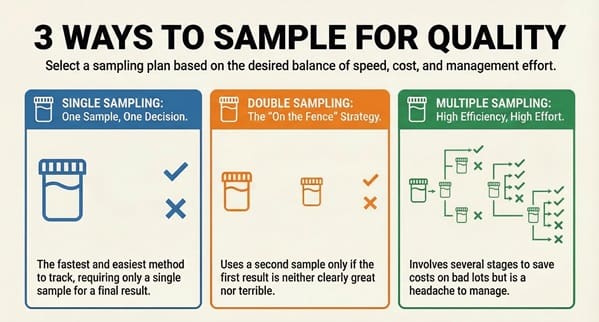
We usually categorize these plans based on how many “bites” we take at the apple:
- Single Sampling Plan: You take one sample and make a final decision immediately. It’s fast and easy to track.
- Double Sampling Plan: You take a small sample first. If the quality is great, you accept. If it’s terrible, you reject. But if it’s “on the fence,” you take a second sample before deciding.
- Multiple Sampling: This involves several stages. It can be cheaper because you might reject a very bad lot after only checking a few items, but it’s a headache to manage.
The Risks We Face (Producer vs. Consumer)
Here is the thing: because we aren’t checking everything, there is always a chance we’ll be wrong. We call these statistical risks.
Type I Error: The Producer’s Risk ($\alpha$)
This happens when a perfectly good batch gets rejected. Picture this: a supplier sends high-quality gear, but by pure bad luck, you picked the only three bad ones in the box for your sample. You reject it, and the producer loses money. We usually aim to keep this risk around 5%.
Type II Error: The Consumer’s Risk ($\beta$)
This is the one that keeps quality managers awake at night. This happens when a bad batch gets accepted. You checked a sample, it looked okay, but the rest of the box is junk. Your customers end up with bad products, and your brand suffers.
Understanding the OC Curve
To visualize these risks, we use the Operating Characteristic (OC) Curve. This graph shows the probability of accepting a lot based on its actual quality level.
An “ideal” curve would be a vertical line—accepting everything below a certain defect rate and rejecting everything above it. In the real world, the curve is an “S” shape. As the sample size ($n$) increases, the curve gets steeper, meaning the plan becomes better at telling “good” from “bad.”
Also Read: Systematic Sampling
Important Terms You Need to Know
If you’re going to use acceptance sampling, you’ll hear these acronyms a lot. Let’s break them down:
- AQL (Acceptable Quality Level): This is the poorest quality level that the consumer thinks is “good enough.” It’s the limit of what we are willing to live with.
- LTPD (Lot Tolerance Percent Defective): This is the “danger zone.” It’s the level of defects that we definitely want to reject.
- AOQ (Average Outgoing Quality): This tells us the average quality of the goods leaving the inspection station, assuming we fix or replace the defects we find.
When Should You Use This Method?
I’ve found that acceptance sampling isn’t for every situation. You should consider it when:
- Testing is destructive (like crash-testing a car).
- The cost of 100% inspection is too high.
- You have thousands of items to check.
- The supplier has a solid history, and you just need a “sanity check.”
However, if a single defect could cause a disaster—like in medical heart valves or airplane bolts—you probably shouldn’t rely on sampling. In those cases, 100% inspection or automated sensor testing is a must.
Frequently Asked Questions About Acceptance Sampling
Is acceptance sampling the same as Statistical Process Control (SPC)?
No. We use SPC during production to prevent defects from happening. We use sampling after the goods are finished to see if they are okay to ship.
What happens to a rejected lot?
In most cases, we return it to the supplier. Sometimes, we perform “rectifying inspection,” where we check 100% of that specific batch, pull out the bad ones, and keep the good ones.
Can I pick my own sample size?
You can, but it’s better to use standard tables like the MIL-STD-105E. These tables are based on math, not gut feelings.
Key Takeaways on Acceptance Sampling
- Acceptance sampling saves money and time by checking a fraction of a batch.
- It uses a “go/no-go” logic based on a maximum allowed defect count ($c$).
- Producer’s risk is rejecting a good lot; Consumer’s risk is accepting a bad one.
- The OC Curve helps you see how effective your sampling plan really is.
- It works best for high-volume, low-risk items or destructive testing.
Final Words
In my view, acceptance sampling is an essential tool for any growing business. It allows you to maintain high standards without slowing down your supply chain to a crawl. While it isn’t perfect—it’s a game of probability, after all—it provides a structured, scientific way to manage quality. By understanding your AQL and the risks involved, you can protect your customers and your bottom line.
At our company, we believe your success is our success. We don’t just provide tools; we provide the peace of mind that comes with knowing your quality control is backed by solid science. We’re committed to helping you scale your operations with precision and care.