
Are you struggling to keep your projects on track? Do you find it difficult to know if your team is getting enough done for the money you are spending? You have a budget and a schedule, but determining your actual performance—that is the real challenge. You need a reliable method that helps you see your project’s true status right now.
This is where Earned Value Management (EVM) plays a vital role. EVM is nothing but a powerful project management technique. It helps you objectively measure project performance and progress by integrating the key elements of scope, schedule, and cost. Understanding EVM ensures that you make timely and informed decisions, thus keeping your project profitable and successful.
In this comprehensive guide, we will explore this essential technique. We will define the key EVM concepts, look at its powerful formulas, and discuss how you implement it to gain real-time project insight.
Table of contents
What is Earned Value Management (EVM)?
Earned Value Management (EVM) can be understood as a systematic project management process. It measures the project’s performance by comparing the work you planned to complete, the work you actually completed, and the actual cost incurred. This means EVM answers three crucial questions at any point in time:
- How much work did you plan to do up to this point?
- How much work have you actually finished?
- How much money have you spent to do that finished work?
EVM helps you determine if your project is ahead or behind schedule and under or over budget. It converts both time and cost into a single, understandable measure: the monetary value of the work accomplished. This sophisticated system allows you to quantify your progress.
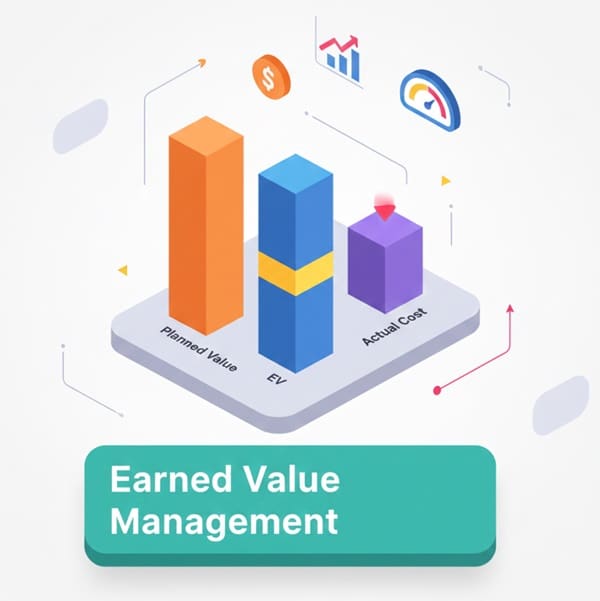
The basic principle of Earned Value Management is simple. It does not just look at your spending. It looks at the value of the work you earned with that spending. This leads to a clear and objective assessment of project health.
Key EVM Concepts
To effectively implement Earned Value Management, you must first understand the three fundamental components. These terms form the basis for all EVM calculations and analysis.
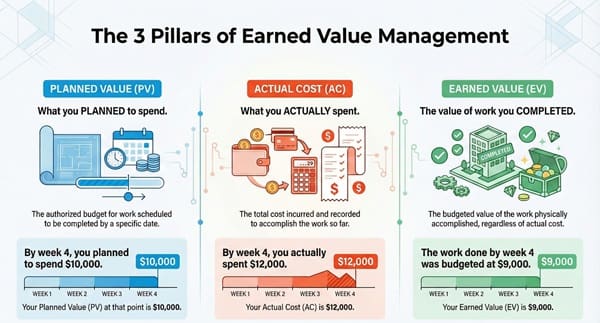
1. Planned Value (PV)
Planned Value (PV) refers to the authorized budget assigned to the work you need to complete up to a specific point in time. PV is also commonly known as the Budgeted Cost of Work Scheduled (BCWS).
- PV is nothing but the total cost planned for a task or component.
- You calculate the PV before the work begins.
- It represents your time-phased budget baseline.
- Planned Value tells you what your progress should be at a given date.
For example, if you planned to spend $10,000 by the end of week four, your Planned Value (PV) at that point is $10,000.
2. Actual Cost (AC)
Actual Cost (AC) signifies the total cost incurred and recorded in accomplishing the work during a given time period. AC is also known as the Actual Cost of Work Performed (ACWP).
- AC includes all expenses used to achieve the work.
- It signifies the real money spent up to the measurement date.
- The Actual Cost directly comes from your project’s accounting records.
If you spent $12,000 to complete the work by the end of week four, your Actual Cost (AC) is $12,000.
3. Earned Value (EV)
Earned Value (EV) is the value of the work you physically completed, expressed in terms of the budget authorized for that work. EV is also called the Budgeted Cost of Work Performed (BCWP).
- EV is the most critical EVM metric.
- It measures the actual work accomplished against the project baseline.
- Earned Value represents the dollar value of the work finished, regardless of the money you spent.
If the work you completed by week four was originally budgeted to cost $9,000, your Earned Value (EV) is $9,000. This is true even if you spent $12,000 (AC) to do it.

Public, Onsite, Virtual, and Online Six Sigma Certification Training!
- We are accredited by the IASSC.
- Live Public Training at 52 Sites.
- Live Virtual Training.
- Onsite Training (at your organization).
- Interactive Online (self-paced) training,
Key EVM Concepts: PV, AC, and EV
When you look at PV, AC, and EV together, you gain a powerful understanding of your project’s status. Let us now look at a comparison chart to clarify the differences.
| Basis for Comparison | Planned Value (PV) | Actual Cost (AC) | Earned Value (EV) |
| What it measures | Budget authorized for work scheduled | Actual cost of work performed | Budget authorized for work performed |
| When it is set | Before the work starts (Baseline) | As money is spent | As work is completed |
| Question it answers | How much should we have spent? | How much have we actually spent? | How much work have we actually finished (in budget terms)? |
| Other Name | BCWS (Budgeted Cost of Work Scheduled) | ACWP (Actual Cost of Work Performed) | BCWP (Budgeted Cost of Work Performed) |
Also Read: Value Engineering: Maximize Value & Minimize Cost
Calculating EVM Metrics: Performance Indicators
The power of Earned Value Management truly appears when you use the three core concepts (PV, AC, EV) to calculate performance indicators. These indicators immediately tell you if your project is healthy or requires corrective action.
1. Variance Calculations (Dollars)
Variance calculations measure the difference between your planned, earned, and actual values in monetary terms.
a. Cost Variance (CV)
Cost Variance (CV) indicates whether your project is over or under budget. It measures the difference between the value of the work performed (EV) and the actual cost spent to achieve that work (AC).
Formula: CV = EV – AC
Interpretation:
- If CV is positive (CV > 0), you are under budget. This means you completed the work for less than its budgeted value.
- If CV is negative (CV < 0), you are over budget. This means you spent more than the budgeted value for the work completed.
Example: If your EV is $9,000 and your AC is $12,000, then CV = 9,000 – 12,000 = -$3,000. You are $3,000 over budget.
b. Schedule Variance (SV)
Schedule Variance (SV) indicates whether your project is ahead or behind schedule. It measures the difference between the value of the work performed (EV) and the value of the work you planned to perform (PV).
Formula: SV = EV – PV
Interpretation:
- If SV is positive (SV > 0), you are ahead of schedule. This means you earned more value than you planned.
- If SV is negative (SV < 0), you are behind schedule. This means you earned less value than you planned.
Example: If your EV is $9,000 and your PV is $10,000, then SV = 9,000 – 10,000 = -$1,000. You are $1,000 behind schedule (in terms of planned value).
2. Performance Index Calculations (Efficiency)
Performance indexes provide a ratio that measures the efficiency of your project’s cost and schedule performance.
a. Cost Performance Index (CPI)
The Cost Performance Index (CPI) measures your cost efficiency. It indicates the earned value for every dollar you spent.
Formula: CPI = EV / AC
Interpretation:
- If CPI is greater than 1 (CPI > 1), you are cost efficient (under budget). This means you are earning more than you are spending.
- If CPI is less than 1 (CPI < 1), you are cost inefficient (over budget). This means you are spending more than the value you are earning.
Example: If your EV is $9,000 and your AC is $12,000, then CPI = 9,000 / 12,000 = 0.75. This means you are only earning 75 cents of value for every dollar you spend.
b. Schedule Performance Index (SPI)
The Schedule Performance Index (SPI) measures your schedule efficiency. It indicates the earned value achieved for every dollar of planned work.
Formula: SPI = EV / PV
Interpretation:
- If SPI is greater than 1 (SPI > 1), you are ahead of schedule. This means you are progressing faster than planned.
- If SPI is less than 1 (SPI < 1), you are behind schedule. This means you are progressing slower than planned.
Example: If your EV is $9,000 and your PV is $10,000, then SPI = 9,000 / 10,000 = 0.90. This means you are only progressing at 90% of the planned rate.
Forecasting with Earned Value Management
One of the greatest benefits of Earned Value Management is its ability to forecast future performance. By analyzing current trends (using CPI and SPI), you can predict the final cost and schedule outcome of your project.
1. Budget at Completion (BAC)
Budget at Completion (BAC) is nothing but the total planned budget for the entire project. This figure represents the original, agreed-upon cost estimate.
2. Estimate at Completion (EAC)
The Estimate at Completion (EAC) is the projection of the total cost that the project will incur when it is completed. You calculate EAC by taking into account the performance trend up to the present date.
Formula 1 (Assuming current variances are typical):
EAC = BAC / CPI
This formula is most commonly used. It assumes that the current Cost Performance Index (CPI) will continue for the remainder of the project.
Formula 2 (Assuming future work will be performed at the budgeted rate):
EAC = AC + (BAC – EV)
This formula is used when you believe the current, poor performance was an isolated event. It assumes that future work will proceed as originally planned.
Example (Using Formula 1): If your BAC is $100,000 and your current CPI is 0.75, then EAC = 100,000 / 0.75 = $133,333.33. This suggests the project will likely finish $33,333.33 over budget if performance does not improve.
3. Estimate to Complete (ETC)
The Estimate to Complete (ETC) is the cost required to finish all the remaining work on the project.
Formula: ETC = EAC – AC
Estimate to Complete shows you the remaining funding you need.
4. Variance at Completion (VAC)
The Variance at Completion (VAC) projects the difference between the total planned budget (BAC) and the projected final cost (EAC).
Formula: VAC = BAC – EAC
VAC shows the total expected project surplus (positive) or deficit (negative).
Essential Role of the Project Baseline
Earned Value Management relies completely on a solid project baseline. The baseline is the approved, integrated plan for the project scope, schedule, and cost. It acts as the reference point against which you measure all performance.
The Performance Measurement Baseline (PMB) is the sum of all Planned Value (PV) across the entire project lifespan. You need this to effectively measure your Earned Value.
The systematic breakdown of the project into a Work Breakdown Structure (WBS) is a crucial first step. The Work Breakdown Structure provides a hierarchical structure, allowing you to assign budget (PV) to specific work packages. This assignment enables the precise calculation of Earned Value as you complete each work package.
How to Implement Earned Value Management?
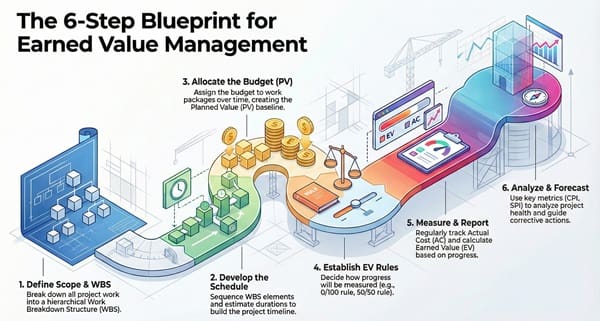
Implementing Earned Value Management involves several key steps. This ensures that you can establish a reliable measurement system.
- Define the Scope and WBS: First, you define all the work (scope) and break it down into a hierarchical Work Breakdown Structure (WBS). This provides the foundation for cost and schedule planning.
- Develop the Schedule: Then, you sequence the WBS elements, estimate durations, and build the project schedule. This establishes your time frame.
- Allocate the Budget (PV): You allocate the total budget (BAC) to the WBS work packages over the schedule. This creates your Planned Value (PV) curve, which is the Performance Measurement Baseline.
- Establish EV Rules: You decide how you will measure Earned Value. For example, you may use the 0/100 Rule (0% credit until complete, then 100% credit), the 50/50 Rule, or a physical measurement method.
- Measure and Report: Regularly (e.g., weekly or monthly), you track the Actual Cost (AC) and determine the Earned Value (EV) based on the work completed. You then calculate the variances and indices.
- Analyze and Forecast: Finally, you use the calculated CPI, SPI, CV, and SV to analyze the project’s health and forecast the EAC and VAC. This analysis drives corrective action.
Also Read: What is Expected Monetary Value (EMV)?
Why Earned Value Management is Crucial for Your Projects?
Why should you, the project manager, rely on Earned Value Management? The answer lies in the objective insight it provides.
- Early Warning System: Earned Value Management provides an early warning of impending cost and schedule issues. By focusing on CPI and SPI, you can spot problems much earlier than simply comparing the total budget to actual expenditures.
- Objective Performance: EVM forces you to use a clear, mathematical approach to performance reporting. This removes subjective bias from status updates.
- Integration of Triple Constraint: The system seamlessly integrates the project’s scope, schedule, and cost. This helps you understand how a delay (SV) affects your cost (CV), which is vital for effective project management.
- Better Forecasting: It enables realistic Estimate at Completion (EAC) forecasting. This helps you manage stakeholder expectations and secure necessary funds well in advance.
Frequently Asked Questions (FAQs) About EVM
What is the difference between CV and CPI?
Cost Variance (CV) indicates the absolute dollar amount you are over or under budget, while the Cost Performance Index (CPI) shows the efficiency as a ratio. CV is a dollar measure of magnitude; CPI is a ratio measure of efficiency. CPI is typically a better predictor of future performance.
Why is EV not the same as AC?
Earned Value (EV) is the budgeted value of the work performed. Actual Cost (AC) is the actual money spent on the work performed. EV focuses on value; AC focuses on expenditure. A negative CV (where EV < AC) shows that the actual money spent was more than the work’s planned budget.
What is the most important EVM metric?
While all metrics are essential, the Cost Performance Index (CPI) is often considered the most important. CPI is typically the best indicator of a project’s final cost at completion. It provides a simple, immediate gauge of cost efficiency.
When should I use EVM?
You should use Earned Value Management on projects that are complex, long-term, and involve high costs. EVM is especially effective when stakeholders require frequent, objective performance reports.
Key Takeaways
- EVM integrates three critical dimensions: Earned Value Management combines scope, schedule, and cost to provide a comprehensive view of project performance, answering what work was planned, what was completed, and what was spent.
- Master the three core metrics: Planned Value (PV) shows what should be spent, Actual Cost (AC) tracks what was actually spent, and Earned Value (EV) reveals the budgeted value of work completed—these form the foundation of all EVM analysis.
- Variance analysis reveals project health: Cost Variance (CV = EV – AC) shows budget status, while Schedule Variance (SV = EV – PV) indicates schedule performance, with negative values signaling trouble areas requiring immediate attention.
- Performance indices measure efficiency: Cost Performance Index (CPI = EV / AC) and Schedule Performance Index (SPI = EV / PV) provide ratio-based efficiency measurements, where values below 1.0 indicate performance issues and values above 1.0 show positive progress.
- EVM enables accurate forecasting: By using metrics like CPI, you can calculate Estimate at Completion (EAC = BAC / CPI) to predict final project costs, allowing proactive budget management and realistic stakeholder communication.
- A solid baseline is non-negotiable: EVM requires a well-defined Work Breakdown Structure (WBS) and Performance Measurement Baseline to function effectively—without these, performance measurements lack a reliable reference point.
Final Words
Earned Value Management (EVM) is undoubtedly the gold standard for objective project performance measurement. It moves beyond simply tracking dollars spent and days passed. Instead, EVM clearly shows the true value you have earned for the resources you have used. By mastering the core concepts of Planned Value (PV), Actual Cost (AC), and Earned Value (EV), you can calculate the powerful performance indicators CPI and SPI. These indicators allow you to take early corrective action and make accurate final forecasts (EAC).
Using Earned Value Management ensures that you manage your project proactively, not reactively. You are no longer guessing your project’s final outcome; you are projecting it based on solid, measurable data. This level of control is what defines successful project management.

About Six Sigma Development Solutions, Inc.
Six Sigma Development Solutions, Inc. offers onsite, public, and virtual Lean Six Sigma certification training. We are an Accredited Training Organization by the IASSC (International Association of Six Sigma Certification). We offer Lean Six Sigma Green Belt, Black Belt, and Yellow Belt, as well as LEAN certifications.
Book a Call and Let us know how we can help meet your training needs.