
Have you ever wondered why some Six Sigma initiatives fail to deliver lasting results? You invested time and money in training your team, but the improvements just did not stick. This often happens because many organizations treat Six Sigma like an optional checklist, not a core business strategy.
This approach introduces significant Six Sigma risks. The methodology, which is nothing but a powerful tool for process improvement, requires a consistent, quality-controlled structure to thrive.
The biggest challenge facing this vital methodology is the lack of a single Six Sigma governing body. Without one central, authoritative source, the quality, application, and overall success of Six Sigma can vary wildly. This article explains the major problems that result from this lack of oversight.
Let us now explore these crucial risks and how they impact your organization’s journey toward operational excellence.
Table of contents
Six Sigma Governing Body: Why Is It Important?
Six Sigma governing body refers to an official, centralized group. This group would set and enforce clear, unified standards for the entire methodology.
As we know, Six Sigma aims at reducing process variation and defects to near-perfect levels. This requires precise, consistent application of tools and statistical methods. However, no single, globally recognized Six Sigma governing body exists.
This absence leads to several issues, similar to having a rulebook for a game where every player can interpret the rules differently. This lack of standardization directly impacts the quality and trustworthiness of Six Sigma certifications and project outcomes.

Public, Onsite, Virtual, and Online Six Sigma Certification Training!
- We are accredited by the IASSC.
- Live Public Training at 52 Sites.
- Live Virtual Training.
- Onsite Training (at your organization).
- Interactive Online (self-paced) training,
Major Six Sigma Risks Without a Governing Body: A Comparison
The biggest risks Six Sigma faces are all interconnected. They stem from the core issue of a non-standardized environment. This creates confusion for both individuals seeking certification and companies trying to implement the methodology effectively.
Here is a quick comparison of the major Six Sigma risks without a centralized authority:
| Basis for Comparison | Risk of Non-Standardized Training | Risk of Certification Dilution | Risk of Inconsistent Application |
| Core Issue | Varying training curriculum and quality. | Certifications lacking universal recognition. | Projects use different metrics and steps. |
| Impact on Practitioner | May lack essential skills for complex projects. | Certification may not be accepted by other employers. | Difficulty in transferring skills between companies. |
| Impact on Organization | High-cost training that produces low-value results. | Cannot rely on a candidate’s belt level alone. | Inconsistent project success across departments. |
| Long-Term Effect | Devalues the overall methodology. | Reduces professional credibility. | Hinders continuous improvement culture. |
Now, let us discuss these biggest risks Six Sigma faces in detail.
1. Risk of Non-Standardized Six Sigma Training
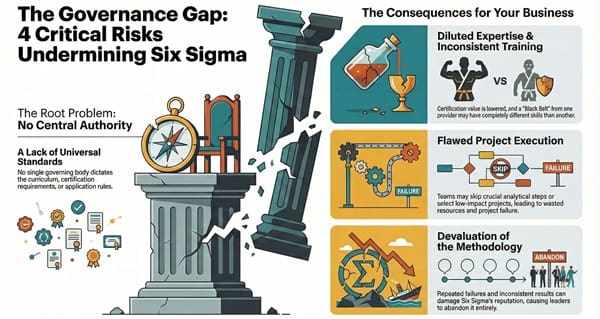
Six Sigma training provides the fundamental knowledge for anyone performing process improvement work. The success of any Six Sigma project depends on the Black Belt, Green Belt, or Yellow Belt having the correct skills.
Non-standardized Six Sigma training is a significant problem today. Various providers offer their own versions of the curriculum. This means the content, duration, and even the skills taught can differ widely from one training center to another.
Why Does Non-Standardized Six Sigma Training Occur?
In simple words, because no single, official group dictates the curriculum. This gives every training provider the freedom to design its own course outline.
- Some providers focus heavily on statistical analysis and the DMAIC steps.
- Others might spend more time on soft skills or change management tools.
- A few others simply provide a basic overview without practical application or a required project.
This variation implies that a Six Sigma Black Belt from one institute may possess completely different knowledge and skills than a Black Belt from another.
How Non-Standardized Six Sigma Training Harms Your Business
This lack of consistency creates a gap between what the certificate promises and what the holder can actually deliver. When you hire someone with a Six Sigma certification, you expect a specific, high-level skill set.
If their Six Sigma training was weak or incomplete, they cannot effectively lead or contribute to your improvement projects. This leads to project delays, rework, and ultimately, failed initiatives.
Non-standardized Six Sigma training reduces the Return on Investment (ROI) for both the individual and the hiring company.
Also Read: Common Barriers and Risks to a Successful Six Sigma Change Project
2. Risk of Six Sigma Certification Dilution
Six Sigma certification dilution is another major challenge. Certification should signify that an individual has mastered a specific body of knowledge and demonstrated the ability to apply it. The absence of a central Six Sigma governing body destroys this assurance.
What Is Six Sigma Certification Dilution?
Six Sigma certification dilution is nothing but the lowering of the perceived value and trustworthiness of a Six Sigma belt level. Certifications become diluted when they are given out too easily or without proper testing and project completion requirements.
For example, you see advertisements promising a Black Belt certification in a matter of days. This is a clear sign of dilution. An actual Six Sigma Black Belt needs months of rigorous training and a successfully completed, high-impact project.
When a Six Sigma Black Belt is awarded without meeting tough, universal standards, the entire credential loses credibility.
Six Sigma Certification Dilution and Hiring Decisions
This dilution makes hiring decisions extremely difficult for you. When a candidate presents a Six Sigma Black Belt certificate, you cannot rely on it alone. You are then forced to implement your own rigorous screening process to check their real-world skills.
Six Sigma certification dilution increases the time and cost associated with recruiting. It also poses a direct Six Sigma risk to project quality, as inexperienced individuals may be placed in critical leadership roles.
3. Risk of Inconsistent Six Sigma Application
The core of Six Sigma is the DMAIC (Define, Measure, Analyze, Improve, Control) methodology. This is a structured, five-step approach to problem-solving and process improvement.
The lack of a single Six Sigma governing body allows for an inconsistent Six Sigma application of these fundamental principles. Organizations can create their own interpretations, often skipping crucial steps to save time or resources.
How Does Inconsistent Six Sigma Application Happen?
Inconsistent Six Sigma application often results when organizations cherry-pick the parts of the methodology they like.
- For example: An organization may focus only on the ‘Define’ and ‘Improve’ steps. They might skip the rigorous ‘Measure’ and ‘Analyze’ phases that prove the root cause of the problem.
- Another issue is the variable use of tools. One team might use a full Design of Experiments (DOE), while another might settle for a simple cause-and-effect diagram for the same type of problem.
The systematic breakdown of the DMAIC process is key to success. Inconsistent Six Sigma application essentially ignores the structured, data-driven nature of the methodology.
The Result of Inconsistent Six Sigma Application
When different teams or departments within the same company follow different standards for their projects, the results are uneven. This makes it impossible to compare project outcomes or share best practices effectively.
Inconsistent Six Sigma application prevents the entire organization from speaking a common language of process improvement. It significantly hinders the creation of a strong, organization-wide culture of operational excellence.
4. Risk of Poor Project Selection and Failure
A successful Six Sigma initiative depends heavily on selecting the right projects. A central governing body would provide standardized criteria for project selection, ensuring maximum impact. Without this guidance, companies often choose the wrong projects.
What is Poor Six Sigma Project Selection?
Poor Six Sigma project selection happens when projects are chosen based on urgency, personal preference, or low-hanging fruit, instead of clear business impact and data. A good Six Sigma project must meet three key criteria:
- It is directly linked to a business goal (e.g., cost reduction, customer satisfaction).
- The scope is manageable within a few months.
- The problem is measurable using data.
When these factors are ignored, poor Six Sigma project selection leads to:
- Scope creep: The project becomes too large and unmanageable.
- Low Impact: The project successfully solves a minor problem, but provides little value to the company.
- Lack of Data: The team cannot prove the root cause or the improvement, leading to failure.
Six Sigma Faces Risk of Poor Project Selection
A Six Sigma governing body would promote standardized project charters and approval processes. Without this, organizations often waste valuable resources on projects that are either too ambitious, too small, or simply the wrong focus.
The result is project failure, which directly impacts leadership buy-in and resource commitment for future Six Sigma initiatives.
Also Read: Manufacturing Compliance
5. Risk of Six Sigma’s Overall Devaluation
The most significant long-term Six Sigma risk is the overall devaluation of the methodology. This happens when the cumulative effect of the other four risks damages the reputation of Six Sigma.
How Does Six Sigma Devaluation Occur?
Six Sigma devaluation occurs gradually as more organizations experience failed projects and inconsistent results. If a company invests heavily in a program and sees little return, they naturally start to question the methodology itself.
- Problem: The problem is not with the DMAIC methodology; the problem lies with its poor application due to a lack of standards.
- Perception: The company perceives Six Sigma as a fad or a flawed process.
When people see easy, non-rigorous certifications being sold, they may think the entire methodology is simple or lacks depth. This makes it harder for true practitioners to gain respect and drive important change.
Why is Six Sigma Devaluation a Critical Risk?
If Six Sigma is devalued, companies stop using it. They may switch to other improvement methodologies, or worse, abandon the idea of structured process improvement entirely. This directly undermines the goal of operational excellence.
A central Six Sigma governing body could effectively mitigate this by:
- Enforcing consistent, high-quality training.
- Providing universal certification standards.
- Promoting proven best practices for project execution.
Also Read: Project Management Communication Plan
Frequently Asked Questions About Six Sigma Risks
What is the biggest challenge to the Six Sigma methodology?
The biggest challenge to the Six Sigma methodology is the lack of a single, global Six Sigma governing body. This absence creates non-standardized training, certification dilution, and inconsistent application, which collectively erode the methodology’s credibility and value.
Why do some Six Sigma projects fail?
Six Sigma projects fail for several reasons. These include poor project selection (choosing projects with low impact or unmeasurable problems), inconsistent Six Sigma application (skipping the ‘Measure’ or ‘Analyze’ steps), and a lack of leadership support. Poorly trained Green or Black Belts due to non-standardized training also contribute to failure.
What does “Six Sigma certification dilution” mean?
Six Sigma certification dilution means that the value and recognition of a Six Sigma belt (like Green Belt or Black Belt) are reduced. This happens when certifications are awarded too easily or without a requirement for rigorous training, testing, and successful project completion.
What is the primary role of a Six Sigma Black Belt?
The primary role of a Six Sigma Black Belt is to lead large, complex, and high-impact process improvement projects using the DMAIC methodology. They also train and mentor Green Belts, and work with leadership to ensure projects align with business strategy.
Is Six Sigma still relevant today?
Yes, Six Sigma is still relevant today. Its core principles of using data to reduce variation and eliminate defects are essential for any organization seeking to improve efficiency, reduce costs, and enhance customer satisfaction. However, its effectiveness relies on strict, standardized implementation.
Key Takeaways on Six Sigma Risks
- Risk 1: Non-Standardized Training means a Six Sigma Black Belt from one provider may not have the same skills as one from another. This makes hiring and skill transfer difficult.
- Risk 2: Certification Dilution lowers the credibility of belts, forcing companies to re-verify skills and increasing hiring costs.
- Risk 3: Inconsistent Application leads to uneven project results and prevents the company from building a unified culture of process improvement.
- Risk 4: Poor Project Selection causes a waste of resources on projects that do not provide maximum business impact, leading to failure.
- Risk 5: Overall Devaluation is the long-term threat. If Six Sigma constantly produces mixed results, organizations will stop using the powerful methodology.
All these biggest risks Six Sigma faces are preventable. They require a commitment to internal standardization within your organization.
Final Words
You now understand the critical Six Sigma risks that can derail your improvement efforts. Do not let the lack of a global Six Sigma governing body become an excuse for failure.
Your business deserves the consistent, high-impact results that only a properly implemented Six Sigma program can deliver. We offer standardized training and consulting services that enforce the strict, high-quality standards the methodology requires. We ensure your team receives the authentic, rigorous training necessary to succeed.
Contact us today to schedule a consultation and take the necessary steps to secure your Six Sigma investment and achieve true operational excellence.

About Six Sigma Development Solutions, Inc.
Six Sigma Development Solutions, Inc. offers onsite, public, and virtual Lean Six Sigma certification training. We are an Accredited Training Organization by the IASSC (International Association of Six Sigma Certification). We offer Lean Six Sigma Green Belt, Black Belt, and Yellow Belt, as well as LEAN certifications.
Book a Call and Let us know how we can help meet your training needs.