
Have you ever felt like you’re running a race on a treadmill? You’re moving fast, sweating buckets, but staying in the exact same spot. Most of us pack our schedules until they’re bursting, yet we still feel like we haven’t actually done anything. We live in a world that glorifies “busy,” but being busy is often just a mask for waste.
What if I told you that the same logic used to build world-class cars could help you reclaim your Saturday mornings? It sounds a bit clinical, I know. But here’s the thing: Lean thinking isn’t just for factory floors or corporate boardrooms. It’s a mindset. In my experience, applying these principles to your daily routine is the quickest way to stop “doing” and start “achieving.”
So, why not put more lean into your life? Why keep dragging around the extra baggage of inefficient habits? Let’s talk about how to trim the fat from your day-to-day existence without losing the “meat” that actually makes life worth living.
Table of contents
Understanding Lean in a Personal Context
Lean is a methodology focused on creating more value with fewer resources. It originated from the Toyota Production System, where the goal was to eliminate anything that didn’t add value to the final product. But when we talk about your life, the “product” is your happiness, your time, and your goals.
Why not put more lean into your life to find out what actually matters to you? To be honest, most of us spend about 40% of our time on “non-value-added” activities. That’s nearly half your life spent on things that don’t make you richer, happier, or healthier.
When you start putting lean into your life, you begin to look at your actions through a different lens. You stop asking “How can I do more?” and start asking “What can I stop doing?” It’s a radical shift. Instead of adding more tools to your belt, you’re sharpening the ones you already have and tossing the ones that are rusted shut.

Public, Onsite, Virtual, and Online Six Sigma Certification Training!
- We are accredited by the IASSC.
- Live Public Training at 52 Sites.
- Live Virtual Training.
- Onsite Training (at your organization).
- Interactive Online (self-paced) training,
The Eight Wastes Hiding in Your Routine
In the world of Lean Six Sigma, experts talk about “Muda,” which is the Japanese word for waste. Traditionally, there are eight types of waste. You might think these only apply to making widgets, but they’re surprisingly relevant to your kitchen, your commute, and your inbox.
Why not put more lean into your life by identifying these eight wastes?
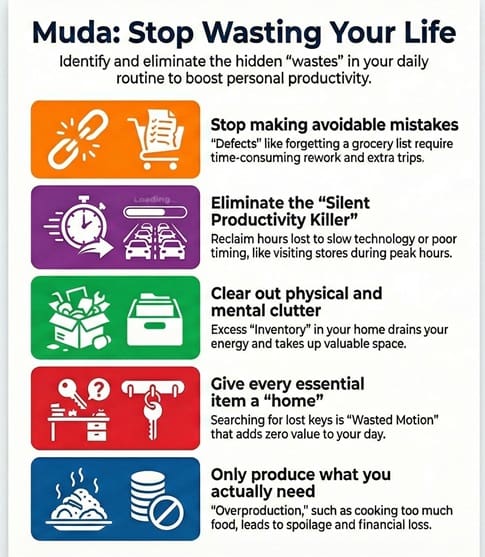
- Defects: Think of these as mistakes that require rework. Did you forget your grocery list and have to drive back to the store? That’s a defect.
- Overproduction: Making more than you need. Do you cook enough food for an army when it’s just you and a roommate? That leads to spoilage and wasted money.
- Waiting: This is the silent killer of productivity. Waiting for a slow computer, waiting in line because you went at peak hours, or waiting for a friend who’s always late.
- Non-Utilized Talent: Are you spending your time on data entry when you’re actually a brilliant strategist? This waste happens when you don’t use your best skills.
- Transportation: Moving things unnecessarily. If your printer is in the basement but your office is on the second floor, you’re wasting movement.
- Inventory: Having too much “stuff.” A cluttered closet is just inventory that takes up mental and physical space.
- Motion: Any movement that doesn’t add value. Searching for your keys every morning because they don’t have a “home” is wasted motion.
- Extra-Processing: Doing more work than is required. Do you spend three hours formatting a spreadsheet that your boss only looks at for thirty seconds?
Applying the Five Lean Principles to Your Day
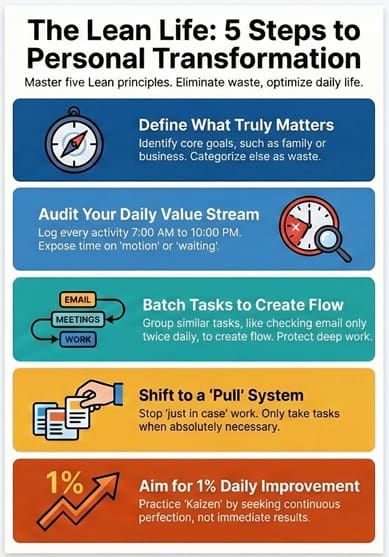
If you want to effectively put more lean into your life, you need a framework. The Five Principles of Lean provide a roadmap for this transformation.
1. Define Value
What do you actually value? Is it time with your kids? Is it building a side business? If an activity doesn’t contribute to these things, it’s waste.
2. Map the Value Stream
Look at your day. Literally write down everything you do from 7:00 AM to 10:00 PM. This is your “Value Stream.” You’ll likely be shocked at how much time is spent in the “waiting” or “motion” categories.
3. Create Flow
Once you remove the junk, you want your day to flow. This means grouping similar tasks together. Don’t check email every ten minutes; check it twice a day. This creates a “flow” of deep work.
4. Establish Pull
In manufacturing, “pull” means you only make something when a customer asks for it. In your life, don’t take on a task until it’s actually necessary. Why not put more lean into your life by stopping the “just in case” work that usually ends up in the trash?
5. Seek Perfection
This is about “Kaizen,” or continuous improvement. You won’t get it right on day one. The goal is to be 1% better every day.
Also Read: Pursue an Exciting Career in Lean Six Sigma
Practical Ways to Put More Lean Into Your Life
Why not put more lean into your life by starting with your physical environment? I used to have a desk covered in “to-do” piles. Every time I looked at them, my brain felt like it had fifty tabs open. That’s “Inventory” waste.
Here are some real-world ways to apply lean principles tomorrow:
- The 5S Method: Sort, Set in order, Shine, Standardize, and Sustain. Start with your junk drawer. Toss what you don’t use, give everything else a specific spot, and keep it clean.
- Batching Tasks: Instead of doing laundry every day, do it once a week. This reduces the “set-up time” of sorting, washing, and folding.
- Standardized Work: Create a morning routine that is so automatic you don’t have to think. Thinking takes energy. Save that energy for the hard stuff.
Why Not Put More Lean Into Your Life for Better Mental Health?
Why not put more lean into your life to reduce stress? There is a massive correlation between a cluttered environment and a cluttered mind. When you have too many “open loops”—tasks you’ve started but haven’t finished—your brain stays in a state of low-level anxiety.
In my experience, “Lean Living” is the ultimate antidote to burnout. Burnout usually doesn’t come from working too hard; it comes from working hard on things that don’t matter. When you eliminate the “Muda” from your schedule, you leave room for “Mahi”—meaningful work.
Does your current schedule allow you to breathe, or are you constantly gasping for air between meetings? By putting lean into your life, you create “slack.” Slack is the space where creativity happens. You can’t have a breakthrough idea if your brain is 100% occupied with remembering to buy milk and responding to Slack notifications.
Also Read: Online Lean Six Sigma Green Belt Certification
Common Obstacles to Lean Living
Why not put more lean into your life despite the hurdles? It isn’t always easy. You’ll run into a few common roadblocks:
- The “Sunk Cost” Fallacy: You keep doing something because you’ve always done it. “But I’ve been in this club for five years!” If it doesn’t add value now, it’s waste.
- Fear of Idle Time: We are conditioned to think that if we aren’t working, we’re failing. Lean creates free time. Use it for rest, which is a high-value activity.
- Over-complicating the Process: You don’t need a complex software system to be lean. A piece of paper and a pen are usually enough to map your value stream.
Have you ever noticed how the most successful people seem the least stressed? It’s because they’ve mastered the art of saying “no” to the non-essential. They are lean by default.
Key Takeaways
- Lean thinking helps you reclaim your time by focusing on value and eliminating waste in your life.
- Identify the eight wastes—defects, overproduction, waiting, non-utilized talent, transportation, inventory, motion, and extra-processing—to streamline your daily routine.
- Apply the five lean principles: define value, map the value stream, create flow, establish pull, and seek perfection for effective changes.
- Utilize practical methods like the 5S Method, batching tasks, and standardized work to implement lean principles in your life.
- Overcome obstacles like the sunk cost fallacy and fear of idle time to adopt lean living and enhance your mental health.
Final Words
Why not put more lean into your life starting today? We’ve talked about the wastes, the principles, and the practical steps to reclaim your time. Lean isn’t about being a robot; it’s about being more human by removing the mechanical, wasteful parts of our existence.

About Six Sigma Development Solutions, Inc.
Six Sigma Development Solutions, Inc. offers onsite, public, and virtual Lean Six Sigma certification training. We are an Accredited Training Organization by the IASSC (International Association of Six Sigma Certification). We offer Lean Six Sigma Green Belt, Black Belt, and Yellow Belt, as well as LEAN certifications.
Book a Call and Let us know how we can help meet your training needs.