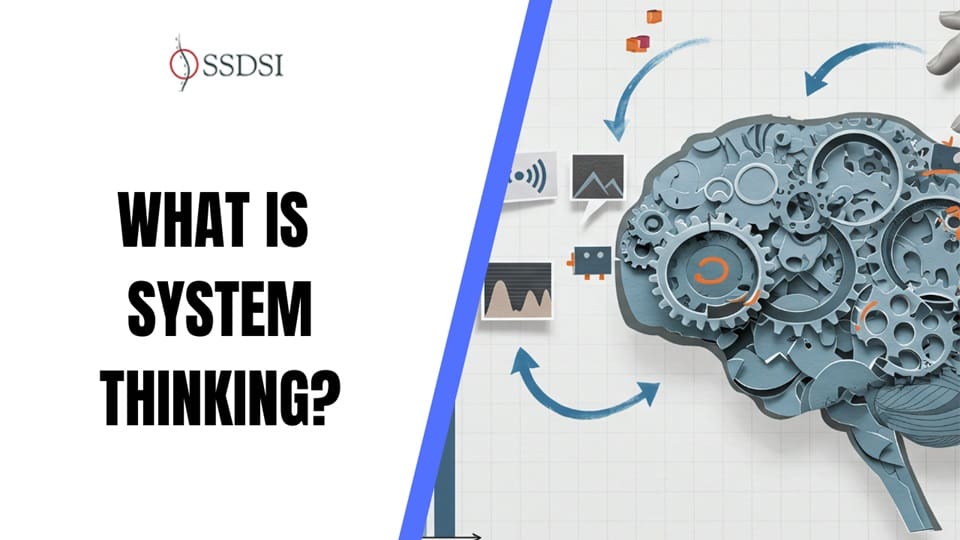
Systems Thinking is an approach to understanding how things influence one another within a whole. Instead of looking at individual, isolated pieces, Systems Thinking looks at the bigger picture and the relationships between the parts.
In this section, we will define Systems Thinking, explore its core concepts, and see why it is such a powerful lens for problem-solving in business, environment, and social issues.
Table of contents
What is Systems Thinking?
Systems Thinking is defined as a discipline for seeing wholes. It is a framework that helps us to look beyond immediate events and simple cause-and-effect relationships to see the underlying structures and patterns that shape system behavior.
In simple words, Systems Thinking means realizing that everything is connected. When you try to fix one part of a complex problem, you often end up creating new problems elsewhere. Systems Thinking teaches us to anticipate these wider consequences.
A system refers to a group of interacting, interconnected elements that form a complex whole. These elements work together for a common purpose, or to produce a collective outcome. Think of a human body, an ecosystem, or a business organization—they are all examples of systems.
Core Components of Systems Thinking
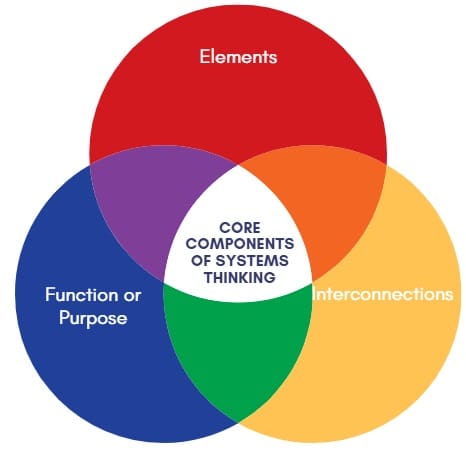
A system is not just a pile of parts. It has three essential components that work together to produce its behavior. To truly master Systems Thinking, you must understand these three parts.
1. Elements
The elements are the tangible or intangible parts that make up the system. These are the easiest components to see.
For example, if the system is a bicycle, the elements include the frame, the wheels, the gears, and the chain. If the system is a company, the elements include the employees, the buildings, the money, and the machines.
- Elements can change without changing the identity of the system. For instance, you can change a bicycle’s seat or color, but it is still a bicycle. You can hire new employees in a company, and it remains the same company.
2. Interconnections
The interconnections are the relationships and links that hold the elements together. These are what make the system a whole rather than just a collection of parts.
Interconnections define how the elements interact and influence each other. On a bicycle, the chain connects the pedals to the rear wheel. In a company, the organizational chart or the communication channels connect the employees and departments.
- Interconnections are often more important than the elements themselves. They determine the system’s behavior. A broken connection, like a slipped chain on the bike, stops the entire system from working correctly.
3. Function or Purpose
The function or purpose is the main job of the system—what it is meant to achieve. This is often the hardest component to see, as it can be implied rather than stated.
The purpose is the overall goal that the system is structured to serve. Purpose of a bicycle is to provide transportation. The purpose of a public transportation system is to move people efficiently.
- Purpose dictates the way a system will behave. The most critical insight from Systems Thinking is that the structure of the system often determines its behavior.

Public, Onsite, Virtual, and Online Six Sigma Certification Training!
- We are accredited by the IASSC.
- Live Public Training at 52 Sites.
- Live Virtual Training.
- Onsite Training (at your organization).
- Interactive Online (self-paced) training,
Why is Systems Thinking Important?
Now that we know the basic components, why should we care about Systems Thinking?
Systems Thinking is important because it shifts our focus from linear causality (A causes B) to circular causality (A influences B, which in turn influences A). This way of thinking helps us understand why problems persist even after we try to fix them.
Most of us are trained to look for single, simple causes for problems. However, the world’s most difficult and persistent problems—like climate change, poverty, or chronic debt—are not caused by a single thing. They are caused by the structure and behavior of complex systems.
- Systems Thinking helps us avoid the common mistake of “fixing the symptoms” instead of addressing the root cause. This long-term perspective is crucial for creating real, sustainable change.
The System Structure Creates the Behavior
In many cases, the way a system is built—its rules, information flows, and connections—causes its characteristic behavior.
For example, think about a city’s traffic congestion. Building a new road (a simple element fix) might ease traffic for a short time. However, the system’s structure encourages more people to drive, and soon the new road is also congested. This is a common phenomenon in Systems Thinking known as “induced demand.”
Therefore, changing the way the system is structured, such as adding incentives for public transit or high-occupancy vehicle lanes, is a far more effective long-term systems thinking solution.
Also Read: What is Lean Thinking: Principles, Benefits & More
Types of Interconnections in Systems Thinking
Interconnections are the engine of a system. When we study them in Systems Thinking, we usually look at two main types: feedback loops and stocks and flows. Understanding these concepts helps us model and predict a system’s behavior.
1. Feedback Loops
A feedback loop is a circular flow of influence. It is when an action taken on one part of the system feeds back to influence the original part. This is a cornerstone of Systems Thinking and the reason for circular causality.
There are two primary types of feedback loops:
A. Reinforcing Feedback Loops
A reinforcing feedback loop (also called a positive loop) drives change in one direction, causing a system to grow or collapse exponentially.
Reinforcing feedback loops are often responsible for fast growth or runaway effects.
- For example: The more money you have in a savings account (the stock), the more interest you earn (the flow). The interest is added to your account (the flow feeds back into the stock), so you now earn even more interest next time. This cycle causes exponential growth.
- In contrast: A reinforcing loop can also lead to collapse, such as a stampede where fear causes more people to run, which in turn causes more fear.
B. Balancing Feedback Loops
A balancing feedback loop (also called a negative loop) resists change and tries to keep the system at a desired state or goal. It aims for stability.
Balancing feedback loops are what create equilibrium or steady states in a system.
- For example: A thermostat is a perfect example of a balancing loop. When the room temperature (the stock) drops below the set temperature (the goal), the furnace turns on (the action). The furnace raises the temperature until it reaches the goal, and then it shuts off. The system is constantly adjusting to maintain the goal.
- Balancing feedback loops explain why systems are so resistant to change; they are always trying to pull themselves back to their original state.
2. Stocks and Flows
In Systems Thinking, the concepts of stocks and flows are fundamental for understanding how things accumulate and change over time.
A stock is the amount of something at any given time. It is the memory of the system—it is what has accumulated from the past.
- Examples of stocks: The amount of water in a bathtub, the number of cars on the road, the population of a country, or the money in a bank account.
A flow is the rate of change in a stock. Flows are the activities that cause the stock to increase or decrease.
- Flows have two types: Inflows (which add to the stock) and Outflows (which subtract from the stock).
- For example: For a bathtub (the stock), the faucet running is the inflow, and the drain is the outflow.
The level of a stock is determined by the difference between its inflows and outflows over time.
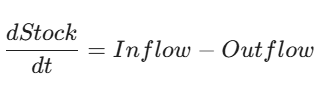
This simple concept is key to Systems Thinking because it separates the things that change (flows) from the things that accumulate (stocks). People often focus too much on flows, like monthly income, and forget about the stock, like total savings.
Other Key Concepts in Systems Thinking
To fully engage with the discipline, we must explore a few more concepts that give Systems Thinking its power.
Delays
Delays are a critical aspect of Systems Thinking. A delay is the time it takes for a flow to affect a stock, or for a change in one part of the system to be felt elsewhere.
- Delays can make a system difficult to manage because when we take action, we do not see the full result right away. This often leads to over-correction.
- For example: If a central bank lowers interest rates to fight a recession, it may take six to eighteen months for that change to fully impact the economy. If the bank waits too long for the effect to be felt, it might keep lowering rates too much, causing inflation later.
Boundaries
The boundary of a system determines what is included in our analysis and what is considered outside.
- In Systems Thinking, setting the boundary is a crucial, subjective decision. If the system is a factory, do you include the local community and the environment in your boundary, or just the machines and employees? The choice impacts the solution.
Leverage Points
A leverage point is a place in a system where a small shift can lead to a large change in the entire system’s behavior.
- Systems thinkers aim to find these leverage points because they offer the most effective, lasting solutions. They are rarely found in the elements; they are almost always found in the feedback loops, the purpose, or the rules of the system.
Final Words
Systems Thinking is not just an academic idea; it is a practical skill for solving real-world problems. It helps you see beyond surface-level events to the deep structures that drive behavior. By understanding elements, interconnections, stocks, flows, and feedback loops, you gain the power to not just react to problems, but to design better systems from the start.
This approach aligns with our core belief: that deep understanding is the foundation of effective action. We are committed to providing you with the tools to master complex concepts like Systems Thinking and use them to create lasting, positive change.
Also Read: Critical Thinking
Key Takeaways
- Systems Thinking is an approach that explores the relationships and interconnections in a system, focusing on the bigger picture rather than isolated parts.
- It comprises three key components: elements, interconnections, and purpose, with each affecting the system’s behavior.
- Understanding feedback loops and stocks and flows helps clarify how systems change over time and how elements influence each other.
- This methodology shifts our perspective towards circular causality, helping to identify root causes of complex problems rather than just symptoms.
- By mastering Systems Thinking, individuals can design better solutions and foster sustainable change in various contexts.
FAQs on Systems Thinking
1. What is Systems Thinking in a simple way?
Systems Thinking is a way of looking at a problem by seeing the big picture instead of just the small, isolated parts. It recognizes that everything is connected and that actions in one place can cause unexpected results somewhere else. You look for the circular relationships, not just the straight line of cause and effect.
2. What is a “system” in this context?
A system is a group of things—like people, parts, or ideas—that are interconnected and work together to produce a specific pattern of behavior over time. Think of it like an ice cube floating in a glass of water, which is part of the system of a cooling drink.
3. Why should I use Systems Thinking?
You should use it to find lasting solutions to tough problems. Standard thinking often only fixes the symptoms (what you see on the surface), but Systems Thinking helps you find the root cause in the structure of the system.
4. What are the key ideas in Systems Thinking?
The main key ideas are:
- Interconnections: How the parts influence each other.
- Feedback Loops: The circular flow where an action feeds back to change the original situation (like a thermostat turning a heater on and off).
- Emergence: The new, collective behavior that the whole system produces, which none of the individual parts could do alone.
5. What is the hardest thing about adopting this type of thinking?
The hardest thing is that our brains naturally prefer linear thinking (A causes B). Systems Thinking requires you to think in circles and patterns, which is often called circular causality. It forces you to look at things like time delays and unintended consequences, which are usually invisible in a fast-paced world.

About Six Sigma Development Solutions, Inc.
Six Sigma Development Solutions, Inc. offers onsite, public, and virtual Lean Six Sigma certification training. We are an Accredited Training Organization by the IASSC (International Association of Six Sigma Certification). We offer Lean Six Sigma Green Belt, Black Belt, and Yellow Belt, as well as LEAN certifications.
Book a Call and Let us know how we can help meet your training needs.