
Six Sigma to prevent insurance fraud is a game-changer for an industry that loses billions every year to dishonest claims. Picture this: a claims adjuster sits at their desk, staring at a stack of paperwork that looks perfectly normal. But hidden in those pages are tiny patterns—red flags—that the human eye usually misses. That’s where the magic of data-driven methodology comes in.
To be honest, most insurance companies accept a certain level of “leakage” as a cost of doing business. But why should they? When we look at the numbers, fraud isn’t just a minor nuisance; it’s a systemic drain on resources. By applying a structured framework like Lean Six Sigma, or LSS, we can move from reactive guessing to proactive prevention.
In my experience, the secret isn’t just about catching the “bad guys” after the money is gone. It’s about tightening the process so the fraud never happens in the first place. Are you ready to see how these manufacturing principles are flipping the script on insurance scammers? Let’s jump in.
Table of contents
Why Use Six Sigma to Prevent Insurance Fraud?
The core goal of Six Sigma to prevent insurance fraud is to reduce variance. In the world of claims, “variance” often looks like suspicious delays, inconsistent data, or flat-out lies. When a process is “in control,” it behaves predictably. Fraud, by its very nature, is an outlier.
We’ve all been there—waiting weeks for a claim to process because the system is clogged with manual checks. LSS helps by streamlining the workflow. It removes the “muda” (waste) and focuses on “critical to quality” (CTQ) factors. For an insurance firm, the most important CTQ is an accurate, honest claim payout.
Have you ever wondered why some companies catch fraud faster than others? It usually comes down to their ability to measure their errors. If you can’t measure it, you can’t fix it. Six Sigma provides the ruler.

Public, Onsite, Virtual, and Online Six Sigma Certification Training!
- We are accredited by the IASSC.
- Live Public Training at 52 Sites.
- Live Virtual Training.
- Onsite Training (at your organization).
- Interactive Online (self-paced) training,
The DMAIC Roadmap for Fraud Detection
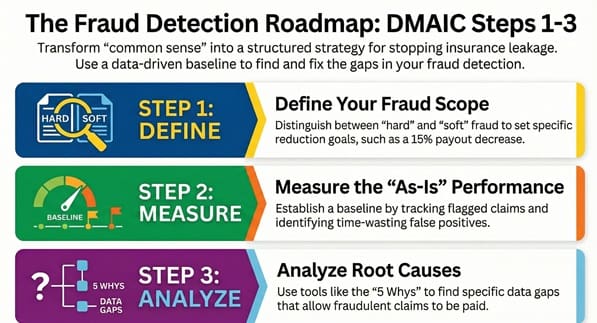
When we talk about Six Sigma to prevent insurance fraud, we have to talk about DMAIC. It stands for Define, Measure, Analyze, Improve, and Control. It sounds technical, but it’s actually a very common-sense way to solve a problem.
Define the Scope of Leakage
First, we define what fraud looks like in your specific niche. Is it “hard fraud” where someone stages an accident? Or “soft fraud” where a person just inflates the value of a stolen laptop? We need to set clear goals. For instance, a company might aim to reduce fraudulent payouts by 15% within six months.
Measure the Current Performance
Next, we gather the data. We look at the “as-is” state. How many claims are flagged now? How many of those flags are false positives? To be fair, false positives are a huge waste of time for adjusters. We need a baseline to know if our future changes actually work.
Analyze the Root Causes
Here is where the real detective work begins. We use tools like the “5 Whys” or Fishbone Diagrams. Why did this fraudulent claim get paid? Because the automated system didn’t check the address. Why? Because the data field was optional. By digging deep, we find the gaps in the armor.
Statistical Tools for Identifying Red Flags
You don’t need to be a math genius to use Six Sigma to prevent insurance fraud, but you do need to trust the data. We use Pareto Charts to find the “vital few.” Usually, 80% of fraud comes from 20% of claim types or regions.
Regression analysis is another powerful tool. It helps us see the relationship between different variables. For example, does the time of day a claim is filed correlate with its likelihood of being fake? Often, the answer is yes.
I once saw a case where a team used control charts to monitor the average payout amount. When a specific branch started showing “out of control” spikes, they investigated. It turned out to be an internal fraud ring. Without those charts, it might have gone unnoticed for years.
Lean Principles: Speeding Up Honest Claims
While Six Sigma to prevent insurance fraud focuses on accuracy, “Lean” focuses on speed. We want to fast-track honest customers while putting the brakes on suspicious ones. This is called “segmentation.”
By removing unnecessary steps in the approval process for low-risk claims, we free up our best investigators. They can then spend their time on the high-risk files. It’s about working smarter, not harder. Does it make sense to put a $200 glass claim through the same scrutiny as a $50,000 medical bill? Probably not.
Also Read: Pursue an Exciting Career in Lean Six Sigma
Improving the Claims Process
Once we know where the holes are, we plug them. This might mean adding a new validation step in the mobile app. Or, it could involve training adjusters on “behavioral red flags.”
In the “Improve” phase of Six Sigma to prevent insurance fraud, we test our solutions. We don’t just roll them out globally. We try them in one department, check the results, and then scale up. This minimizes the risk of breaking a process that is already working.
The Importance of the Control Phase
The biggest mistake companies make is fixing a problem and then walking away. The “Control” in Six Sigma to prevent insurance fraud ensures the gains stick. We create dashboards that monitor fraud metrics in real-time.
If the fraud rate starts to creep back up, the system triggers an alert. We call this “Poka-Yoke” or mistake-proofing. We want to make it physically or digitally impossible to process a claim if certain security criteria aren’t met.
Real-World Impact: A Case Study Perspective
Picture this: A large auto insurer was struggling with “staged accidents.” They implemented a Six Sigma project to tackle the issue. By analyzing historical data, they found that 60% of these accidents happened within 30 days of the policy being issued.
They updated their “Define” phase to focus on new policies. They then “Improved” the process by adding a mandatory photo-inspection for any vehicle insured with a high-deductible plan. The result? A 22% drop in suspicious claims in the first year. That is the power of a structured approach.
Overcoming Resistance to Change
Implementing Six Sigma to prevent insurance fraud isn’t always easy. People are often set in their ways. “We’ve always done it this way,” is a phrase I hear a lot.
To be successful, you need buy-in from the top. But you also need the front-line workers to understand that these tools make their jobs easier, not harder. When an adjuster has better data, they feel more confident in their decisions. It reduces the stress of “getting it wrong.”
AI and Six Sigma: The Future Duo
Now, let’s look at where we’re headed. Combining Six Sigma to prevent insurance fraud with Artificial Intelligence (AI) is the next frontier. While Six Sigma provides the framework, AI provides the “brain” to process massive datasets in milliseconds.
Predictive modeling can now flag a claim the moment it’s submitted. However, we still need the Six Sigma mindset to ensure the AI’s “logic” is aligned with business goals. Without a solid process, even the best AI will just produce “garbage in, garbage out.”
Also Read: Manufacturing Compliance
Common Pitfalls to Avoid
Even with 10 years of experience, I see teams trip up. The most common error is “analysis paralysis.” They spend so much time measuring that they never get to the “Improve” phase.
Another issue is keyword-based tunnel vision. Don’t just look for what you expect to find. Use the data to tell you where the problems are. Sometimes the biggest fraud leaks are in areas you thought were totally safe.
Key Takeaways
- Six Sigma to prevent insurance fraud uses the DMAIC cycle to find and fix process gaps.
- Data-driven decisions reduce “leakage” and save companies millions.
- The methodology focuses on reducing variance and eliminating outliers (fraud).
- Lean principles help fast-track honest claims, improving customer satisfaction.
- Control plans are vital to ensure that fraud stays at low levels long-term.
- Combining human expertise with statistical tools creates a “culture of quality.”
Frequently Asked Questions
What is the main benefit of Six Sigma in insurance?
It provides a structured way to identify and eliminate the root causes of errors and fraud, leading to higher profits and better customer service.
How long does a typical Six Sigma fraud project take?
Most projects run between 3 to 6 months, depending on the complexity of the data and the size of the department.
Do I need expensive software to start?
Not necessarily. While specialized tools help, you can do a lot of basic Six Sigma analysis with standard spreadsheet software.
Is Six Sigma only for large insurance companies?
No. Smaller firms can use these principles to tighten their claims processes and compete more effectively.
How does Six Sigma differ from traditional fraud detection
Traditional methods are often reactive (catching fraud after it happens). Six Sigma is proactive, aiming to change the process so fraud cannot occur.
Final Words
In summary, using Six Sigma to prevent insurance fraud is about more than just numbers; it’s about integrity. At 6Sigma.us, we believe that a well-oiled process is the best defense against dishonesty.
Our focus is always on giving you the tools to succeed and protecting your bottom line. We’ve spent years helping clients transform their operations, and we’re ready to do the same for you. Let’s build a more transparent future together.

About Six Sigma Development Solutions, Inc.
Six Sigma Development Solutions, Inc. offers onsite, public, and virtual Lean Six Sigma certification training. We are an Accredited Training Organization by the IASSC (International Association of Six Sigma Certification). We offer Lean Six Sigma Green Belt, Black Belt, and Yellow Belt, as well as LEAN certifications.
Book a Call and Let us know how we can help meet your training needs.