Have you ever walked into a hotel room only to find a stray hair in the sink or a missing towel? It’s frustrating, right? We’ve all been there. In the world of hotels and travel, we usually think of “vibe” and “decor” as the keys to success. But here is the thing: a pretty lobby can’t save a business from bad service. This is where Six Sigma in hospitality industry becomes a literal game-changer for owners and managers.
You might think Six Sigma belongs in a car factory. To be honest, I used to think the same. It sounds cold and calculated. However, at its heart, it is just a way to stop making mistakes. If a factory makes a part wrong, they melt it down. If a hotel gets an order wrong, they lose a customer forever.
Why do some hotels always seem to get it right while others struggle? Is it luck? In my view, it’s rarely luck. It is usually a disciplined system. Stick around, and we’ll look at how these data-driven tools make your staff faster and your guests much happier.
Table of contents
What is Six Sigma in Hospitality?
The term Six Sigma refers to a specific statistical goal. In simple terms, it means having only 3.4 mistakes for every million chances you have. Imagine serving a million coffees and only spilling three. That sounds impossible, doesn’t Six Sigma in hospitality industry strive for that level of perfection.
In our world, a “defect” isn’t a broken machine part. It’s a long check-in line. It’s a cold meal or it’s a noisy hallway at 2 AM. When we apply this logic to hotels, we aren’t just looking at numbers; we are looking at the “guest journey.”
We use this method to find out where things go wrong and why. Instead of guessing that “the front desk is slow,” we measure exactly how many minutes a guest waits. Then, we fix the root cause. It turns a “gut feeling” into a proven plan.

Public, Onsite, Virtual, and Online Six Sigma Certification Training!
- We are accredited by the IASSC.
- Live Public Training at 52 Sites.
- Live Virtual Training.
- Onsite Training (at your organization).
- Interactive Online (self-paced) training,
The DMAIC Process: Implementing Six Sigma in Hospitality
To make Six Sigma in hospitality industry work, we use a tool called DMAIC. Think of it as a roadmap for fixing any problem in your hotel. Let’s break it down into bite-sized pieces.
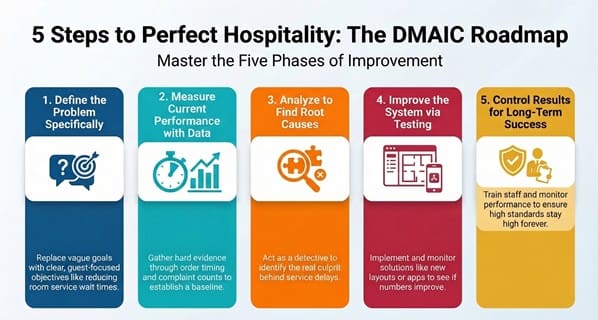
1. Define the Problem
First, you must pick a specific issue. Don’t just say, “we want to be better.” That is too vague. Instead, say, “it takes too long to get room service to the guest.” You define who the guest is and what they expect. Have you ever noticed how “fast” means different things to different people? We define the goal clearly here.
2. Measure Current Performance
Now, we gather the data. We don’t guess. We time the orders and we count the complaints. This gives us a baseline. It shows us exactly where we are standing today.
3. Analyze the Root Cause
This is the “detective” phase. Why is the food slow? Is the elevator broken? Is the kitchen staff too small? We use tools like the “Fishbone Diagram” to find the real culprit. Often, the problem isn’t what you think it is.
4. Improve the System
Once we know the cause, we test solutions. Maybe we change the kitchen layout. Or perhaps we use a new app for orders. We try it out and see if the numbers get better.
5. Control the Results
Finally, we make sure the problem doesn’t come back. We train the staff and keep an eye on the times. This ensures the high standard stays high forever.
Also Read: Lean Six Sigma in Las Vegas Casinos
Why Should Your Hotel Care?
You might wonder, “Is all this math worth it?” In short, yes. Here is why Six Sigma in hospitality industry matters for your bottom line.
- Cost Savings: Every mistake costs money. Refunding a room or comping a meal eats your profit. By reducing errors, you keep more of your hard-earned cash.
- Faster Service: When processes are smooth, things happen quickly. Guests love speed.
- Employee Happiness: Believe it or not, staff hate chaos. A clear system makes their jobs easier and less stressful.
- Guest Loyalty: A flawless stay turns a one-time visitor into a lifelong fan.
Real-Life Example: The Check-In Nightmare
Picture this: A large resort noticed their guests were grumpy upon arrival. The reason? The check-in process took 15 minutes. Using Six Sigma in hospitality industry, the team studied the flow.
They found that the front desk clerks spent 5 minutes just looking for physical keys. By switching to digital keys and a pre-arrival app, they cut the time down to 3 minutes. The guests were happier, and the staff felt less overwhelmed. It’s a win-win, right?
Common Hurdles in the Hospitality Sector
It isn’t all sunshine and rainbows. Implementing a system like this is hard work. To be honest, the biggest hurdle is usually “culture.”
Hotel staff are used to being “people persons.” They might feel that data is cold or boring. You have to show them that data helps them serve people better. Another issue is time. We’ve all been there—trying to fix a ship while it’s already sailing. It takes patience to stop and measure things when the lobby is full.
Also Read: How do you decide whether to use Six Sigma or Lean for a Process Improvement Project?
Key Takeaways for Six Sigma in Hospitality
- Data over Guessing: Stop making decisions based on “vibes.” Use numbers to see where the real leaks are.
- Small Wins Matter: You don’t have to fix the whole hotel at once. Start with one area, like the laundry or the bar.
- Focus on the Guest: Always ask, “Does this change make the guest’s life better?”
- Consistency is Queen: Use the “Control” phase of DMAIC to make sure your improvements stick.
Frequently Asked Questions for Six Sigma in Hospitality
Does Six Sigma work for small boutique hotels?
Yes! While big chains like Marriott use it, small hotels can too. You just need to focus on your most common guest complaints.
Is Lean the same as Six Sigma?
They are cousins. Lean focuses on removing waste (like extra steps), while Six Sigma focuses on removing errors. Most hotels use a mix called Lean Six Sigma.
How long does it take to see results?
You can often see “low-hanging fruit” improvements in a few weeks. However, a full culture shift usually takes six months to a year.
Final Words
Six Sigma in hospitality industry is the bridge between a good hotel and a great one. It is about respecting your guest’s time and your own resources.
We believe that every traveler deserves a seamless experience. Our company is dedicated to helping you reach that gold standard. We don’t just provide tools; we provide a path to excellence. Your guests deserve the best, and we are here to help you deliver it.

About Six Sigma Development Solutions, Inc.
Six Sigma Development Solutions, Inc. offers onsite, public, and virtual Lean Six Sigma certification training. We are an Accredited Training Organization by the IASSC (International Association of Six Sigma Certification). We offer Lean Six Sigma Green Belt, Black Belt, and Yellow Belt, as well as LEAN certifications.
Book a Call and Let us know how we can help meet your training needs.