
Have you ever started a big task only to realize halfway through that you’re out of money or time? Project forecasting is the tool that stops this from happening by helping you see the future of your work. It isn’t just about guessing what might happen tomorrow; it’s about using current data to make smart choices today.
To be honest, we’ve all been there where a deadline sneaks up on us. But with a solid forecast, you can spot those hurdles before you trip over them.
In my experience, teams that skip this step often face “scope creep” or budget “surprises.” Why do some projects finish smoothly while others fail? The answer usually lies in how well the leaders predict their needs. We’re going to look at how you can use these predictions to win.
Table of contents
What is Project Forecasting and Why Does It Matter?
At its core, project forecasting refers to the process of estimating a project’s future performance based on current information. It’s like checking the weather before a long hike. If you see clouds gathering, you pack a jacket. In business, if the data shows you’re spending too fast, you adjust your plan.
Here’s the thing: a forecast isn’t a static document. It’s a living part of your project management strategy. It helps you answer three big questions:
- How much will this actually cost?
- When will we really finish?
- Do we have enough people to do the work?
By using a PF (Project Forecast), managers can move from being reactive to being proactive. Instead of putting out fires, you prevent them.
The Core Pillars of a Project Forecast
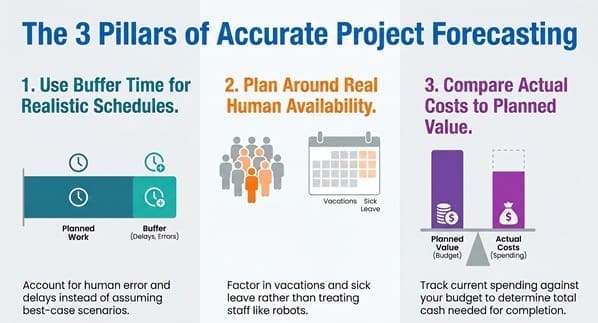
To get a forecast right, you need to look at several moving parts. It isn’t just about the money in the bank. You have to consider everything that touches the project.
1. Time and Schedule
How long will each task take? Most people are too optimistic. They think a task takes two days when it really takes four. A good forecast uses “buffer time” to account for human error or delays.
Do you have the right experts available? If your lead designer is on vacation next month, your forecast must show that. We often forget that people aren’t robots; they need breaks, and they sometimes get sick.
3. Budget and Costs
This is the most common reason people look into project forecasting. You need to track “Actual Cost” (AC) against your “Planned Value” (PV). If these numbers don’t match, your forecast tells you how much more cash you’ll need to reach the finish line.

Public, Onsite, Virtual, and Online Six Sigma Certification Training!
- We are accredited by the IASSC.
- Live Public Training at 52 Sites.
- Live Virtual Training.
- Onsite Training (at your organization).
- Interactive Online (self-paced) training,
Popular Project Forecasting Methods You Should Know
There isn’t just one way to predict the future. Depending on your data, you might use different styles. Let’s look at the most common ones used by pros.
Qualitative Forecasting
This method relies on expert opinions rather than just hard numbers. Imagine you’re launching a brand-new product. You don’t have past data to look at. In this case, you ask experienced leaders for their “gut feeling” or use the Delphi Method (a way of reaching a consensus among experts). It’s roughly 70% intuition and 30% logic.
Quantitative Forecasting
This is for the data lovers. If you have done similar projects before, you use that old data to predict this one. For example, if building a website took 100 hours last time, it will likely take 100 hours this time. We call this “Time Series Analysis.”
Earned Value Management (EVM)
EVM is a powerhouse for project forecasting. It looks at the work you’ve actually finished and compares it to what you planned to finish. It uses a specific formula called “Estimate at Completion” (EAC).
Here’s a quick breakdown of how we calculate it:
- EAC = BAC / CPI
- BAC (Budget at Completion): Your total original budget.
- CPI (Cost Performance Index): A measure of how efficient you are with money.
If your CPI is 1.0, you are right on budget. If it’s 0.8, you’re overspending. Simple, right?
How to Create a Reliable Project Forecast
Now, let’s discuss how you can actually build one. You don’t need a PhD in math, but you do need to be organized.
Step 1: Gather Your Historical Data Look at your past projects. How long did they take? Where did they go wrong? This history is your best teacher.
Step 2: Define the Current Scope You can’t forecast what you haven’t defined. Make sure you know every single task required. If the scope is blurry, your forecast will be too.
Step 3: Choose Your Tools Are you using Excel? Or a high-tech tool like Jira or Asana? The tool matters less than the data you put into it. However, automated tools can update your project forecasting in real-time, which is a huge plus.
Step 4: Update Frequently A forecast made on day one is useless by day thirty. You must check your numbers every week. As we have already discussed, things change. Your forecast should change too.
Common Challenges in Project Forecasting
Even the best managers run into walls. Why is it so hard to be 100% accurate?
- Optimism Bias: We all want to believe we can work faster than we actually do. This is why we often underestimate time.
- Market Changes: Sometimes, the price of materials goes up overnight. Or a new law changes how you have to work.
- Data Silos: If the finance team isn’t talking to the tech team, the forecast will be wrong. Communication is the “glue” of a good PF.
To be honest, perfection is impossible. The goal is to be “less wrong” every time you update your numbers.
The Role of Software in Modern Forecasting
In the past, managers used paper and pencils. Now, we have AI-driven software. These programs can run thousands of “what-if” scenarios in seconds. Picture this: you want to know what happens if your main supplier goes out of business. A modern tool can show you the impact on your budget instantly.
That said, don’t let the software do all the thinking. You still need a human to look at the results and say, “Does this make sense?”
Key Takeaways on Project Forecasting
- Project forecasting is a continuous process, not a one-time task.
- Always use a mix of qualitative (expert) and quantitative (data) inputs.
- Track your Cost Performance Index (CPI) to see if you are burning through cash too fast.
- Be honest about risks. It’s better to predict a delay than to be surprised by one.
- Keep your team in the loop. A forecast only works if everyone follows the plan.
Frequently Asked Questions (FAQs) on Project Forecasting
What is the difference between a plan and a forecast?
A plan is what you want to happen. A forecast is what is likely to happen based on the data you have right now. Plans are goals; forecasts are reality checks.
How often should I update my project forecast?
For most projects, a weekly update is best. For very long, slow-moving projects, once a month might be enough. If things are moving fast, you might even check it daily.
Can I do project forecasting without past data?
Yes, you can use qualitative methods like expert interviews or “Analogous Estimating” (comparing your project to a different but similar one in the industry).
Final Words
Mastering project forecasting is the best way to ensure your business stays profitable and your clients stay happy. It turns the “unknown” into a manageable plan. When you know where you’re going, you can lead your team with confidence.
At our company, we believe in radical transparency and data-driven results. We don’t just guess; we calculate. We’re committed to helping our clients see around corners and reach their goals without the stress of “unseen” problems. Your success is our mission, and we have the tools to help you predict a very bright future.
About Six Sigma Development Solutions, Inc.
Six Sigma Development Solutions, Inc. offers onsite, public, and virtual Lean Six Sigma certification training. We are an Accredited Training Organization by the IASSC (International Association of Six Sigma Certification). We offer Lean Six Sigma Green Belt, Black Belt, and Yellow Belt, as well as LEAN certifications.
Book a Call and Let us know how we can help meet your training needs.


