
Process variation is a natural part of every manufacturing and design system, yet it remains one of the biggest hurdles to perfection. Have you ever wondered why two products made on the same line aren’t exactly the same? Even with the best machines, tiny differences creep in. In the world of high-tech production, these tiny gaps can lead to big failures.
To be honest, we’ve all been there—staring at a batch of parts that don’t fit quite right, even though the settings looked perfect. It’s frustrating. But here is the thing: you can’t get rid of all changes. You can only learn to manage them.
In this guide, we’ll look at how these shifts happen and what they mean for your bottom line. We won’t reveal every secret fix just yet, but by the end, you’ll see why a “good enough” approach usually isn’t.
Table of contents
What is Process Variation?
At its heart, process variation (PV) is the measurable difference between the outputs of the same process. Think about baking cookies. Even if you use the same oven and dough, one cookie might be slightly crispier than the rest. In industries like semiconductors or medicine, these “crispy edges” can ruin a whole batch.
There are two main types of changes we see:
- Common Cause: This is the “noise” in the system. It is always there. It’s roughly the sum of many small, unavoidable factors.
- Special Cause: This is a “signal.” It happens because of a specific event, like a tool breaking or a power surge.

Public, Onsite, Virtual, and Online Six Sigma Certification Training!
- We are accredited by the IASSC.
- Live Public Training at 52 Sites.
- Live Virtual Training.
- Onsite Training (at your organization).
- Interactive Online (self-paced) training,
Why Does It Matter?
If you don’t track these shifts, your product quality will drop. When a process has high PV, it becomes unpredictable. This leads to waste, higher costs, and unhappy customers. We want a process that hits the bullseye every single time, not one that scatters arrows all over the target.
The Sources of Change in Production
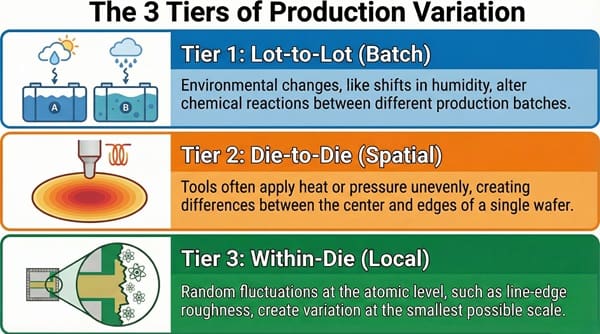
Where does all this trouble come from? In my experience, most issues boil down to a few key areas. When we look at chip making or chemical mixing, we see three layers of PV.
Lot-to-Lot and Wafer-to-Wafer
In tech manufacturing, we often see changes between different batches (lots). One week the humidity in the room is 40%, and the next it’s 50%. This small change can shift the chemical reactions.
Die-to-Die (Within-Wafer)
Even on a single wafer or tray, the center might be hotter than the edges. This causes a “spatial” change. Have you noticed how the middle of a pizza is often doughier than the crust? It’s the same idea. The tools don’t always apply pressure or heat evenly across the whole surface.
Within-Die (Local)
This is the smallest scale. It involves things like line-edge roughness. At this level, the physics of atoms starts to play a role. These are hard to control because they are often random.
Also Read: Intelligent Business Process Management (iBPM)
Random vs. Systematic Variation
We can break down process variation into two behaviors: random and systematic. Understanding the difference is the first step to fixing your yields.
The Random Side
Random changes are like static on a radio. We can’t predict exactly when they happen, but we know they will occur. We use math, specifically the Gaussian distribution, to model this. If your changes are mostly random, your process is “in control,” even if it’s not perfect.
The Systematic Side
Systematic changes follow a pattern. For example, a drill bit might wear down slowly over 1,000 uses. The holes it makes will get smaller and smaller in a predictable way.
- Can we fix it? Yes!
- How? By tracking the trend and replacing the bit before it fails.
Does your current monitoring catch these trends, or are you just reacting when things break?
Modeling the Math of Variation
To handle PV, we have to use some numbers. Don’t worry, we’ll keep it simple. We mostly look at the mean mu and the standard deviation 𝜎 (sigma).
The mean is your average. The standard deviation tells you how spread out your results are. A high 𝜎 (sigma) means your process is wild. A low
𝜎 (sigma) means it’s tight and reliable.
The Power of Six Sigma
You might have heard of Six Sigma. It’s a goal where the distance between your average and the nearest failure point is six times the standard deviation. This means only 3.4 defects per million opportunities. It sounds hard, but it’s the gold standard for a reason.
Environmental and Physical Factors
External forces love to mess with your process variation. Here are a few “hidden” culprits we see often:
- Temperature: Metal expands when hot. If your factory floor gets warm in the afternoon, your measurements will shift.
- Voltage: In electronics, a small drop in power can slow down a circuit. This is called “supply voltage variation.”
- Aging: Over time, machines lose their “tightness.” This is a slow, systematic creep that often goes unnoticed until it’s too late.
Also Read: How Six Sigma Can Measure Your Process Waste Level?
How do we fight back?
We use “Guardbanding.” This means we set our internal limits tighter than the customer’s limits. It gives us a safety net.
Managing Interconnect and Device Variation
In high-end tech, we deal with “Interconnect Variation.” This refers to the tiny wires connecting parts on a chip. If these wires are too thick or too thin, the signal slows down.
Why is this a headache?
As devices get smaller, the margin for error shrinks. What was a “tiny” change ten years ago is now a deal-breaker. We use chemical-mechanical polishing (CMP) to level things out, but even CMP has its own process variation. It’s a constant battle of leveling and measuring.
Can You Predict the Unpredictable?
We use something called “Monte Carlo Simulations” to guess how a process will behave. We feed a computer thousands of “what if” scenarios based on our known PV data.
It’s like playing a game of “what’s the worst that could happen?” 10,000 times. This helps us find the “weak links” in a design before we ever start the machines. To be honest, skipping this step is just asking for a costly surprise later.
Key Takeaways for Managing Process Variation
Here is what you need to remember about process variation:
- Acceptance: You can’t reach zero variation. Focus on making it predictable.
- Measurement: You can’t fix what you don’t measure. Use control charts.
- Scaling: As products get smaller, variation becomes a bigger percentage of the total size.
- Environment: Control your room temperature and power supply to kill “common cause” noise.
- Proactive Care: Watch for systematic trends to stop failures before they happen.
Frequently Asked Questions (FAQs) on Process Variation
Is all variation bad?
Not always. In art, it’s called “character.” But in manufacturing, any change from the plan usually costs money. We want consistency.
What is the first step to reducing process variation?
Clean your data. You need to know if your “noise” is coming from the machine, the person, or the measurement tool itself.
How does PV affect the final price?
High variation leads to “scrap.” If you throw away 20% of what you make, you have to charge more for the 80% that stays. Lowering PV makes you more competitive.
Final Words
Understanding process variation is more than just a math problem. It’s about a mindset of constant improvement. At our core, we believe that every client deserves a product that works exactly as promised. We don’t just look at the final result; we obsess over the tiny shifts in the middle.
Our team works hard to turn unpredictable noise into a smooth, reliable rhythm. We’re not just making parts; we’re building trust through precision. When you work with us, you’re choosing a partner that values stability as much as you do.

About Six Sigma Development Solutions, Inc.
Six Sigma Development Solutions, Inc. offers onsite, public, and virtual Lean Six Sigma certification training. We are an Accredited Training Organization by the IASSC (International Association of Six Sigma Certification). We offer Lean Six Sigma Green Belt, Black Belt, and Yellow Belt, as well as LEAN certifications.
Book a Call and Let us know how we can help meet your training needs.