Have you ever wondered how large factories keep their workers safe while handling dangerous chemicals? Many industries work with materials that could cause huge fires or leaks if they escape. This is where Process Safety Management comes into play. It is not just about wearing hard hats or safety glasses. Instead, it is a broad system used to stop the release of toxic, reactive, or flammable liquids and gases.
Process Safety Management, often called PSM, focuses on the design and tech side of safety. While regular safety looks at trips and falls, PSM looks at the big picture of chemical risks. Does your facility handle high-pressure systems or explosive materials? If so, understanding what is PSM is vital for your team.
In this guide, we will look at how companies use these rules to protect people and the environment. We will see the parts that make up a strong safety plan. We will also learn why these rules are more than just paperwork. Let us start by looking at the basic PSM meaning and how it works in the real world.
Table of contents
What is Process Safety Management (PSM)?
PSM meaning refers to a set of rules and tools designed to manage the risks of highly hazardous chemicals. It is a regulation created by groups like OSHA to make sure companies follow strict steps. These steps help prevent big industrial accidents.
Process safety is different from personal safety. Personal safety deals with things like slipping on a wet floor. Process safety deals with the pipes, tanks, and valves that hold dangerous materials. If a pipe bursts, it can affect everyone in the building. PSM aims to keep those chemicals inside the pipes where they belong.
Why do we need Process Safety Management?
Process Safety Management acts as a shield for both workers and the community. Without it, the risk of a major leak or blast goes up. High-risk industries like oil refining, plastics, and chemical making use these rules every day.
- It helps find weak spots in the machines.
- It trains workers on how to handle emergencies.
- It ensures that equipment stays in good shape through regular checks.

Public, Onsite, Virtual, and Online Six Sigma Certification Training!
- We are accredited by the IASSC.
- Live Public Training at 52 Sites.
- Live Virtual Training.
- Onsite Training (at your organization).
- Interactive Online (self-paced) training,
PSM vs. Occupational Safety
To understand this better, we must look at the differences between general workplace safety and process safety. Both are important, but they focus on different goals.
| Basis for Comparison | Occupational Safety | Process Safety Management (PSM) |
| Primary Focus | Individual worker health and injury prevention. | Preventing major releases of hazardous chemicals. |
| Common Hazards | Slips, trips, falls, and tool usage. | Fires, explosions, and toxic leaks. |
| Scale of Impact | Usually affects one or two people. | Can affect the whole plant and local town. |
| System Check | PPE and ergonomic tools. | Integrity of tanks, valves, and control systems. |
| Regulatory Lead | General OSHA standards. | OSHA 1910.119 and EPA RMP. |
The 14 Elements of Process Safety Management
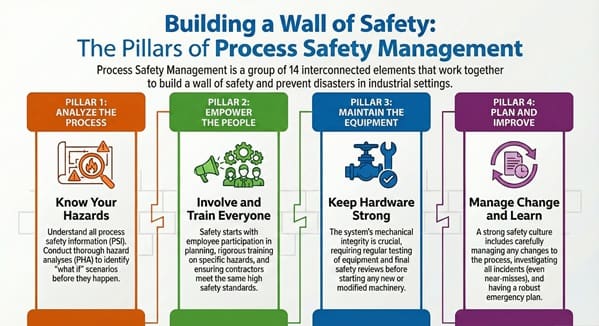
PSM is not a single rule. It is a group of 14 different parts that work together. Each part covers a specific area of the factory. Let us look at these elements to see how they build a wall of safety.
1. Employee Participation
Process Safety Management starts with the people on the floor. Workers know the machines better than anyone else. This rule says companies must involve employees in safety plans. They should help write the rules and find risks.
2. Process Safety Information (PSI)
Process Safety Information is the data you need to understand the hazards. Before you can fix a problem, you must know what you are working with. This includes:
- Chemical toxicity levels.
- The maximum pressure a tank can hold.
- The flow charts of the piping systems.
3. Process Hazard Analysis (PHA)
PSM requires a deep look at what could go wrong. This is the Process Hazard Analysis. A team of experts sits down to look at every step of the job. They ask “what if” questions. What if a valve fails? What if the power goes out? Finding these answers helps prevent disasters before they happen.
4. Operating Procedures
Process safety relies on clear instructions. You cannot guess how to run a chemical reactor. Companies must write down every step for starting, running, and stopping a process. These must be easy to read and always kept up to date.
5. Training
PSM meaning includes making sure every worker is a pro at their job. High-risk work requires special skills. Workers must learn the specific hazards of the chemicals they use. They also need to practice what to do if something goes wrong.
6. Contractors
Process Safety Management also covers outside workers. If you hire a plumber to fix a pipe, they must follow the same safety rules as your full-time staff. The company must check the safety record of the contractor before hiring them.
7. Pre-Startup Safety Review (PSSR)
Process safety requires a final check before turning on new machines. A PSSR makes sure everything is built right. It confirms that the operators are trained and the safety systems are active. You never want to start a machine and find a leak later.
8. Mechanical Integrity
PSM demands that equipment stays in top shape. This means regular testing of pipes, tanks, and relief valves. If a part looks old or rusty, it must be fixed. Keeping the hardware strong is a core part of process safety.
9. Hot Work Permit
Process Safety Management controls activities that cause sparks. Welding or cutting metal near chemicals is very dangerous. A permit system ensures that the area is clear of fumes before any fire or heat is used.
10. Management of Change (MOC)
PSM meaning involves tracking every change. If you swap a small valve for a big one, it might change the pressure in the system. MOC is a process where experts review changes to make sure they do not create new risks.
11. Incident Investigation
Process safety learns from mistakes. If a small leak happens, the company must find out why. Was it a broken part or a human error? Investigating small “near misses” prevents large accidents later.
12. Emergency Planning and Response
PSM prepares you for the worst. Even with the best plans, leaks can happen. This element makes sure there is an alarm system and an escape plan. It also ensures that workers know how to use fire tools or first aid.
13. Compliance Audits
Process Safety Management stays strong through regular checks. Every three years, companies must audit their safety plan. This confirms that they are actually following the 14 elements. It is a way to prove that the safety system is working.
14. Trade Secrets
Process safety information must be shared even if it is a secret recipe. While companies want to protect their formulas, they must give safety data to the people who need it. Safety always comes before secrets.
Also Read: How Six Sigma Can Measure Your Process Waste Level?
How PSM Protects Your Facility
Process Safety Management works by creating layers of protection. Imagine a series of filters. If a mistake passes through one filter, the next one should catch it.
Process safety systems use both physical tools and human actions. For example, a tank might have an automatic shut-off valve (hardware). It also has a worker watching the pressure gauge (human action). Together, they keep the facility stable.
The Role of Technology in PSM
Modern PSM uses smart sensors and computers. These tools can spot a tiny change in temperature or pressure. This allows the system to fix the issue before a human even sees it.
Benefits of a Strong PSM Program
Process Safety Management offers more than just safety. It actually helps the business grow.
- Less Downtime: Machines that are well-maintained do not break as often.
- Better Quality: Stable processes produce better products.
- Lower Costs: Preventing a fire is much cheaper than fixing one.
- Trust: The local community feels safer living near the plant.
Common Questions About PSM
What is the main goal of PSM?
The main goal of Process Safety Management is to prevent the release of dangerous chemicals. This protects workers, the public, and the environment from fires and toxic clouds.
Is PSM required by law?
Yes, in many countries, it is a legal rule. In the United States, OSHA 1910.119 sets the standards for PSM. If a company handles a certain amount of hazardous material, they must follow these rules.
How often should a PHA be updated?
A Process Hazard Analysis must be updated or “revalidated” every five years. However, if a major change happens in the plant, you should look at it sooner.
Who is responsible for process safety?
Everyone is responsible. While managers set the rules, operators and maintenance staff must follow them. Process safety only works when the whole team stays alert.
Also Read: Analytic Hierarchy Process
Keys to a Successful Safety Culture
Process Safety Management is not just a book of rules. It is a way of thinking. To make it work, you need a strong safety culture. This means that everyone, from the CEO to the newest worker, cares about safety more than speed or profit.
Process safety fails when people get lazy. Sometimes, a plant might go years without an accident. This can make people think they are safe when they are not. A good PSM plan keeps everyone focused on the risks that are always there.
Tips for Maintaining PSM
- Keep it Simple: Write procedures that are easy to follow.
- Listen to Workers: They are the first to notice a weird sound or a small drip.
- Invest in Tools: Give your team the best sensors and valves.
- Stay Curious: Always ask why something happened, even if it was a small glitch.
Key Takeaways
- PSM stops big chemical leaks, fires, and explosions.
- The system uses 14 key elements to cover every part of the plant.
- Process Hazard Analysis (PHA) is a vital tool for finding risks.
- Regular training and equipment checks are required for process safety.
- A strong PSM plan saves lives and reduces business costs.
Final Words
Process Safety Management is the backbone of a secure industrial world. By following the 14 elements, companies can handle the world’s most dangerous chemicals with confidence. It is a system that values human life and environmental health.
PSM is not a finish line; it is a journey. As technology changes, safety plans must change too. When you invest in process safety, you are investing in the future of your workers and your business. You are building a workplace where people feel safe and machines run smoothly.
Our company believes that every worker deserves to go home safe at the end of the day. We are dedicated to helping our clients build the best safety systems in the world. We focus on your needs and your safety. Let us work together to make your facility a model of Process Safety Management.

About Six Sigma Development Solutions, Inc.
Six Sigma Development Solutions, Inc. offers onsite, public, and virtual Lean Six Sigma certification training. We are an Accredited Training Organization by the IASSC (International Association of Six Sigma Certification). We offer Lean Six Sigma Green Belt, Black Belt, and Yellow Belt, as well as LEAN certifications.
Book a Call and Let us know how we can help meet your training needs.