
Let us understand how to build a high-performing company. Do you wonder why some organizations consistently perform better than their rivals?
This outcome is not about luck; it depends on mastering organizational effectiveness. This key concept refers to the efficiency and success with which an organization reaches its goals. When you boost organizational effectiveness, you ensure every part of your business works together smoothly.
This strategic focus acts as a vital foundation for sustainable growth and long-term success.
In this comprehensive guide, we will explore what truly drives a company’s success. We focus on the models, the measurements, and the steps you must take to make your organization effective.
Table of contents
What is Organizational Effectiveness?
Organizational effectiveness can be understood as the extent to which an organization achieves its desired outcomes and goals using its available resources. Simply put, an effective organization not only does things right but also does the right things.

It is important to note that organizational effectiveness is nothing but a measure of how well an organization meets the needs of its various stakeholders. Stakeholders include customers, employees, investors, and the community. This broad concept focuses on factors like financial performance, employee satisfaction, and overall adaptability.
Core Components of Organizational Effectiveness
The overall success of an organization depends on several interconnected parts. These components must function together optimally to ensure true organizational effectiveness.

The following are the essential components that contribute to robust organizational effectiveness:
- Strategic Leadership: Strategic leadership provides the direction and vision for the entire organization. Effective leaders set clear, achievable goals and make sure that all employees understand their role in achieving these goals.
- Efficient Processes: This refers to the systems and methods used to produce goods or services. Efficient processes minimize waste, reduce costs, and improve the speed and quality of work.
- High-Performing Culture: A company culture is the shared values and beliefs that guide employee behavior. A high-performing culture promotes collaboration, innovation, and continuous improvement across all teams.
- Talent Management: This process comprises attracting, developing, and keeping skilled employees. Proper talent management ensures the organization always has the right people with the right skills to meet current and future needs.
- Stakeholder Satisfaction: Organizational effectiveness relies on pleasing the people who matter most. Satisfied customers bring in revenue, and happy employees perform better.

Public, Onsite, Virtual, and Online Six Sigma Certification Training!
- We are accredited by the IASSC.
- Live Public Training at 52 Sites.
- Live Virtual Training.
- Onsite Training (at your organization).
- Interactive Online (self-paced) training,
Key Models for Measuring Organizational Effectiveness
How do you measure something as broad as organizational effectiveness? Several models exist to provide a framework for evaluation. These models help you determine if your organization is truly effective and point out areas for improvement.
Let us now discuss the most prominent models used for measuring organizational effectiveness.
1. The Goal Attainment Model
The Goal Attainment Model is the simplest and most direct approach. This model asserts that organizational effectiveness depends on how well an organization achieves its stated goals.
- Goal Attainment Model requires clear, measurable goals. Goals must be specific, measurable, achievable, relevant, and time-bound (SMART).
- Performance is measured by comparing the actual outcomes against the targets. For example, if a company aims for a 15% profit margin, achieving that target shows effectiveness.
However, the Goal Attainment Model fails to consider external factors or potential conflict among multiple goals.
2. The Systems Resource Model
The Systems Resource Model focuses on the organization’s ability to get and manage resources from its environment. This model believes that organizational effectiveness depends on the ability to secure scarce and valued resources.
- Resource acquisition is key. Resources include not only money and raw materials but also skilled employees, knowledge, and political influence.
- The Systems Resource Model is particularly useful when an organization faces resource shortages or must compete intensely for inputs.
This model is primarily focused on the input side of the organization, not the output side.
3. The Internal Process Model
The Internal Process Model looks inside the organization to assess its health and efficiency. This perspective suggests that smooth, well-functioning internal operations lead to organizational effectiveness.
- Effective internal processes include strong communication, quick decision-making, high employee morale, and efficient information flow.
- The Internal Process Model emphasizes that internal stability and control are essential. Poor internal health will eventually hurt external performance.
This model often ignores external factors like market demand or competitor actions.
4. The Strategic Constituencies Model
The Strategic Constituencies Model measures organizational effectiveness based on how well an organization satisfies the demands of its strategic stakeholders. These are the groups that an organization depends on for survival.
- Strategic constituencies often include creditors, suppliers, customer groups, and government regulators.
- Effectiveness is determined by whether the organization meets the needs and expectations of these key groups. This ensures continued support and legitimacy for the organization.
Why does the Strategic Constituencies Model matter? Because it forces the organization to look beyond just profit and consider its overall impact.
5. The Competing Values Framework (CVF)
The Competing Values Framework (CVF) combines elements of the other models. It suggests that there is no single measure of organizational effectiveness. Instead, effectiveness is a set of competing or contradictory values.
- CVF identifies four major models of effectiveness: Human Relations, Open Systems, Rational Goal, and Internal Process.
- Organizations must balance these competing values, such as the need for stability (Internal Process) versus the need for flexibility (Open Systems).
The Competing Values Framework provides the most comprehensive view, recognizing that effectiveness looks different depending on the organization’s current focus.
Comparison of Key Organizational Effectiveness Models
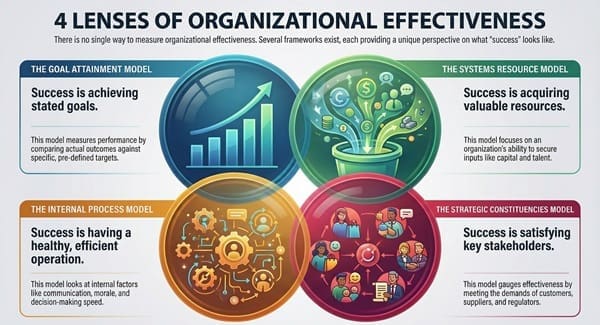
A clear understanding of the differences between these models is important. The table below provides a quick comparison.
| Basis for Comparison | Goal Attainment Model | Systems Resource Model | Internal Process Model | Strategic Constituencies Model |
| Focus Area | Achievement of stated outcomes | Acquisition of vital inputs | Organizational internal health | Satisfaction of strategic stakeholders |
| Key Indicator | Meeting specific targets | Ability to secure scarce resources | Smooth, efficient operations | Meeting demands of critical groups |
| Primary Concern | End results (output) | Initial inputs (input) | Internal functioning (throughput) | External legitimacy (output) |
| Effectiveness View | Successful objective fulfillment | Resource-getting ability | Organizational stability & control | External support and survival |
Also Read: Biggest Risks Six Sigma Faces Without a Governing Body
How to Boost Organizational Effectiveness?
Now that you understand the models, let us discuss how you can actively boost your company’s organizational effectiveness. It requires a systematic approach to people, processes, and technology.
Organizational Effectiveness Through People Management
Talent is the most important asset an organization possesses. You must manage your people effectively to realize your organization’s full potential.
- Implement a strong performance management system so as to link individual goals directly to the organization’s strategy. This ensures everyone’s effort contributes to the bigger picture.
- Develop your employees constantly. Training and development programs build new skills. This increases competency and prepares the organization for future challenges.
- Ensure clear communication throughout the organization. When employees understand what is expected, they perform more effectively.
- Use effective motivational strategies. Recognize and reward high performance. This maintains high morale and reduces employee turnover.
Organizational Effectiveness Through Process Optimization
Inefficient work processes are nothing but a huge drain on time and money. Streamlining these processes directly increases organizational effectiveness.
- Map all critical business processes so as to identify bottlenecks and redundant steps. Ask yourself: What steps can we eliminate?
- Leverage automation technologies. Process automation reduces human error and increases the speed of repetitive tasks, such as data entry or report generation.
- Implement a culture of continuous improvement. This helps teams regularly review their work and find small ways to make it better. The “Kaizen” approach, for example, focuses on continuous, incremental change.
- Standardize core operations. Standardization ensures consistency in quality and output, which is crucial for delivering reliable products or services.
Also Read: How Can Six Sigma Improve Your Social Media Marketing?
Organizational Effectiveness Through Strategic Technology Adoption
Technology plays a vital role in enabling organizational effectiveness in the modern world. It serves as a powerful tool to connect teams and streamline operations.
- Adopt an Enterprise Resource Planning (ERP) system. An ERP system integrates core business processes such as finance, HR, and supply chain. This provides a single source of truth for all data.
- Use data analytics tools. Data analytics allows you to make data-driven decisions. If you understand the factors that influence your outcomes, you can make more effective strategic choices.
- Invest in collaboration tools. Tools like project management software and internal communication platforms facilitate seamless teamwork, regardless of where employees are located.
Frequently Asked Questions About Organizational Effectiveness
Now, the question arises: What are the common challenges when trying to boost organizational effectiveness?
- What is the difference between organizational effectiveness and organizational efficiency?
- Organizational effectiveness focuses on doing the right things—achieving the overall goals and objectives.
- Organizational efficiency focuses on doing things right—using the minimum resources (time, cost, effort) to produce the output.
- A company can be efficient (produce many units quickly) but not effective (if those units do not sell). True success requires both.
- How long does it take to see results from an organizational effectiveness program?
- You can see some immediate improvements, such as lower costs from eliminating waste. However, fundamental change takes time.
- It typically requires 6 to 18 months to fully embed new processes and a new culture that substantially boosts organizational effectiveness.
- How do you ensure employee buy-in for new effectiveness initiatives?
- Communicate the why before the what. Explain how the changes benefit the employees, not just the company.
- Involve employees in the design and testing of new processes. This makes them feel valued and leads to better solutions.
Key Takeaways for Organizational Effectiveness
So, with the above discussion, we can say that organizational effectiveness is not a one-time project. It is a continuous journey that requires constant attention.
- Effectiveness is Multi-Dimensional: You cannot judge success only by profit. You must also consider internal health, resource strength, and stakeholder satisfaction.
- People and Process are Interlinked: You cannot fix one without addressing the other. Talent management and process optimization must work together.
- Choose the Right Model: Select an effectiveness model that fits your organization’s current challenges, whether it is resource acquisition or internal coordination.
Final Words
We provide the expertise you require to measure, analyze, and implement the changes that drive true organizational effectiveness. We focus on creating measurable results and helping you build a company that is not just fast, but fundamentally strong.
Contact our team today to start designing a plan that delivers sustainable growth and helps your organization realize its maximum potential.

About Six Sigma Development Solutions, Inc.
Six Sigma Development Solutions, Inc. offers onsite, public, and virtual Lean Six Sigma certification training. We are an Accredited Training Organization by the IASSC (International Association of Six Sigma Certification). We offer Lean Six Sigma Green Belt, Black Belt, and Yellow Belt, as well as LEAN certifications.
Book a Call and Let us know how we can help meet your training needs.


