
Have you ever felt like you’re constantly putting out fires instead of actually building something? We’ve all been there. You fix a delay today, only to see it pop up again next week in a different department. It’s frustrating, right? That’s where Lean Problem Solving Techniques come into play. These aren’t just fancy corporate buzzwords; they’re a set of tools designed to help you find the “why” behind the “what.”
To be honest, most businesses waste about 90% of their effort on tasks that don’t even matter to the customer. Imagine if you could cut that waste and focus only on what brings value. In this guide, we’ll walk through how these techniques work and how you can use them to make your daily work life a whole lot easier.
Table of contents
What is Lean Problem Solving Anyway?
At its heart, Lean problem solving is a systematic way to identify and fix issues by getting to the root cause. Instead of just slapping a bandage on a symptom, you’re looking to heal the wound.
Picture this: your team keeps missing deadlines. A traditional approach might be to tell everyone to work harder or stay later. But a Lean approach asks, “Why are we missing them?” Maybe the instructions are unclear, or perhaps a specific machine breaks down every Tuesday.
By using Lean Problem Solving Techniques, you focus on two things: maximizing value and minimizing waste (or “muda,” as it’s often called). It’s about being lean, mean, and efficient.

Public, Onsite, Virtual, and Online Six Sigma Certification Training!
- We are accredited by the IASSC.
- Live Public Training at 52 Sites.
- Live Virtual Training.
- Onsite Training (at your organization).
- Interactive Online (self-paced) training,
The Foundation: The 5 Principles of Lean
Before we jump into the tools, we need to understand the logic. Everything in the Lean world revolves around five simple steps:
- Define Value: What does your customer actually want to pay for?
- Map the Value Stream: Look at every step in your process. Which ones add value? Which ones are just fluff?
- Create Flow: Make sure your work moves smoothly from one step to the next without getting stuck in a bottleneck.
- Establish Pull: Only start work when there’s a real demand for it. Don’t overproduce!
- Pursue Perfection: This is the big one. You’re never “done.” You’re always looking for ways to get a little bit better every day.
Also Read: Lean Six Sigma Essentials for Effective Sales
4 Essential Lean Problem Solving Techniques
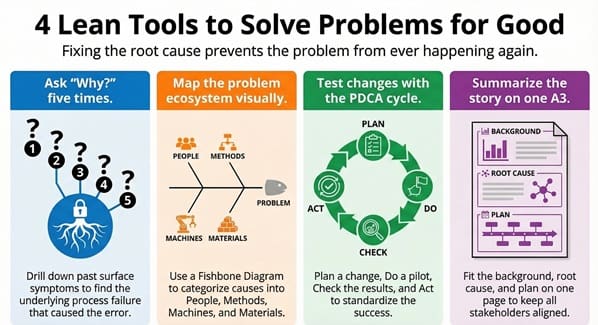
Now, let’s get into the nitty-gritty. How do you actually solve these problems? Here are some of the most effective methods we use in the field.
1. The 5 Whys (Root Cause Analysis)
This is probably the simplest tool in the shed. When a problem happens, you ask “Why?” and then you ask “Why?” again. You usually have to do this about five times to find the real culprit.
- The Problem: The client received the wrong report.
- Why? The analyst pulled the wrong data set.
- Why? The file names in the folder were confusing.
- Why? We don’t have a naming standard for our files.
- Why? We never sat down to create a process for document control.
- Why? (The Root Cause): We lack a standardized workflow for data management.
See how that works? If we just yelled at the analyst, the problem would happen again. By fixing the naming standard, we solve it forever.
2. The Fishbone Diagram (Ishikawa)
Sometimes a problem is too big for a simple list of “whys.” That’s when we use a Fishbone Diagram. It looks like a fish skeleton (hence the name). You put the main problem at the “head” and then draw “bones” representing different categories like:
- People: Do they have the right training?
- Methods: Is the process outdated?
- Machines: Is the software glitching?
- Materials: Are the raw inputs low quality?
This helps you see the whole “ecosystem” of a problem. It’s great for brainstorming with a team because it keeps everyone focused on different angles.
3. PDCA Cycle (Plan-Do-Check-Act)
Think of PDCA as the scientific method for your office. It’s a four-step loop that helps you test out solutions without risking everything at once.
- Plan: Identify the issue and decide on a small change to try.
- Do: Run a tiny pilot test. Don’t roll it out to the whole company yet!
- Check: Look at the data. Did the change actually help?
- Act: If it worked, make it the new standard. If it didn’t, go back to the drawing board.
4. A3 Problem Solving
An A3 is basically a one-page report that tells the story of a problem. It’s named after the size of paper it used to be printed on (A3 size). It forces you to be concise. You can’t hide behind 50-page PowerPoint decks. You have to fit the background, the current state, the goal, the root cause analysis, and the plan all on one sheet.
It’s a fantastic way to keep stakeholders aligned. When everyone is looking at the same piece of paper, communication becomes much faster.
Why Should You Care? (The Benefits)
You might be thinking, “This sounds like a lot of work.” To be honest, it is—at first. But the payoff is huge. In my experience, companies that embrace Lean Problem Solving Techniques see:
- Higher Morale: Employees hate broken processes. When you give them the tools to fix things, they feel empowered.
- Cost Savings: Less waste means more money in the bank. It’s as simple as that.
- Faster Delivery: When you remove bottlenecks, your products and services get to the customer much quicker.
- Better Quality: By focusing on root causes, you stop making the same mistakes over and over.
Also Read: What is Defect Management?
Common Pitfalls to Avoid
We’ve all seen “Lean” go wrong. Usually, it happens because management tries to force it from the top down. Here’s a tip: the people closest to the work are the ones with the answers. If you don’t involve the frontline staff, your Lean project will likely fail.
Also, don’t get stuck in “analysis paralysis.” You don’t need a perfect plan. You just need a “good enough” plan that you can test and improve. Remember the PDCA cycle? The “Do” and “Check” parts are just as important as the “Plan.”
Key Takeaways
- Lean is about value: If it doesn’t help the customer, it’s waste.
- Ask why five times: Don’t stop at the first answer you get.
- Standardize your work: If you don’t have a standard, you can’t have an improvement.
- Involve the team: Problem solving is a team sport, not a solo mission.
- Start small: Use the PDCA cycle to test ideas before going big.
Frequently Asked Questions (FAQs)
Q: Is Lean only for manufacturing?
No way! While it started in car factories (shoutout to Toyota), it works everywhere—from hospitals and software teams to coffee shops and law firms. Any process can be “leaned.”
Q: How long does it take to see results?
You can see wins from a 5 Whys session in ten minutes. A full cultural shift takes longer, but the “quick wins” keep everyone motivated along the way.
Q: What is the difference between Lean and Six Sigma?
Lean focuses on speed and waste. Six Sigma focuses on quality and reducing variation. When you combine them (Lean Six Sigma), you get the best of both worlds.
Conclusion
Mastering Lean Problem Solving Techniques isn’t about memorizing Japanese words or drawing perfect charts. It’s about building a culture where everyone feels responsible for making things better. It’s about looking at a messy process and saying, “We can do better than this.”
At our company, we believe that your time is your most valuable resource. We’re dedicated to helping you stop wasting it on “firefighting” so you can focus on what you’re truly passionate about. We value our clients’ success above all else, and we’re here to guide you every step of the way on your journey to excellence.

About Six Sigma Development Solutions, Inc.
Six Sigma Development Solutions, Inc. offers onsite, public, and virtual Lean Six Sigma certification training. We are an Accredited Training Organization by the IASSC (International Association of Six Sigma Certification). We offer Lean Six Sigma Green Belt, Black Belt, and Yellow Belt, as well as LEAN certifications.
Book a Call and Let us know how we can help meet your training needs.