Intelligent Business Process Management (iBPM) is a sophisticated evolution of traditional management suites that integrates artificial intelligence (AI), machine learning (ML), and real-time analytics into the organizational workflow. It goes beyond simple automation by enabling systems to “think” and adapt to changing data patterns without constant human intervention.
Intelligent Business Process Management serves as the digital nervous system of a modern enterprise, connecting disparate data streams to create a more responsive and agile operational environment.
Here’s the thing about modern business: the old ways of mapping out a process and letting it run for five years are dead. You’ve probably felt that frustration when a rigid system can’t handle a “special case” or a sudden market shift. Traditional BPM was like a train on tracks—reliable, but unable to steer. Intelligent Business Process Management is more like a self-driving car. It sees the traffic, predicts the weather, and changes routes to get you there faster.
To be honest, most companies are still drowning in “dumb” automation. They automate a mess and wonder why they just have a faster mess. In my experience, the real magic happens when you inject cognitive capabilities into those workflows. But how does this actually work in a high-stakes corporate environment?
Table of contents
Comparison Chart: BPM vs iBPM
| Basis for Comparison | Traditional BPM | Intelligent Business Process Management (iBPM) |
| Meaning | A methodology to manage and optimize predictable, repetitive business processes. | An advanced suite using AI and cloud capabilities to manage dynamic, complex workflows. |
| Data Handling | Primarily handles structured data from internal databases. | Processes structured and unstructured data (social media, video, IoT). |
| Decision Making | Based on pre-defined, rigid business rules set by humans. | Driven by real-time analytics and machine learning models. |
| Technology Stack | On-premise servers and basic workflow engines. | Cloud-native architecture with AI, ML, and big data integration. |
| Adaptability | High effort required to change processes manually. | Self-optimizing and adaptive based on continuous feedback loops. |
| User Interaction | Limited to desktop interfaces and static forms. | Supports mobile, social collaboration, and conversational AI. |
Evolution of Intelligent Business Process Management
The journey toward Intelligent Business Process Management didn’t happen overnight. It started with simple workflow automation in the 1990s, where we just wanted to move a digital folder from Person A to Person B. Then came the era of “Business Process Management” (BPM), which added a layer of governance and modeling.
However, as the “Internet of Things” (IoT) and big data exploded, these older systems started to crack. They couldn’t handle the sheer volume of “unstructured data”—things like emails, voice notes, and social media sentiment. This gap birthed Intelligent Business Process Management. According to research on the role of AI in management (MECSJ), the shift was driven by the need for “straight-through processing” where machines handle the bulk of the cognitive load.
Intelligent Business Process Management represents the “third wave” of process improvement. It’s no longer just about doing things right; it’s about doing the right things at the right time. Have you ever wondered why some companies seem to pivot to market trends in days while others take months? The answer usually lies in their process intelligence.

Public, Onsite, Virtual, and Online Six Sigma Certification Training!
- We are accredited by the IASSC.
- Live Public Training at 52 Sites.
- Live Virtual Training.
- Onsite Training (at your organization).
- Interactive Online (self-paced) training,
Core Components of iBPM Suites
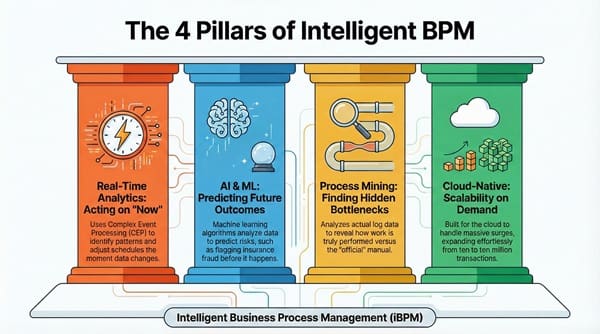
To understand Intelligent Business Process Management, we have to look under the hood. It isn’t just one software; it’s a symphony of several high-tech instruments working together.
Real-Time Analytics Engine
This is the heart of the system. Unlike traditional reporting that tells you what happened last month, this component tells you what is happening right now. It uses Complex Event Processing (CEP) to identify patterns in data streams. If a supply chain delay happens in Asia, the system knows immediately and adjusts the production schedule in Europe.
Artificial Intelligence and Machine Learning
Intelligent Business Process Management relies heavily on ML algorithms to predict outcomes. For instance, in insurance claims, the system can learn which “red flags” usually indicate fraud. Over time, it gets better at flagging suspicious cases, reducing the burden on human investigators.
Process Discovery and Mining
Ever tried to document a process only to find out nobody actually follows the “official” manual? Process mining tools look at log data to see how work actually gets done. It uncovers bottlenecks you didn’t even know existed.
Cloud-Native Architecture
Most Intelligent Business Process Management platforms are built for the cloud. This allows for massive scalability. Whether you’re processing ten transactions or ten million, the system expands to meet the demand. This is crucial for businesses that experience seasonal spikes, like retail during the holidays.
Also Read: Quantum Communication
How Intelligent Business Process Management Works?
The working of Intelligent Business Process Management can be understood through a continuous loop of sensing, thinking, and acting.
First, the system senses by gathering data from various “touchpoints.” This could be an RPA bot scraping data from a website, a sensor on a factory floor, or a customer’s tweet.
Second, the system thinks. The Intelligent Business Process Management engine analyzes this data against historical patterns. It asks: “Is this normal? What is the most likely outcome if we follow Step A versus Step B?”
Finally, the system acts. If the confidence score is high, it executes the decision automatically. If it’s a complex or sensitive issue, it “escalates” the task to a human, providing them with all the necessary data to make a quick call.
In my experience, the “Learning” phase is where the real value lies. Every time a human overrides or confirms a system decision, the Intelligent Business Process Management suite gets smarter. It’s like training a new employee who never forgets a single lesson.
The Role of Cognitive Computing
Now, this is where it gets really interesting. Cognitive computing is the “brain” inside Intelligent Business Process Management. According to insights from Cognizant, cognitive systems don’t just follow instructions; they learn and interact with humans naturally.
Intelligent Business Process Management uses Natural Language Processing (NLP) to read and understand customer emails. Instead of just routing an email based on a keyword, it can sense the “tone.” Is the customer angry? Are they confused? A cognitive iBPM system will prioritize an angry customer and route them to a senior manager immediately.
One counterintuitive point: cognitive computing isn’t meant to replace humans. To be honest, it’s meant to “augment” us. It handles the boring, data-heavy analysis so we can focus on the creative, empathetic parts of the job. Isn’t that a better way to work?
Also Read: Sprint Project Management
Key Benefits for Enterprises
Why should a CEO care about Intelligent Business Process Management? It sounds expensive and complex, right? Well, the “Return on Investment” (ROI) usually speaks for itself.
- Extreme Agility: When the market changes, you don’t need to rewrite your entire software code. You just adjust the goals in your Intelligent Business Process Management suite, and the AI helps the process adapt.
- Reduced Operational Risk: By using real-time monitoring, the system can catch errors before they become catastrophes. In banking, this is the difference between catching a fraudulent transfer and losing millions.
- Enhanced Customer Experience: We’ve all been stuck in “customer service limbo.” Intelligent Business Process Management speeds up response times by ensuring that the right data is always in front of the agent.
- Empowered Knowledge Workers: Instead of spending 4 hours a day on data entry, your best people can spend 4 hours on strategy. This leads to higher job satisfaction and lower turnover.
Challenges and Limitations
It’s not all sunshine and rainbows. If you’re thinking about implementing Intelligent Business Process Management, you need to be aware of the “potholes” in the road.
Intelligent Business Process Management requires high-quality data. As the saying goes: “Garbage in, garbage out.” If your data is messy or siloed in different departments, the AI will make bad decisions. You can’t just slap an “intelligent” label on a broken data strategy.
Another hurdle is the cultural shift. People are often afraid that AI is coming for their jobs. In my experience, the biggest failure in iBPM projects isn’t the technology—it’s the “change management.” You have to show your team that the system is a tool, not a replacement.
Finally, there is the “Black Box” problem. Sometimes, ML models make a decision, and it’s hard to explain why. In regulated industries like healthcare or finance, “because the computer said so” isn’t a valid legal defense. This is why “Explainable AI” is becoming a huge part of the Intelligent Business Process Management conversation.
Also Read: Smart Grid System
Real-World Applications
Let’s look at how this plays out in the wild. Intelligent Business Process Management is making waves in sectors you might not expect.
Healthcare Patient Care
In a hospital, a patient’s condition can change in seconds. An iBPM system can monitor vitals from wearable devices and automatically alert the “Rapid Response Team” if a patient shows signs of sepsis. It coordinates the pharmacy, the lab, and the nursing staff in one seamless, intelligent workflow.
Smart Manufacturing
In “Industry 4.0,” Intelligent Business Process Management manages “predictive maintenance.” Instead of fixing a machine when it breaks, the system monitors vibrations and heat. It schedules a repair before the breakdown happens, saving thousands in lost production time.
Financial Services
Think about a mortgage application. It used to take weeks of back-and-forth paperwork. With Intelligent Business Process Management, the system can automatically verify income, check credit scores, and assess property risk in minutes. It only involves a human for final “sign-off” or complex exceptions.
Important Considerations for Implementation
If you are ready to take the plunge into Intelligent Business Process Management, don’t try to boil the ocean. Start small. Pick one “high-friction” process—maybe it’s your onboarding or your procurement—and apply iBPM principles there first.
It is noteworthy that the most successful companies don’t just buy a “tool.” They build a “Center of Excellence” (CoE) to manage their process intelligence. They hire people who understand both the business logic and the AI algorithms.
Are you prepared for your processes to start “talking back” to you? Because that’s what happens when you embrace Intelligent Business Process Management. You get a system that tells you when your goals are unrealistic or when your strategy is failing in real-time. It’s brutal honesty, but it’s exactly what a modern business needs to survive.
Key Takeaways
- Intelligent Business Process Management (iBPM) integrates AI, ML, and real-time analytics to enhance workflows, going beyond traditional automation.
- iBPM adapts to changes using real-time data, while traditional BPM struggles with rigidity and is limited to structured data.
- Key components of iBPM include a real-time analytics engine, ML for predictive outcomes, and cloud-native architecture for scalability.
- Implementing iBPM requires high-quality data and a cultural shift to ease fears about AI replacing jobs.
- Real-world applications of iBPM include healthcare monitoring, smart manufacturing, and accelerated financial services processes.
Final Words
Intelligent Business Process Management is not just a fancy acronym for the IT department. It is a fundamental shift in how we think about work, data, and value. By combining the “muscles” of automation with the “brains” of AI, organizations can finally move at the speed of the digital world.
At our core, we believe that technology should serve people, not the other way around. We focus on creating solutions that empower your team to do their best work while the “intelligent” systems handle the heavy lifting. The future of business isn’t just about being fast; it’s about being smart.

About Six Sigma Development Solutions, Inc.
Six Sigma Development Solutions, Inc. offers onsite, public, and virtual Lean Six Sigma certification training. We are an Accredited Training Organization by the IASSC (International Association of Six Sigma Certification). We offer Lean Six Sigma Green Belt, Black Belt, and Yellow Belt, as well as LEAN certifications.
Book a Call and Let us know how we can help meet your training needs.