
Six Sigma for marketing is a powerful method. It helps companies get much better results. Marketers work hard to reach customers. They want their campaigns to make money. But sometimes, campaigns do not work as planned. This problem is called variation. Six Sigma is a tool that fixes this. It uses data and science to make sure marketing efforts work almost perfectly.
Six Sigma for marketing helps you stop wasting money. It stops you from guessing what works. You want your marketing to be steady and strong. Six Sigma for marketing is the way to get there. It shows you the true path to success.
Table of contents
What Is Six Sigma and How Does Six Sigma Help Marketers?
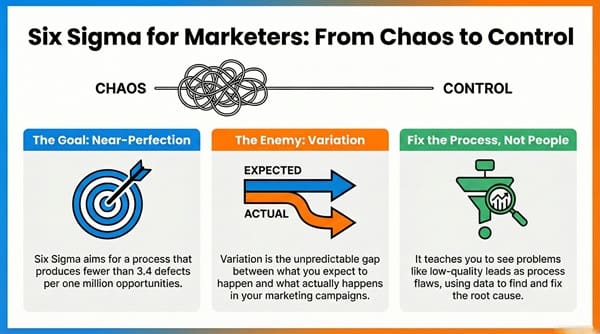
Six Sigma is a set of tools. It is also a method. It aims to make processes almost flawless. In simple words, Six Sigma wants less than 3.4 mistakes for every one million tries. This goal is called near-perfection. Companies use it to save money and make customers happier.
Six Sigma help marketers by giving them a clear plan. Marketers often face problems like low click rates or bad quality leads. Six Sigma teaches you to see these problems as process flaws. You do not blame the people. You fix the process itself. This makes all your future work better. It gives you a strong way to check your work.
Six Sigma for marketing means you use facts, not feelings. Are you getting the return on investment (ROI) you want? If not, Six Sigma can help marketers find out why. We will look at the main method it uses. This method is called DMAIC.
Six Sigma and Variation
Six Sigma for marketing starts with understanding variation. Variation is the difference between what you expect to happen and what actually happens.
For example, you launch an ad. You expect 100 people to click. Only 50 click. The 50-person gap is variation. Too much variation means your marketing is unpredictable. You cannot plan well.
Six Sigma help marketers turn chaos into order. It finds the root cause of the variation. This is the real reason for the problem. It is not just “the ad was bad.” It might be “the ad showed on the wrong websites.” Six Sigma for marketing uses data to find these hidden issues. This makes your results stable.

Public, Onsite, Virtual, and Online Six Sigma Certification Training!
- We are accredited by the IASSC.
- Live Public Training at 52 Sites.
- Live Virtual Training.
- Onsite Training (at your organization).
- Interactive Online (self-paced) training,
The DMAIC Method: How Six Sigma Help Marketers Fix Campaigns
The most common way Six Sigma help marketers is by using the DMAIC method. DMAIC is a five-step process. It stands for Define, Measure, Analyze, Improve, and Control. This method works best when you want to fix an existing marketing campaign or process that is failing.
Define: What Is the Problem?
The first step in Six Sigma for marketing is to Define the problem. You must be very clear. What exactly is going wrong?
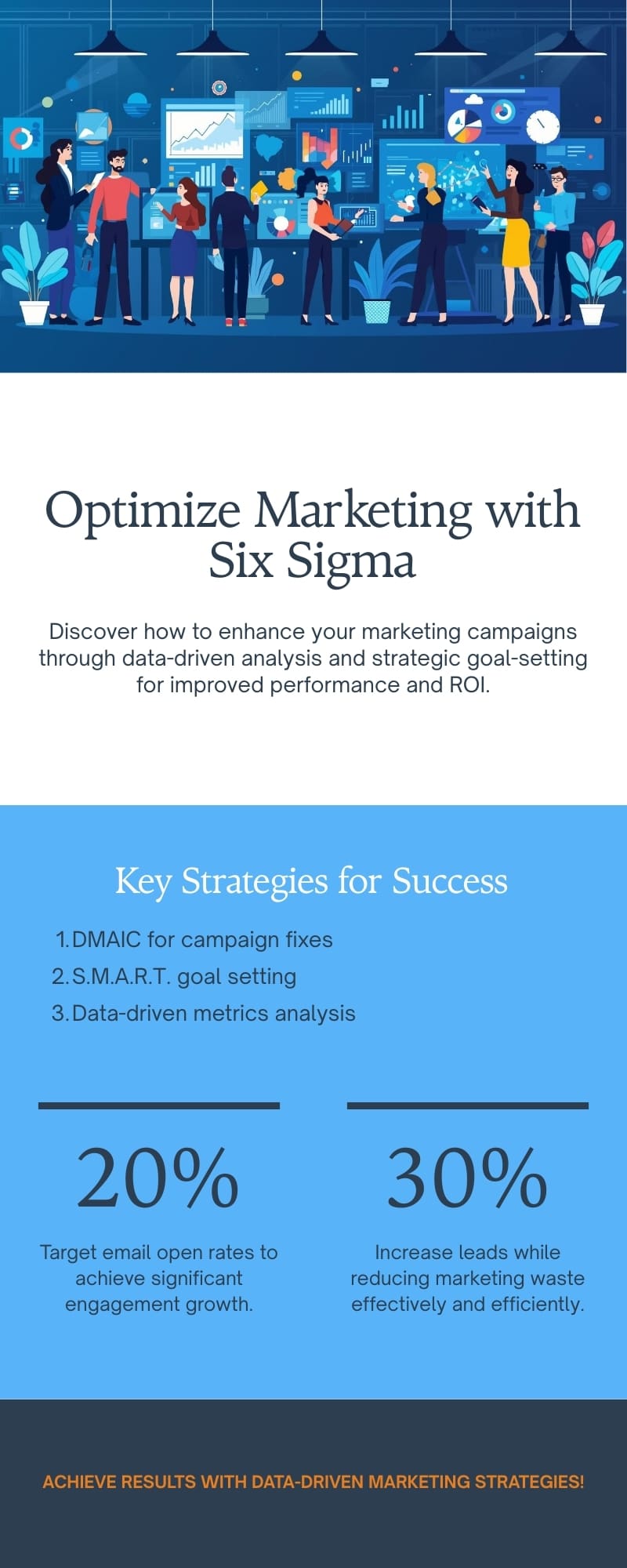
Six Sigma help marketers write a problem statement. This is a short, clear paper about the issue. It says how the problem hurts the company. You must also set a clear goal. This goal should be S.M.A.R.T. (Specific, Measurable, Achievable, Relevant, Time-Based).
Six Sigma for marketing must have a measurable goal. For instance, a S.M.A.R.T. goal is: “Increase the email open rate from 15% to 25% by the end of the next quarter.” The Define phase sets the target.
Measure: How Big Is the Problem?
The second step in Six Sigma for marketing is to Measure. You need to collect solid data. This data shows you the size of the problem.
Six Sigma help marketers choose the right metrics. You must collect data from the failing process. Examples of marketing data include:
- Click-Through Rates (CTR)
- Cost Per Acquisition (CPA)
- Lead Conversion Rates
- Website Bounce Rate
Six Sigma for marketing relies on clean data. Marketers must ensure the data is correct. If the measuring system is broken, the whole effort fails. This step creates a clear picture of the current state.
Analyze: Why Did This Happen?
The third step in Six Sigma for marketing is to Analyze. This is where the detective work happens. You look at the data collected in the Measure step. You ask “Why?” many times.
Six Sigma help marketers find the root cause of the variation. They use tools like the Fishbone Diagram or 5 Whys. For example, the data may show that low-quality leads come only from one specific social media ad. The root cause might be a mistake in the ad’s targeting settings.
Six Sigma for marketing means you look for facts that link the cause to the effect. You prove which factor truly causes the bad result.
Improve: What Should We Change?
The fourth step in Six Sigma for marketing is to Improve. Now that you know the cause, you fix it. You create and test new solutions.
Six Sigma help marketers try out new ways to work. If the problem was the ad targeting, you change it. You run a small test first. This is called a pilot study. You check if the new way solves the problem. You do not change everything at once. Instead, you make small, smart changes.
Six Sigma for marketing finds the best solution. The best solution is the one that gives the biggest result with the lowest cost.
Control: How Do We Keep It Fixed?
The last step in Six Sigma for marketing is to Control. You found a great solution. Now you must make sure the problem never comes back.
Six Sigma help marketers standardize the new process. You write down the new rules and guidelines. This is often called a Standard Operating Procedure (SOP). Everyone must follow the new steps. You also set up a monitoring system. This system checks the process over time. If the results start to drop, the system alerts the team.
Six Sigma for marketing makes the improvement stick. It locks in the gains you made.
Also Read: What Is a Klout Score?
Design for Six Sigma (DFSS): Six Sigma for New Marketing Projects
What if you are starting a brand-new marketing project? You do not have an existing process to fix. In this case, Six Sigma help marketers use a different method. This is called Design for Six Sigma (DFSS). DFSS uses the DMADV process.
Six Sigma for marketing uses DMADV to design quality from the start. This method helps you avoid mistakes before they even happen.
- Define: Define the new product or service goal. Define what the customer wants.
- Measure: Measure customer needs. What metrics will show success?
- Analyze: Analyze possible designs. Pick the best design for the customer.
- Design: Design the new marketing process. This is the fun part.
- Verify: Verify that the new design works perfectly before launch.
Six Sigma can help marketers avoid mistakes before they happen. DFSS is key for launching a new website or a new product line.
Comparing DMAIC and DMADV in Six Sigma for Marketing
Six Sigma for marketing uses two main methods. It is important to know which one to pick. DMAIC is for fixing a running process. DMADV is for creating a new process.
Six Sigma help marketers choose the right tool for the job. Do you want to fix an old car? Use DMAIC. Do you want to build a new car? Use DMADV.
| Basis for Comparison | DMAIC (Improve Existing Process) | DMADV (Design New Process) |
| Meaning | Fixes errors in a process that already exists. | Creates a new process or product from scratch. |
| Nature | Reactive: It acts to solve current problems. | Proactive: It acts to stop future problems. |
| Examples | Improving a website’s conversion rate. | Designing the marketing plan for a brand-new product. |
| Functions | Reduces defects and variation in current results. | Makes sure the new design meets all customer needs perfectly. |
| Key Characteristics | Focused on finding the root cause of failure. | Focused on making a perfect design before launch. |
Six Sigma for marketing makes sure you do not waste time. Using the right tool is the fastest way to success.
Also Read: How do you align QFD in Six Sigma with your organization’s strategy and goals?
Advantages: How Six Sigma Can Help Marketers Get Better Results
Six Sigma can help marketers in many powerful ways. Marketers who use Six Sigma see huge benefits. These benefits lead to real growth.
- Increases ROI. When you cut out waste, you spend less. When you focus only on channels that work, you earn more. This directly boosts your Return on Investment (ROI).
- Get High-Quality Leads. The Analyze phase finds out what creates a bad lead. Marketers can then fix the source of the bad leads. This means sales teams get better contacts.
- Improves Customer Experience. You stop pushing ads that annoy people. You focus on what the customer truly values. This makes customers happier. Happy customers stay longer.
- Create a Data Culture. Six Sigma forces the team to use facts. Decisions are based on numbers, not on feelings. This makes the team smarter.
- Reduces Campaign Waste. Think about time and money spent on ads that go nowhere. Six Sigma cuts that waste. You become a leaner, faster team.
Disadvantages: What Marketers Must Know About Six Sigma
While Six Sigma for marketing is great, it is not always easy. Marketers should know the challenges they may face.
- Requires Training and Time. Six Sigma needs special training. Team members must learn the tools. This takes time away from daily tasks. It is an investment.
- Needs Great Data. The process fails if the data is messy or missing. Marketers must build strong systems to track every action perfectly.
- Face Resistance to Change. People often do not like new ways of working. Standardizing a process (Control step) can feel like extra work at first. The team must believe in the process.
Six Sigma for marketing is a long-term strategy. It is not a quick fix. You must commit fully to the method.
Six Sigma for Marketing in Action
Six Sigma for marketing works best with clear examples. Let us consider how marketers apply DMAIC to solve a common problem.
Example 1: Fixing a Low-Performing Email Campaign
Problem: The email list has 50,000 subscribers. But only 12% open the weekly newsletter. (Goal: Reach 20% open rate.)
- Define: The goal is to increase the open rate from 12% to 20% in three months.
- Measure: The team measures open rates by segment, by subject line length, and by the time of day sent. They find that old email addresses have almost a 0% open rate.
- Analyze: The data shows that the old emails are inactive. The root cause is a bad list-cleaning process. The team also finds that subject lines with emojis have a higher rate.
- Improve: The team creates a new list-cleaning process. They add a step to remove inactive users every month. They start using emojis in their subject lines as a test. The open rate jumps to 18%.
- Control: The new list-cleaning process becomes the company rule (SOP). Six Sigma help marketers set an alert. If the open rate drops below 16%, the system alerts the team.
Example 2: Improving SEO Ranking
Six Sigma for marketing is great for SEO.
- Define: The goal is to get the company website on the top three results on Google for the main keyword by year’s end.
- Measure: The team collects current data: current ranking, number of backlinks, page loading speed, and time users spend on the page.
- Analyze: The data shows that many users leave the site fast (high bounce rate). The root cause is slow page speed on mobile phones. Also, a competitor has 50 more high-quality backlinks.
- Improve: The team works with the web developer to speed up the mobile site. They launch a content campaign to earn high-quality backlinks. Six Sigma for marketing tracks the ranking change.
- Control: The team creates a guideline. All new web pages must pass a mobile speed test before they go live. Six Sigma can help marketers keep the process strong.
Key Takeaways
- Six Sigma help marketers fix the problem of variation (mismatched results).
- The primary method is DMAIC (Define, Measure, Analyze, Improve, Control) for fixing existing, broken campaigns.
- Six Sigma for marketing relies only on data and facts to find the true root cause of problems.
- DMADV is used to design new, perfect marketing processes from the start.
- Six Sigma can help marketers boost ROI, get better leads, and standardize processes.
- Success requires training, commitment, and excellent data tracking.
Frequently Asked Questions (FAQs) About Six Sigma for Marketing
1. What is the main goal of Six Sigma for marketing?
The main goal of Six Sigma for marketing is to reduce errors and defects. It wants to make marketing processes so steady that they work nearly perfectly. This means better, more predictable results.
2. Is Six Sigma only for manufacturing companies?
No. While Six Sigma started in manufacturing, companies in all areas use it now. Six Sigma help marketers improve any process that has measurable results, like ad campaigns or SEO.
3. What is a “defect” in the marketing world?
A defect in marketing is any result that does not meet the customer’s need or the campaign’s goal. Examples are a high bounce rate, a broken website link, or a lead that is not qualified.
4. How long does a Six Sigma marketing project take?
A full DMAIC project usually takes 3 to 6 months. It depends on how big the problem is. Six Sigma can help marketers by defining a clear project scope in the first step.
5. Do I need a Black Belt to use Six Sigma for marketing?
Not always. A White Belt or Yellow Belt certification is a good start. It teaches you the basics. A Green Belt or Black Belt leads the complex, large projects.
6. What is a S.M.A.R.T. goal in the Define phase?
A S.M.A.R.T. goal is Specific, Measurable, Achievable, Relevant, and Time-Based. Six Sigma for marketing demands this level of clarity to measure success correctly.
Final Words
Six Sigma for marketing is a way to gain control. It moves marketing from art to science. By using the DMAIC and DMADV methods, you find the facts. You solve problems at the root. You create systems that work almost perfectly every time. This focus on process excellence saves time, cuts costs, and makes customers happy. Marketers who master these tools become true growth leaders.

About Six Sigma Development Solutions, Inc.
Six Sigma Development Solutions, Inc. offers onsite, public, and virtual Lean Six Sigma certification training. We are an Accredited Training Organization by the IASSC (International Association of Six Sigma Certification). We offer Lean Six Sigma Green Belt, Black Belt, and Yellow Belt, as well as LEAN certifications.
Book a Call and Let us know how we can help meet your training needs.