What is the Shingo Model and How Does It Drive Excellence?
The Shingo Model serves as a world-class framework for any organization that wants to achieve sustainable operational excellence through behavioral change. Have you ever wondered why some companies thrive with Lean tools while others fail after just a few months?
To be honest, most leaders focus on the “tools” like 5S or Kaizen but forget the “people” side of the equation. In my experience, the secret isn’t just in the maps or charts; it’s in the underlying principles that guide how every employee thinks and acts.
The Shingo Model isn’t just another checklist for manufacturing. It is a philosophy named after Dr. Shigeo Shingo, a man who helped shape the Toyota Production System. While many people know him for creating “Poka-Yoke” (error proofing), his true legacy is this model.
It teaches us that “ideal results” require “ideal behaviors,” and those behaviors must be driven by deep-rooted principles. Are you ready to stop chasing “flavor of the month” programs and start building a culture that lasts? Let’s break down how this model actually works.
Table of contents
Why the Shingo Model Matters for Your Business?
When we talk about the Shingo Model, we are looking at a way to align your entire company. Most businesses operate in silos. Marketing does one thing, while production does another. This lack of alignment creates waste. The Shingo Prize, often called the “Nobel Prize of Manufacturing,” is awarded to companies that prove they can sustain excellence using this framework.
Here’s the thing: tools like Kanban or Six Sigma are great, but they are just tools. Think of it like a hammer. A hammer can help you build a house, but it won’t tell you how to be a master carpenter. The Shingo Model provides the blueprint for that mastery. It focuses on the “why” behind the “how.”
Public, Onsite, Virtual, and Online Six Sigma Certification Training!
- We are accredited by the IASSC.
- Live Public Training at 52 Sites.
- Live Virtual Training.
- Onsite Training (at your organization).
- Interactive Online (self-paced) training,
The Three Insights of Operational Excellence
Before we dive into the specific principles, we must understand the three core insights that the Shingo Institute emphasizes. These insights are the foundation of the Shingo Model.
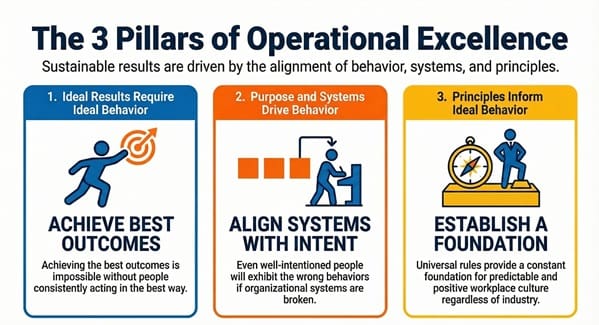
- Ideal Results Require Ideal Behavior: You cannot get the best results if your people aren’t acting in the best way. For example, if you want a safe workplace, everyone must “behave” safely, not just follow a rulebook when the boss is looking.
- Purpose and Systems Drive Behavior: Most people want to do a good job. However, if your systems (like how you pay people or how you measure success) are broken, they will drive the wrong behavior.
- Principles Inform Ideal Behavior: Principles are universal rules. They don’t change based on your industry or the economy. When you base your culture on principles, behaviors become predictable and positive.
Also Read: Understanding the Input Process Output Model
The Shingo Model Guiding Principles
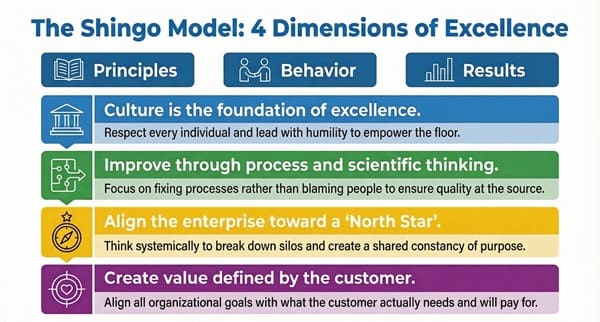
The Shingo Model is organized into four dimensions. Within these dimensions are ten guiding principles. Let’s look at them as if we were chatting over coffee—simple and direct.
Dimension 1: Cultural Enablers
This is the base of the pyramid. Without a strong culture, everything else falls apart. In my view, this is where most companies struggle the most.
- Respect Every Individual: This refers to more than just being “nice.” It means you value the potential of every person. When a worker on the floor has an idea, do you listen? Respecting individuals means giving them the tools and the power to improve their own work.
- Lead with Humility: We’ve all been there—the boss who thinks they know everything. The Shingo Model suggests the opposite. Leaders should be learners. They should go to the “Gemba” (where the work happens) and ask, “How can I help you?”
Dimension 2: Continuous Improvement
This dimension focuses on how we make things better every single day. It’s the “meat” of the Shingo Model for many Lean practitioners.
- Seek Perfection: Is perfection possible? Probably not. But by seeking it, you find ways to improve things you never noticed before. It keeps the energy high and the waste low.
- Embrace Scientific Thinking: This sounds fancy, but it just means “test your ideas.” Don’t just guess that a change will work. Run a small test, look at the data, and then decide. This is the PDCA (Plan-Do-Check-Act) cycle in action.
- Focus on Process: If something goes wrong, don’t blame the person. Look at the process. Roughly 90% of mistakes happen because the process was set up for failure.
- Assure Quality at the Source: Don’t wait until the end of the line to check for errors. Fix them the moment they happen. We call this “building quality in.”
- Improve Flow and Pull: Provide what the customer wants, only when they want it. Avoid making piles of inventory that just sit there gathering dust.
Dimension 3: Enterprise Alignment
How do we make sure everyone is pulling in the same direction? This part of the Shingo Model connects the shop floor to the executive suite.
- Think Systemically: Understand that everything is connected. If you change something in shipping, it might affect accounting. Stop thinking in silos.
- Create Constancy of Purpose: This is about having a clear “North Star.” Why does your company exist? When everyone knows the mission, they can make better decisions without asking for permission every time.
Dimension 4: Results
Finally, we have the results. The Shingo Model insists that if you follow the principles, the results will follow.
- Create Value for the Customer: In the end, the customer decides what is valuable. If the customer won’t pay for it, it is waste. We must always align our goals with what the customer actually needs.
How to Implement the Shingo Model?
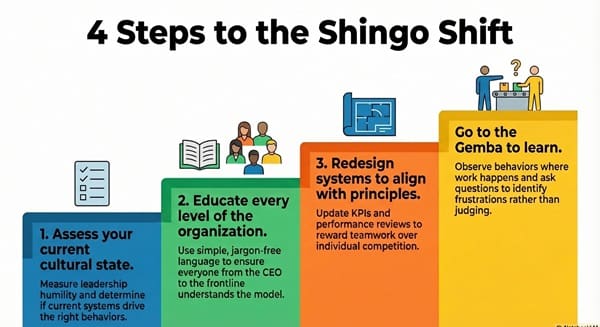
You might be thinking, “This sounds great, but where do I start?” To be honest, it’s a long journey. It’s not a project with a start and end date; it’s a change in how you live your professional life.
Step 1: Assessment First, look at your current state. Are your leaders humble? Do your systems encourage the right behaviors? You can’t fix what you don’t measure.
Step 2: Education Everyone from the CEO to the frontline staff needs to understand the Shingo Model. Use simple words and real-world examples. Don’t drown them in jargon.
Step 3: Redesign Systems Look at your KPIs (Key Performance Indicators). Do they reward teamwork or individual competition? If you want “Respect for Every Individual,” you might need to change how you do performance reviews.
Step 4: The Gemba Walk Go to where the work happens. Observe behaviors. Don’t go there to judge; go there to learn. Ask questions like, “What is the biggest frustration in your day?”
Also Read: Cost Modelling
Common Pitfalls to Avoid
In my experience, many companies treat the Shingo Model like a trophy to win. They want the Shingo Prize so they can put it on their website. This is a mistake. If you focus on the prize, you’ll likely cut corners. Focus on the principles, and the “prize” becomes a natural byproduct of your excellence.
Another trap is “Tool-itis.” This is when a company gets obsessed with using every Lean tool available. They have 5S charts everywhere, but the employees are miserable. Remember, tools don’t drive culture; principles do.
Case Example: The Transformation of “Company X”
Let’s look at a realistic example. Picture this: A mid-sized medical device company was struggling with high turnover and quality defects. They tried Lean tools for two years, but nothing stuck. Then, they adopted the Shingo Model.
Instead of just “fixing machines,” the CEO started holding “Coffee with the Boss” sessions. They focused on “Lead with Humility.” They stopped blaming workers for defects and started asking, “What in our system allowed this mistake to happen?” (Focus on Process). Within 18 months, their defect rate dropped by 40%, and employee satisfaction skyrocketed. They didn’t just “do Lean”; they lived the Shingo principles.
Key Takeaways on Shingo Model
- The Shingo Model is a framework for operational excellence based on universal principles.
- It emphasizes that ideal behaviors lead to ideal results.
- The model consists of four dimensions: Cultural Enablers, Continuous Improvement, Enterprise Alignment, and Results.
- Systems drive behavior. If you want better behavior, you must fix your systems.
- Leadership humility and respect for people are the foundations of a healthy culture.
- Operational excellence (OpEx) is a journey of continuous learning, not a destination.
Frequently Asked Questions About Shingo Model
What is the difference between Lean and the Shingo Model?
Lean is often seen as a set of tools (like 5S or Value Stream Mapping). The Shingo Model is the cultural framework that makes those tools effective. It’s the “operating system” for Lean.
Can non-manufacturing companies use the Shingo Model?
Absolutely! Hospitals, banks, and software companies use it. Principles like “Respect Every Individual” and “Focus on Process” apply to any place where people work together.
How long does it take to see results?
You might see small wins immediately, but a full cultural shift usually takes 3 to 5 years. It’s about building a habit of excellence.
Is the Shingo Prize hard to win?
Yes, it is very prestigious. It requires a deep dive into your organization by expert examiners. However, the value is in the journey of improvement, not just the award.
Final Words
The Shingo Model offers a path to a better way of working. It moves us away from “command and control” and toward a culture of respect, learning, and growth. By focusing on principles rather than just tools, you can create an organization that is not only more profitable but also a better place for people to work.
At our firm, we believe that every client deserves a strategy that lasts. We don’t just provide quick fixes; we help you build the foundation for long-term success. We are dedicated to your growth because your excellence is our passion. Let’s work together to transform your culture today.