Production flexibility is not just about having nice machines. It is a strategic capability that determines if your business thrives or struggles when faced with the unexpected. If you want to outperform your competitors, serve your customers better, and minimize financial risk, you need a deep understanding of what makes a manufacturing system truly adaptable.
In this detailed guide, we will break down the essential types of production flexibility, explore the key technology and workforce components that enable it, and show you exactly how this operational mindset drives real business agility. Let’s find out how to make your production system work for you, no matter what the market throws your way.
Table of contents
What is Production Flexibility?
Production flexibility refers to a manufacturing system’s ability to easily and cost-effectively adapt to changes in the market or customer demands. It is a critical operational characteristic for businesses today.
Production flexibility is defined as the ease with which a manufacturing operation can be modified to produce different products, use different raw materials, or change its volume of output. In simple words, production flexibility means your factory can quickly pivot without losing efficiency or raising costs too much.
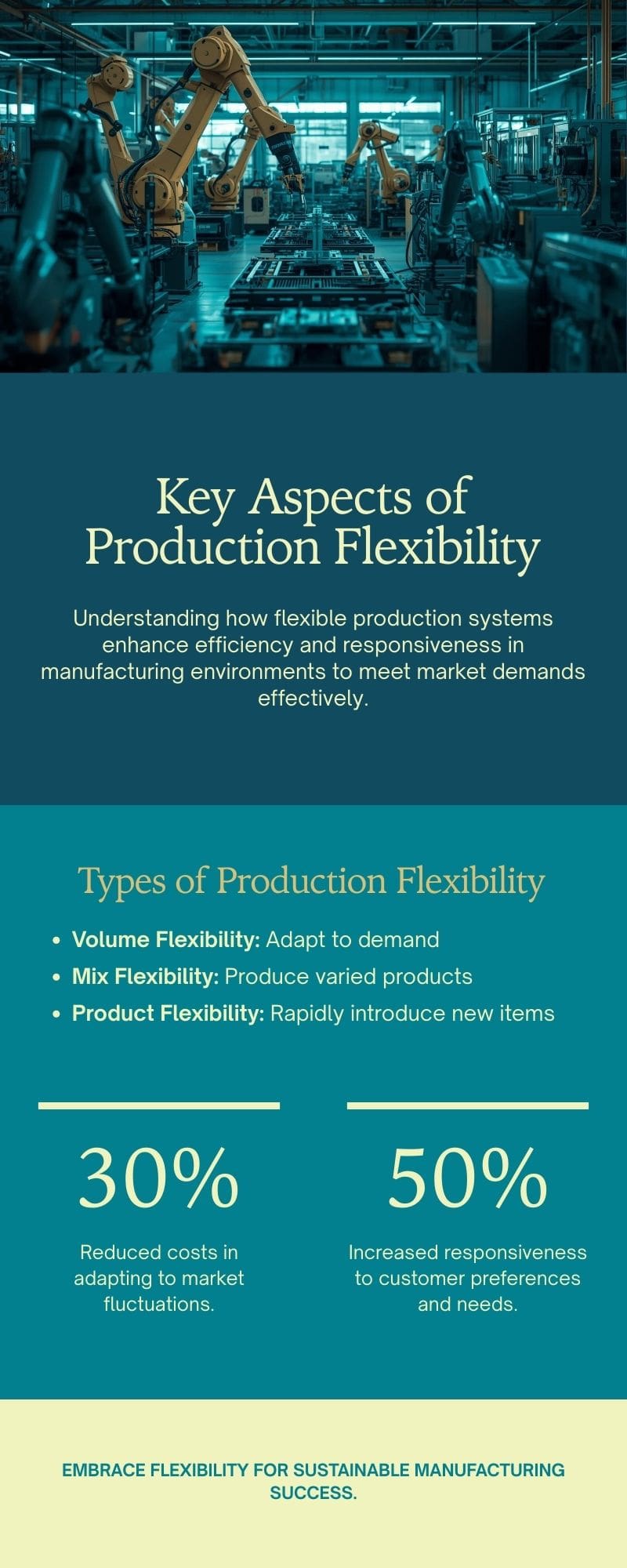
Why does production flexibility matter so much? Because the market changes fast. Customer tastes shift, new technologies emerge, and unexpected events can disrupt the supply chain. A company with high production flexibility can handle these changes better than a rigid one.
For instance, if demand for Product A suddenly drops and demand for Product B surges, a flexible factory can quickly switch its resources to make more of Product B.

Public, Onsite, Virtual, and Online Six Sigma Certification Training!
- We are accredited by the IASSC.
- Live Public Training at 52 Sites.
- Live Virtual Training.
- Onsite Training (at your organization).
- Interactive Online (self-paced) training,
Types of Production Flexibility
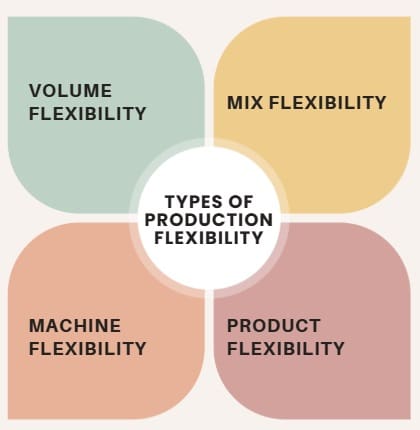
When discussing how a system can adapt, it is helpful to break down production flexibility into specific types. Each type addresses a different aspect of the manufacturing process.
1. Volume Flexibility
Volume flexibility refers to the ability to efficiently change the aggregate level of output, or production volume.
- Volume flexibility allows a company to smoothly increase or decrease the number of units produced.
- For example, during a holiday season, a manufacturer might need to double its output. A system with high volume flexibility can handle this peak in demand without large cost penalties or quality drops.
- Conversely, if demand falls, the system can reduce output without excessive idle time or waste.
2. Mix Flexibility
Mix flexibility is the ability to produce a variety of different products on the same system.
- Mix flexibility is essential for companies that offer many variations of a core product or a diverse product portfolio.
- For instance, an automotive plant that can switch from making a sedan to a truck or an SUV on the same assembly line demonstrates high mix flexibility.
- This is often achieved through sophisticated tooling and reprogrammable machines, such as those used in a Flexible Manufacturing System (FMS).
3. Product Flexibility
Product flexibility refers to the ability to introduce new products quickly and effectively into the production system.
- Product flexibility is crucial for remaining competitive in fast-paced industries like electronics.
- It means the system can accommodate the design and process requirements of an entirely new product with minimal retooling or redesign of the factory floor.
- This also relates to the time it takes to go from a product idea to full-scale production, often called time-to-market.
4. Machine Flexibility
Machine flexibility is the ease with which a machine can be changed to handle a new set of operations or different parts.
- Machine flexibility is the most basic level of system flexibility. It involves a machine’s inherent ability to perform a variety of tasks.
- For example, a Computer Numerical Control (CNC) machine that can be easily reprogrammed to cut a different shape without physical modifications shows high machine flexibility.
Also Read: Design for Manufacturing and Assembly (DFMA): Streamline Production
Key Components of Production Flexibility
Achieving high production flexibility requires a concerted effort across several areas of an organization. It is not just about installing new machines; it is about system design and people.
1. Flexible Manufacturing Systems (FMS)
A Flexible Manufacturing System (FMS) is a key enabler of production flexibility.
- FMS is an automated system where products are transferred between processing stations (like CNC machines or robots) and storage buffers by an automated material handling system (like conveyors or Automated Guided Vehicles (AGVs)).
- The primary characteristic of an FMS is its ability to produce various parts or products simultaneously without constant human intervention to change tooling. This directly enhances mix flexibility and product flexibility.
2. Skilled and Cross-Trained Workforce
People are a vital component of production flexibility.
- A cross-trained workforce can quickly move between different jobs or machines.
- If a system needs to switch production lines, employees who know how to operate multiple machines can prevent bottlenecks.
- This human production flexibility is essential, as machines still require skilled operators, programmers, and maintenance teams.
3. Modular Equipment and Plant Layout
The physical design of the factory floor significantly impacts production flexibility.
- Modular equipment can be easily moved, reconfigured, or added to the existing system.
- A flexible plant layout, often a cellular or U-shaped design, reduces the distance materials and workers must travel.
- This spatial arrangement allows managers to quickly rearrange the flow of work when changing the production mix or volume.
Advantages and Disadvantages of Production Flexibility
While production flexibility is a strategic advantage, it comes with trade-offs.
Advantages of Production Flexibility
| Advantage | Explanation |
| Improved Responsiveness | The business can react faster to sudden shifts in customer demand or competitor actions. This ability to pivot is a key benefit of production flexibility. |
| Increased Capacity Utilization | When demand is low for one product, the system can be quickly switched to produce another product that is in high demand, reducing idle time. |
| Reduced Time-to-Market | New products can be rolled out faster because the existing system requires less time and capital to reconfigure. |
| Enhanced Customer Satisfaction | Being able to quickly meet custom or changing orders directly leads to happier customers. |
Disadvantages of Production Flexibility
| Disadvantage | Explanation |
| Higher Initial Investment | Flexible Manufacturing Systems (FMS) and adaptable machinery are often more expensive to buy and install than dedicated, rigid equipment. |
| Increased Complexity | Managing a flexible system is more complex. Scheduling, routing, and inventory management become more difficult with many different products. |
| Need for Specialized Skills | The workforce needs a higher level of training to manage complex, multi-functional machines, increasing labor costs. |
| Potential for Sub-Optimization | A system designed to do many things might not be the absolute best at doing any single thing, possibly compromising efficiency in specific high-volume runs. |
Also Read: Job Shop Production
Achieving Production Flexibility: Steps and Strategy
How can a company move toward greater production flexibility? It is a continuous process that involves strategic planning and investment.
1. Standardize Parts and Processes
Standardization is the bedrock of production flexibility.
- Standardize parts across different products where possible. This allows a machine to use the same tooling for multiple assemblies.
- Similarly, standardize processes. If the assembly steps for two different products are similar, the changeover time between them is minimized.
2. Invest in Modular and Multi-purpose Equipment
The right technology supports true production flexibility.
- Multi-purpose equipment, like robots with quick-change end effectors, can perform welding, painting, or assembly tasks.
- This investment immediately boosts machine flexibility, making it easier to handle diverse product types. What happens if this new equipment breaks down, though? This is why preventative maintenance is key.
3. Implement Quick Changeover Techniques
To minimize the non-production time, companies must focus on reducing setup time.
- Techniques like Single-Minute Exchange of Die (SMED) are used to reduce machine setup and changeover times to less than ten minutes.
- Shorter changeover times mean a system can switch between products more frequently and economically. This is vital for high mix flexibility.
Production Flexibility vs. Supply Chain Agility
It is important to understand how production flexibility differs from the broader concept of supply chain agility.
| Basis for Comparison | Production Flexibility | Supply Chain Agility |
| Meaning | The ability of a factory or manufacturing system to adapt its output, mix, or volume. | The ability of the entire supply chain network (sourcing, manufacturing, distribution) to respond quickly to changes. |
| Nature | Internal, focusing on the factory floor operations and assets. | External and Internal, focusing on relationships and information flow across all partners. |
| Scope | Confined to the manufacturing process itself. | Encompasses the whole journey from raw material supplier to final customer. |
| Key Metric | Changeover time, range of products that can be made. | Time-to-market, forecast accuracy, order fulfillment cycle time. |
In this way, production flexibility is a core part of supply chain agility. You cannot have a truly agile supply chain without a flexible production system inside it.
Final Words
In conclusion, production flexibility is more than just a buzzword; it is a fundamental requirement for survival and growth in the modern economy. It allows a business to weather sudden storms of demand or capitalize on new opportunities quickly.
The main takeaway is that production flexibility must be built into a system from the ground up, involving smart technology, adaptable layouts, and, most importantly, a highly skilled and cross-trained workforce. By strategically investing in these areas, your company can achieve the adaptability required to lead your market.
FAQs on Production Flexibility
1. What is the main goal of achieving Production Flexibility?
The main goal is to improve market responsiveness. Production flexibility allows a company to efficiently meet unpredictable or rapidly changing customer demands. This can involve changes in product mix, output volume, or even the introduction of entirely new products. Essentially, it minimizes operational disruption when external conditions change.
2. Is Production Flexibility the same as Mass Customization?
No, they are related but different concepts. Production flexibility is the capability of the system to adapt. Mass customization is a strategy that uses that flexibility to produce goods tailored to individual customer needs at near mass-production costs. You need high production flexibility to successfully implement a mass customization strategy.
3. How does Lean Manufacturing relate to Production Flexibility?
Lean Manufacturing focuses on eliminating waste and increasing efficiency. While Lean often prefers high-volume, standardized runs, modern Lean concepts support production flexibility through techniques like SMED (Single-Minute Exchange of Die). SMED dramatically cuts the non-productive time needed to switch between products, making smaller, mixed batches economical, which is the definition of mix flexibility.
4. What is the biggest challenge when implementing Production Flexibility?
The biggest challenge is the initial investment and the increase in complexity. Flexible machinery, like robotics and FMS, requires a substantial upfront capital outlay. Furthermore, managing the complex scheduling and routing for a highly flexible system requires advanced software and a highly skilled workforce, increasing operational complexity.
5. Can a small business achieve Production Flexibility?
Yes, absolutely. Production flexibility is not just for large factories. A small business can achieve it through smart decisions, such as buying multi-purpose, small-scale machinery, cross-training employees extensively, and designing simple, modular workspaces. For a smaller company, high volume flexibility may be the most important starting point.