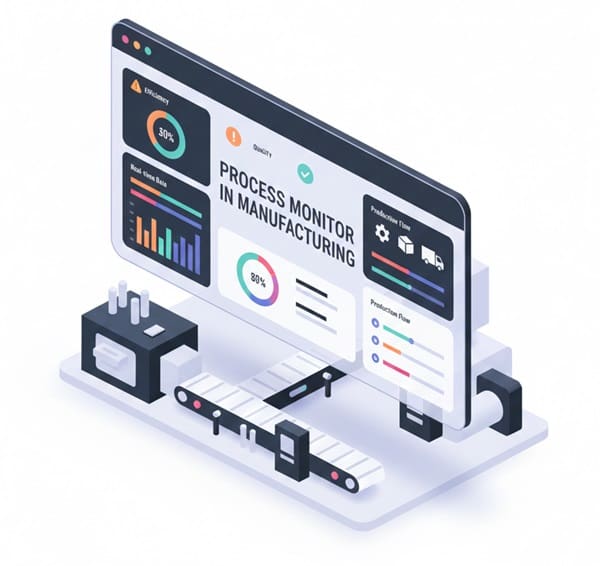
Process Monitor is a powerful concept in the world of automatic control and industrial systems. In simple words, it refers to the systematic act of watching a process to make sure it runs correctly and stays within safe limits. Process Monitor helps you know exactly what is happening inside a complex system right now.
Table of contents
Definition of Process Monitor
Process Monitor is defined as the set of activities used to observe, measure, and analyze the state of a system or process over time, typically to detect abnormal operation, faults, or deviations from the desired performance.
Why does this matter?
Well, imagine you are running a huge chemical plant. A small temperature spike you miss could cause a huge problem. Process Monitor prevents these issues. This tool becomes essential for maintaining safety, quality, and efficiency. We are not just talking about industrial plants, either; you use Process Monitor ideas in IT systems, business operations, and even complex software.
Let us now understand how we use this essential tool to keep systems stable and running smoothly.

Public, Onsite, Virtual, and Online Six Sigma Certification Training!
- We are accredited by the IASSC.
- Live Public Training at 52 Sites.
- Live Virtual Training.
- Onsite Training (at your organization).
- Interactive Online (self-paced) training,
Goal of a Strong Process Monitor System
A good Process Monitor system has several primary goals. Primarily, it wants to let you know when something is going wrong. It acts like a digital alarm bell.
The main objective of a reliable Process Monitor system is to detect and identify faults in a timely manner. Process Monitor aims to maintain control of the system by immediately flagging any deviation from normal operation.
Here, it is important to understand the concept of normal operating conditions. Every system has a range of values where it performs best. If the temperature goes above a certain level or a valve closes too slowly, the system moves outside its normal condition.
- Fault Detection: This is the primary function. Process Monitor detects when an unwanted event, termed as a fault, occurs. Faults are nothing but deviations.
- Fault Isolation: After detection, the system must figure out where the fault came from. Did the sensor fail, or did the pump actually break?
- Safety Assurance: Process Monitor systems ensure the operating environment remains safe for personnel and equipment. This is quite crucial in many industries.
- Quality Control: By watching the process variables, we ensure the final product meets its specifications. Thus, Process Monitor directly influences product quality.
Also Read: Process Management Information System (PMIS)
Steps in a Process Monitor System
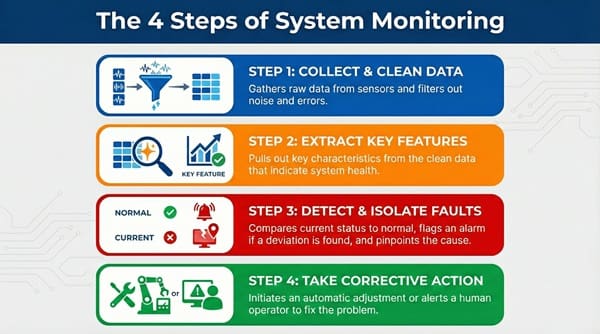
How does a system actually watch a process and decide if it is normal? This involves a sequence of steps that we can broadly classify into four stages.
1. Data Collection and Preprocessing
The very first step in Process Monitor involves collecting raw data. This data comes from various sensors present in the system. These sensors measure important variables like temperature, pressure, flow rate, and concentration.
We need to make sure this data is clean. Process Monitor requires high-quality data. Raw data often contains noise and errors. Data preprocessing means cleaning up this data. Simply put, we filter out the noise so we can see the real signal. This step is quite important because bad data leads to bad decisions.
2. Monitoring and Feature Extraction
Now that we have clean data, what do we do with it? We need to look at the data and pull out key characteristics, or features, that tell us about the system’s health.
For instance, simply looking at the temperature value is not enough. We might also look at the rate of change of the temperature. Is it rising too fast? This rate of change is a feature.
Process Monitor techniques use these features. We often compare the current features to a set of features from when the system was running perfectly (the normal operation profile).
- Statistical Features: These include the mean, variance, and standard deviation of a process variable. They tell us about the average behavior and how much the variable fluctuates.
- Time-Series Features: These look at how the variables change over time. Process Monitor often uses this to spot trends.
3. Fault Detection and Isolation
This is where the actual decision-making happens. We compare the current operating status to the normal status. If a significant difference is found, we flag an alarm.
This comparison is often done using a Process Monitor technique termed as statistical process control (SPC). SPC uses control charts.
Process Monitor uses these charts to define upper and lower control limits. If a measured feature (like the average temperature) goes outside these limits, we say the process is out of control. The system detects a fault.
Fault Isolation then tries to pinpoint the cause. Process Monitor tools look at which specific variables changed. Fault Isolation is a crucial step for the operator; knowing what failed is more helpful than just knowing something failed.
4. Corrective Action
Once we detect and isolate the fault, we must take action. The final stage in Process Monitor is to initiate a corrective measure.
In some fully automated systems, the Process Monitor system itself can automatically adjust a valve or change a setpoint. This is termed as a closed-loop system. In other cases, the system alerts a human operator. The operator then decides on the best course of action. This is called an open-loop system.
- Automatic Correction: Fast-acting systems can correct minor deviations without human help.
- Operator Alert: For major or complex faults, the system alerts the operator, thereby ensuring human oversight.
Comparing Different Process Monitor Techniques
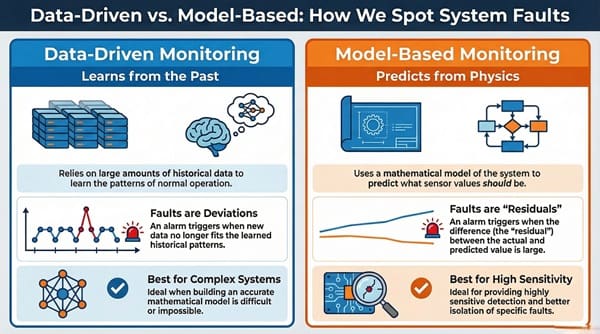
We use several different methods to achieve effective Process Monitor. Each method has its own way of defining “normal” and spotting a fault. Let us now discuss the two major categories: Model-Based and Data-Driven Process Monitor methods.
Data-Driven Process Monitor
Data-Driven Process Monitor is a highly popular approach today. This method relies heavily on historical data. Data-Driven Process Monitor does not need a complex engineering model of the system. Instead, it learns the normal operating profile just by looking at thousands of past data points where the system was running fine.
How does Data-Driven Process Monitor work?
We often use methods called Principal Component Analysis (PCA) or Partial Least Squares (PLS). These are powerful statistical tools. Simply put, they break down the complex relationships between all the variables. PCA, for example, finds the major patterns, or principal components, in the data.
- When the system is running normally, the data points stick close to these learned patterns.
- If a fault occurs, the new data point will deviate significantly from the patterns. Data-Driven Process Monitor sees this deviation and triggers an alarm.
The main benefit of Data-Driven Process Monitor is that we can apply it to complex systems where building a full mathematical model is almost impossible.
Model-Based Process Monitor
Model-Based Process Monitor, on the other hand, requires a deep understanding of the system physics. We must create a mathematical model, or a set of equations, that accurately describe how the system behaves.
The core idea is to use this model to predict what the system variables should be.
- We compare the actual measured variable (from the sensor) with the predicted variable (from the model).
- The difference between these two values is called the residual.
If the system runs normally, this residual is quite small, close to zero. If a fault occurs—say, a leak—the model will not see the leak, but the sensor will. This makes the residual become large. Model-Based Process Monitor systems use a large residual to signal a fault.
What is the benefit of Model-Based Process Monitor?
It is highly sensitive and often provides better fault isolation because the model itself is tied to the physical parts of the system. However, building the model is quite difficult.
Key Takeaways
We have covered the major aspects of Process Monitor. Here are the most essential concepts to keep in mind.
- Process Monitor is defined as systematically observing a process to ensure it stays healthy, safe, and efficient.
- A Fault is nothing but any significant and unwanted deviation from the normal operating condition.
- The Control Chart is a statistical tool used in Process Monitor to define the upper and lower limits of normal operation.
- Data-Driven Method uses historical data (like PCA) to learn the normal patterns; it does not require a physics-based model.
- The Model-Based Method uses a mathematical model of the system; it detects faults by finding a large difference, termed as the residual, between the model’s prediction and the actual measurement.
Process Monitor is nothing but a powerful surveillance system for your processes. It ensures smooth operation by catching small issues before they become big, expensive problems.
Also Read: Business Process Modeling
Frequently Asked Questions (FAQs) about Process Monitor
Why is Process Monitor better than simply setting high and low alarms?
Simply setting a single high or low alarm is too simplistic. Process Monitor is a more sophisticated approach. Process Monitor considers the relationships between multiple variables, not just one. For example, a high temperature might be normal if the pressure is also high. A basic alarm would trigger, but a smart Process Monitor system would understand the context. This helps reduce false alarms.
Can Process Monitor be used for business operations and not just factories?
Yes, absolutely. Process Monitor principles apply everywhere. For instance, in IT, you monitor server response times and CPU usage to detect a fault (like an impending crash). In business, you monitor sales trends and inventory levels to detect a fault (like unexpected stock shortage). Process Monitor is a widely applicable concept.
What is the difference between Process Monitor and Process Control?
This is an important distinction. Process Monitor simply observes and detects deviations. It is all about giving information. Process Control, on the other hand, is the action taken to correct the deviation. Process Control uses the information from Process Monitor to decide how to adjust the system (e.g., open a valve). Both work together. Process Monitor is the eyes; Process Control is the hands.
Conclusion
We have seen that understanding Process Monitor is not just about knowing a technical term. It is about embracing a proactive mindset toward system management. By using smart Process Monitor techniques, you ensure system integrity, maximize efficiency, and, crucially, maintain a safe operating environment.
Your focus on system health should be relentless. That is why our company, a leader in advanced control systems, provides solutions that go beyond simple alarms. We help you design and implement highly sensitive Process Monitor and control systems tailored to your specific needs.