Have you ever wondered how big companies predict the cost of a massive project before they even start? They do not just guess. Instead, they use a data-driven approach known as parametric estimation. This method uses math and history to give you a clear picture of future costs or time.
If you want to understand what is parametric estimation in project management or how it works in statistics, you are in the right place. We will look at how this method turns raw data into reliable plans.
Table of contents
Parametric Estimation Meaning and Basics
Parametric estimation meaning refers to a technique where you use a statistical relationship between historical data and other variables. In simple terms, you find a “parameter” or a unit of work. Then, you multiply that unit by the total number of units in your current project.
The parametric estimation method relies on accuracy. If your past data is solid, your future estimate will be too. It is a step up from simple guessing because it uses real numbers to justify every dollar or hour spent.

Public, Onsite, Virtual, and Online Six Sigma Certification Training!
- We are accredited by the IASSC.
- Live Public Training at 52 Sites.
- Live Virtual Training.
- Onsite Training (at your organization).
- Interactive Online (self-paced) training,
Comparison of Estimation Techniques
| Basis for Comparison | Parametric Estimation | Analogous Estimation | Bottom-Up Estimation |
| Data Source | Statistical data and math models | Past similar projects (Expert judgment) | Detailed breakdown of every task |
| Accuracy | High (if data is good) | Low to Medium | Very High |
| Time Required | Moderate | Fast | Slow |
| Cost | Moderate | Low | High |
| Best Used When | You have clear metrics | Early stages with little info | You have a full project breakdown |
What is Parameter Estimation in Statistics?
To truly grasp the concept, we must ask: what is parameter estimation in statistics? In the world of math, a parameter is a value that describes a whole population. For example, the average height of every human is a parameter. Since we cannot measure everyone, we use a sample.
Parameter estimation methods help us find the most likely value of that population parameter based on the sample we have.
Types of Statistical Estimation
- Point Estimation: This provides a single value as the best guess for the parameter.
- Interval Estimation: This provides a range of values where the parameter likely sits.
While parameter estimation sounds complex, it is just about finding the truth in numbers. Statistical models like Maximum Likelihood Estimation (MLE) or Method of Moments (MoM) are common parameter estimation methods used by data scientists today.
Also Read: Non-Parametric Test
What is Parametric Estimation in Project Management?
In the business world, parametric estimation project management is a vital tool for the “Planning” phase. Project managers use it to calculate the budget or the schedule.
Parametric estimation project management works best for repetitive tasks. If you are building a road, you know the cost per mile. If you are coding a website, you might know the cost per page. You take that “parameter” and scale it up.
Why Use Parametric Estimation Models?
Parametric estimation models help you stay objective. When a client asks why a project costs $100,000, you do not say “because I think so.” You show them the math. You show them the parametric cost estimating data that proves the price is fair.
How the Parametric Estimation Method Works?
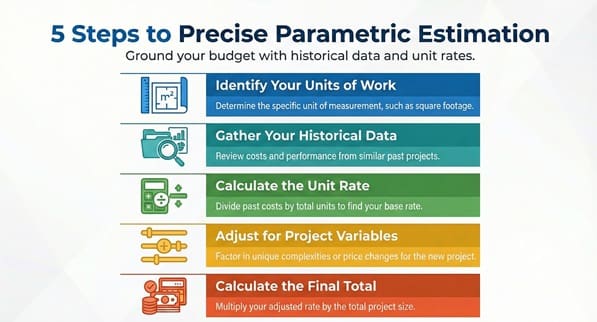
The parametric estimation method follows a specific sequence. You cannot skip steps if you want a reliable result.
- Identify the Units: First, find the unit of work. For a painter, this is a square foot of a wall.
- Gather Historical Data: Look at past jobs. How much did it cost to paint 1,000 square feet last year?
- Calculate the Rate: If 1,000 square feet cost $2,000, your rate is $2 per square foot.
- Adjust for Variables: Is the new wall higher? Is the paint more expensive? Adjust your rate accordingly.
- Calculate the Total: Multiply your rate by the new project size.
This parametric estimation project management flow ensures that your budget remains grounded in reality.
Also Read: Shapiro-Wilk Test
Parametric Estimation Example in Real Life
Let us look at a parametric estimation example to make this clear. Imagine you run a software company. You are tasked with creating a new app.
- The Parameter: Your team writes code at a rate of $50 per line of code (LOC).
- The Project: The new app requires roughly 5,000 lines of code.
- The Calculation: $50 \times 5,000 = $250,000.
In this parametric estimation example, the “line of code” is the parameter. This logic applies to construction, manufacturing, and even healthcare. Parametric cost estimating allows for quick scaling. If the client doubles the requirements, you simply double the math.
What is Parametric Cost Estimating in Industry?
What is parametric cost estimating? It is the process of using algorithms to predict the financial needs of a project. Many government and defense agencies require parametric cost estimating because it is transparent.
It reduces the risk of human bias. When you use parametric estimation models, you are letting the data speak. This is especially helpful in large-scale infrastructure where a 5% error could mean millions of dollars.
Understanding Parametric Estimation Models
There are two main types of parametric estimation models used by professionals:
1. Deterministic Models
These models provide a single, fixed number. You multiply the quantity by the rate, and you get one answer. This is simple but does not account for risks.
2. Probabilistic Models
These models are more advanced. They use a range of possible values. They might say, “The project will cost between $10,000 and $12,000 with 90% certainty.” This is often called a Monte Carlo simulation.
Non Parametric Estimation vs Parametric Estimation
It is important to know about non parametric estimation. While parametric methods assume the data follows a specific shape (like a bell curve), non parametric estimation does not make these assumptions.
Non parametric estimation is useful when your data is messy or does not follow a standard pattern. However, for most project management tasks, the parametric estimation method is preferred because it is easier to calculate and explain to stakeholders.
Advantages of Using Parametric Estimates
Why should you choose this over other ways?
- Scalability: You can estimate a small room or a whole skyscraper using the same logic.
- Speed: Once you have the data, the math takes seconds.
- Auditability: It is easy to show your work to a boss or a client.
- Accuracy: It uses real history, not just “gut feelings.”
Common Challenges with Parameter Estimation Methods
Even though what is parameter estimation methods sounds foolproof, there are traps.
- Bad Data: If your historical records are wrong, your estimate will be wrong. “Garbage in, garbage out.”
- Unique Projects: If you are doing something brand new, there is no historical data to use.
- Changes in Technology: If a new machine makes work twice as fast, your old parameters are useless.
You must keep your data fresh. Parametric estimation project management only works if the parameters match the current world.
Frequently Asked Questions on Parametric
What is the difference between parametric and analogous estimation?
Analogous estimation uses the “total” cost of a past project. Parametric estimation uses “unit” costs. Parametric is usually more accurate because it uses math rather than just a general comparison.
When should I use parametric estimation?
Use it when you have a large amount of reliable historical data and the work is repetitive. It is perfect for construction, data entry, or manufacturing.
Is parametric estimation always accurate?
No. It depends on the quality of your data. If your unit cost is off by just a few cents, and you multiply it by a million units, the error becomes huge.
What is a parameter in a project?
A parameter is any measurable factor. This could be hours per person, cost per square meter, or lines of code per day.
Key Takeaways
- Parametric estimation uses historical data and statistical relationships to calculate costs.
- The parametric estimation meaning is rooted in finding a cost per unit.
- What is parameter estimation methods? They are mathematical ways to find population values from samples.
- Parametric estimation models can be deterministic (one number) or probabilistic (a range).
- This method is more accurate than analogous estimation but requires better data.
Final Words
The parametric estimation method is a bridge between the past and the future. By looking at what you have already done, you can predict what you will do next with great precision. Whether you are looking at what is parameter estimation in statistics or trying to budget a new business venture, these math-based models are your best friend.
Parametric estimation project management removes the stress of the unknown. It replaces “maybe” with “most likely.” As you gather more data, your power to predict will only grow.
We believe that data-driven decisions lead to the best results. Our team focuses on providing you with the tools and insights needed to plan your projects with total confidence. Let us help you turn your data into a roadmap for success.