
Have you ever sat in a meeting where everyone had great ideas, but nobody could agree on which one to start? It’s a common headache. You end up with a whiteboard full of sticky notes and a clock that says time is up. This is where multivoting saves the day. It’s a simple way to take a giant list of options and shrink it down to a manageable size.
To be honest, most teams struggle because they try to pick the “winner” too fast. Instead of arguing, why not use a system that lets everyone have a say?
Have you ever wondered if there’s a fairer way to reach a consensus without hurting anyone’s feelings? In my experience, this tool doesn’t just pick an idea; it builds a sense of ownership among the crew. We’ll look at how it works, but first, let’s see why your current brainstorming might be failing you.
Table of contents
- What is Multivoting in Group Decision Making?
- Step-by-Step Guide to the Multivoting Method
- Multivoting vs. Nominal Group Technique (NGT)
- Tips for a Successful Session
- Common Mistakes to Avoid
- Real-World Case: The Hospital Staffing Dilemma
- How to Handle Disagreements After the Vote
- The Role of the Facilitator
- Digital Tools for Remote Multivoting
- Is Multivoting Always the Best Choice?
- Key Takeaways
- Frequently Asked Questions on Multivoting
- Final Words
- Related Articles
What is Multivoting in Group Decision Making?
At its heart, multivoting is a series of votes used to pare down a long list of items to a few high-priority ones. We often call it “n/3 voting” because of a common rule we use to decide how many votes each person gets. It isn’t about finding a single winner immediately. Rather, it’s about filtering out the noise.
Think of it as a funnel. You start with fifty ideas from a brainstorming session. If you try to discuss all fifty, you’ll be there until next Tuesday. By using this method, the group can quickly identify the top 20%, then the top 10%, and so on. It is a staple in Quality Improvement (QI) because it’s data-driven yet easy to do.
Why Your Team Needs a Multivoting Process
Why bother with a formal process? Well, we’ve all been in meetings where the loudest person wins. That’s not great for morale or for the project. Using a structured approach ensures that the “quiet genius” in the corner has just as much power as the manager.
- It Saves Time: You stop circling the same three arguments.
- It’s Fair: Everyone gets the same number of votes.
- It Builds Buy-In: People support a choice more when they helped pick it.
- It’s Visible: Everyone sees the dots or marks, so there’s no “secret” math.

Public, Onsite, Virtual, and Online Six Sigma Certification Training!
- We are accredited by the IASSC.
- Live Public Training at 52 Sites.
- Live Virtual Training.
- Onsite Training (at your organization).
- Interactive Online (self-paced) training,
When Should You Use Multivoting?
You don’t need this for every little thing. If you’re picking a place for lunch, just point and go. But for big projects? Use it when:
- Your brainstorming session produced more than 10-15 items.
- The group needs to reach a consensus on a few top priorities.
- You want to avoid “groupthink” where everyone just agrees with the boss.
Step-by-Step Guide to the Multivoting Method
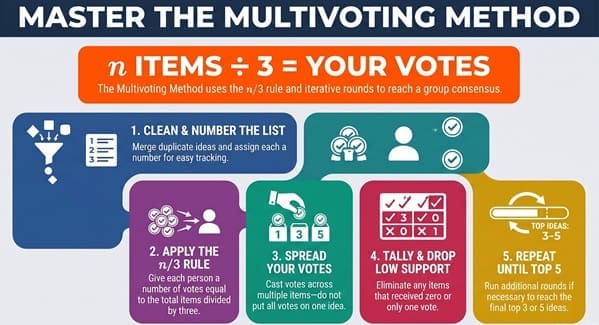
Ready to try it? Here is how you can run a session like a pro.
Step 1: Generate and Clean the List
Before you vote, you need a list. Usually, this comes from a brainstorming or an Affinity Diagram session. First, look for duplicates. If “Better Software” and “New Tech Tools” mean the same thing, combine them. Make sure everyone understands what each item means. If someone is confused, they might vote for the wrong thing!
Step 2: Number the Items
Give every idea a number. It makes it much easier to track. “I vote for number 4” is faster than saying “I vote for the idea about the reorganization of the filing cabinet.”
Step 3: Determine the Vote Count
How many votes does each person get? The gold standard is the n/3 rule. You take the total number of items ($n$) and divide by three.
Example: If you have 15 items, everyone gets 5 votes.
Step 4: Cast the First Round
Let everyone mark their choices. You can use sticky dots, checkmarks, or even a digital poll. In this first round, people can’t put all their votes on one item. They must spread them out. This forces the group to look at the whole “landscape” of ideas.
Step 5: Tally and Reduce
Count the votes. Look for the items with the most support. A good rule of thumb is to keep items that got at least a few votes. If an idea got zero or one vote in a large group, it’s probably safe to drop it.
Step 6: Repeat if Necessary
Is the list still too long? If you started with 30 and now you have 12, do another round. This time, you might give each person fewer votes (like n/3 of the new total). Eventually, you’ll have a top 3 or 5 that everyone feels good about.
Also Read: Brainstorming 101: Process of Generating Breakthrough Ideas
Multivoting vs. Nominal Group Technique (NGT)
People often mix these up. While they are cousins, they aren’t twins. In multivoting, the process is more fluid. It’s about narrowing a list through rounds. Nominal Group Technique is more formal. NGT usually involves ranking items (1st place, 2nd place, etc.) and adding up the scores.
Which is better? If you have a huge list, start with the voting method to get it down to a manageable size. Then, use NGT for the final, precise ranking.
Tips for a Successful Session
I’ve seen these sessions go south when the leader isn’t prepared. Here’s what I’ve learned from years of doing this:
- Don’t Rush the Clarification: If people don’t know what they are voting for, the results are useless.
- Keep it Anonymous: If people are afraid to go against the boss, use secret ballots or a digital tool like Mentimeter.
- Watch for “Lobbying”: Sometimes people try to talk others into their choice during the break. Keep it focused on the criteria.
Common Mistakes to Avoid
Even with a simple tool, things can go wrong. Roughly half of the failed sessions I’ve seen happened because the list was too vague.
- Too Many Options: If you have 100 items, the votes will be too spread out. Try to group them into themes first.
- Not Establishing Criteria: Ask the group: “Are we voting for the easiest ideas or the ones with the most impact?” If half the group thinks “easy” and the other half thinks “impact,” your data will be a mess.
- Allowing “Dot Voting” Manipulation: In some versions, people put all their dots on one thing (called “piling”). It’s usually better to restrict this so you see a broader range of support.
Real-World Case: The Hospital Staffing Dilemma
Picture this: A local clinic was struggling with wait times. They brainstormed 40 different causes. The staff was frustrated and overwhelmed. We used multivoting to help them.
In the first round, each staff member got 13 votes. We quickly saw that “Front desk paperwork” and “Lab result delays” were the big winners. We cut the 40 items down to 10. In the second round, we gave them 3 votes each. By the end of the hour, the team had 3 clear projects to work on. They left feeling relieved because they finally had a plan they all agreed on.
How to Handle Disagreements After the Vote
What if someone’s favorite idea gets cut? It happens. The beauty of this system is that it’s transparent. You can say, “Look, we all had 5 votes, and only one person chose that.” It makes the rejection feel less personal. However, if a critical idea gets dropped, don’t be afraid to have a brief discussion to see if it should be merged with a winner.
The Role of the Facilitator
If you’re running the meeting, your job is to stay neutral. Don’t vote yourself unless you’re part of the team. Your goal is to keep the energy up and make sure the rules are followed. Are people following the n/3 rule? Is the tallying accurate? You are the referee.
Also Read: Affinity Grouping
Digital Tools for Remote Multivoting
Since we’re all doing more Zoom calls these days, how do you do this online?
- Miro/Mural: Great for digital sticky notes and dot voting.
- Google Forms: Simple for secret ballots.
- Poll Everywhere: Good for real-time results.
Is Multivoting Always the Best Choice?
To be honest, no. If you need a mathematically perfect answer, you might need a Decision Matrix. But if you need speed and group agreement? This is your best bet. It’s a “good enough” tool that leads to “great” action.
Key Takeaways
- Multivoting narrows large lists into a few priorities.
- The n/3 rule is the best way to assign votes.
- It prevents “the loudest voice” from dominating the room.
- Clarity on what each item means is vital before the first vote.
- It works best for narrowing, while NGT works best for final ranking.
Frequently Asked Questions on Multivoting
What if there is a tie?
If you have a tie for the last spot, you can either keep both items for the next round or do a quick “tie-breaker” vote between just those two.
Can one person put all their votes on one item?
Usually, no. This is called “bullet voting.” It’s better to require people to spread their votes to find the ideas with the widest appeal.
How many rounds should we do?
Most teams find that 2 or 3 rounds are enough to get a list of 50 down to a top 5.
Is this the same as brainstorming?
No, it happens after brainstorming. Brainstorming creates the list; this tool cleans it up.
Final Words
We’ve all felt the pain of a meeting that goes nowhere. But with multivoting, you give your team a clear path forward. It turns a chaotic mess of ideas into a focused list of goals. It’s fair, it’s fast, and it works. At our company, we believe that every voice matters. We value the collective intelligence of your team and strive to provide tools that make collaboration easy. When you prioritize together, you succeed together.


