Lean enterprise isn’t just a fancy buzzword for cutting costs or firing people to save a buck. To be honest, we’ve all seen companies try to “trim the fat” only to end up breaking their internal culture and losing their best talent. Have you ever wondered why some massive organizations stay agile like a startup while others crumble under their own weight?
The secret lies in a shift from traditional “command and control” management to a system that prizes value above everything else. In my experience, moving toward a lean enterprise (LE) model is the only way to survive in an era where customer demands change faster than your morning coffee cools down. It is a holistic approach that stretches from the person answering the phones to the CEO in the corner office.
But what does it actually look like in practice? Let’s break down the walls and see how this system functions in the real world.
Table of contents
What is a Lean Enterprise?
At its core, a lean enterprise refers to an organization that uses lean principles to maximize value while minimizing waste across the entire value stream. It isn’t just for the manufacturing floor anymore. We’re talking about HR, finance, legal, and software development all working in sync.
The LE model focuses on identifying what the customer is actually willing to pay for. Anything else? That’s waste. Think about the last time you waited three weeks for a simple approval at work. That delay didn’t add value to the customer; it just added frustration to your day. That is exactly what a lean system aims to kill.

Public, Onsite, Virtual, and Online Six Sigma Certification Training!
- We are accredited by the IASSC.
- Live Public Training at 52 Sites.
- Live Virtual Training.
- Onsite Training (at your organization).
- Interactive Online (self-paced) training,
The Five Pillars of Lean Enterprise Thinking
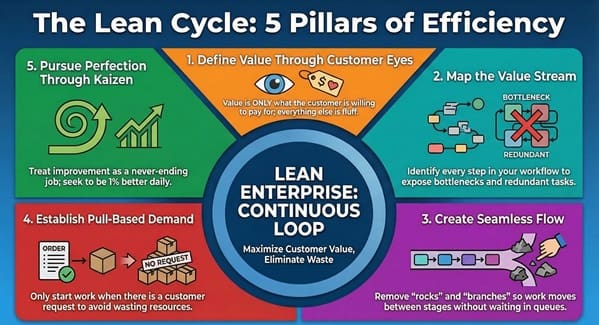
To understand how this works, we need to look at the foundational steps. It’s not a “one and done” checklist. It’s a cycle.
1. Defining Value from the Customer’s Eyes
In a lean enterprise, value is only defined by the end user. We often get caught up in “cool features” or “complex processes,” but if the customer doesn’t care, it’s fluff. Ask yourself: if the client saw this specific task on their invoice, would they pay for it?
2. Mapping the Value Stream
This is where we get into the weeds. You have to map out every single step in your process. We’ve all been there—discovering a step in a workflow that “we’ve always done” but nobody knows why. When you map the stream, you find the bottlenecks and the redundant hand-offs.
3. Creating Flow
Once the waste is gone, you want the remaining steps to flow smoothly. Imagine a river without rocks or fallen branches. In an LE environment, work moves from one stage to the next without waiting in “inboxes” or sitting in queues.
4. Establishing Pull
This is a big one. Instead of pushing products onto a shelf and hoping someone buys them, a lean enterprise only starts work when there is a demand. This reduces inventory costs and ensures you aren’t wasting resources on things nobody wants.
5. Pursuing Perfection
This is the “Kaizen” spirit. It implies that the job is never truly finished. We are always looking for a way to do things 1% better than yesterday.
Also Read: Lean Learning: How to Gain More Skills with Less Waste
Characteristics of a Lean Enterprise
What makes an LE stand out from a traditional company? It usually comes down to how they treat their people and their data.
Culture Over Tools
You can buy all the project management software in the world, but if your team is afraid to report errors, you aren’t lean. A true lean enterprise empowers the workers on the front lines to stop the line if they see a problem. This “bottom-up” intelligence is what drives real growth.
Data-Driven Decision Making
Roughly speaking, lean companies don’t guess. They use Key Performance Indicators (KPIs) that actually matter. They don’t look at “vanity metrics” like how many emails were sent. They look at lead time, cycle time, and first-pass yield.
Why Does Lean Enterprise Matter for Modern Business?
You might be thinking, “This sounds like a lot of work. Why bother?” Well, the consumer sector is changing rapidly. According to McKinsey research, companies that embrace lean management see a 30% to 50% improvement in productivity.
Beyond the numbers, it makes work better for you. When you remove the “busy work,” people get to focus on the creative, high-impact tasks they were actually hired to do. Don’t we all want to feel like our work actually matters at the end of the day?
Common Challenges in Lean Transformation
Transitioning to a lean enterprise isn’t all sunshine and rainbows. To be honest, it’s often painful at first.
- Management Resistance: Leaders often struggle to give up control.
- The “Toolbox” Trap: Many firms think lean is just a set of tools (like 5S or Kanban) rather than a mindset.
- Short-term Thinking: If you’re only looking at next month’s profits, you’ll likely cut corners that destroy the long-term lean flow.
Also Read: Why Not Put More Lean Into Your Life?
Real-World Examples: Lean Beyond the Factory
We often point to Toyota, but let’s look at a modern software company. Picture this: a team that releases updates every day instead of every six months. By using lean principles, they get immediate feedback from users. If a feature is a dud, they stop working on it immediately.
That’s a lean enterprise in action. They saved thousands of hours of coding because they listened to the “pull” of the market.
How to Start Your Lean Journey
If you’re ready to move toward a lean enterprise model, start small.
- Identify a single value stream. Don’t try to fix the whole company at once.
- Talk to the front line. The people doing the work usually know where the waste is.
- Focus on “Why.” Always tie every change back to the customer’s needs.
Frequently Asked Questions (FAQs)
Is lean enterprise just about cutting jobs?
Absolutely not. In fact, a true LE uses the time saved by efficiency to reinvest in innovation. It’s about cutting waste, not people.
Does this work for small businesses?
Yes. Small and Medium Enterprises (SMEs) often find it easier to go lean because they are more flexible than giant corporations.
How long does a lean transformation take?
It’s a journey, not a destination. You’ll see results in months, but the “transformation” lasts as long as the company does.
Key Takeaways
- Lean enterprise focuses on customer value and eliminating waste.
- It requires a total shift in culture, not just new software.
- Flow and Pull are essential to preventing overproduction.
- Continuous improvement (Kaizen) ensures long-term survival.
- Front-line employees are the most valuable source of information.
Final Words
Building a lean enterprise is about creating a resilient, adaptive organization that respects its people and its customers. It is about being honest about what works and what doesn’t. We’ve all seen companies fade away because they were too slow to change. Don’t let yours be one of them. At our core, we value the growth of our clients and the efficiency of their systems. We believe that a better way of working is possible for everyone.
Ready to stop wasting time and start creating value? Let’s build something better together.