Have you ever sat in a boardroom listening to a manager explain a problem that they’ve never actually seen with their own eyes? It feels a bit like someone describing the taste of a peach having only ever read a botany textbook. In the world of lean manufacturing and efficient management, we call the antidote to this “Genchi Genbutsu.”
Genchi Genbutsu is a core pillar of the Toyota Production System. While it sounds like a complex corporate buzzword, the concept is actually refreshingly simple. To be honest, it is something we should all be doing more of in our daily work lives. It basically means “go and see.”
But why is this so transformative? Why does Toyota, one of the most successful companies on the planet, insist that its executives spend time on the factory floor rather than just looking at spreadsheets? In my experience, the difference between a report and reality is often where the biggest business failures hide.
Table of contents
Genchi Genbutsu vs. Gemba Walk
Before we dive into the nuts and bolts, let’s clear up some common confusion. People often use Genchi Genbutsu and Gemba Walk interchangeably. While they are cousins, they aren’t identical twins.
| Basis for Comparison | Genchi Genbutsu | Gemba Walk |
| Meaning | The philosophy of “going to the source” to find the facts and make correct decisions. | The actual physical act of walking through the workplace to observe a process. |
| Focus | Focuses on the mindset and the gathering of authentic data at the source. | Focuses on the physical movement and the scheduled activity of observation. |
| Objective | To understand the root cause of a problem through direct experience. | To engage with employees and identify waste (Muda) in a specific area. |
| Application | Can be applied to any situation, including customer service or product design. | Usually refers to manufacturing or office workflow environments. |
| Frequency | A continuous mindset that should be triggered whenever a problem arises. | Often a scheduled or routine management activity. |
Definition of Genchi Genbutsu
Definition: Genchi Genbutsu is a Japanese phrase that translates literally to “actual place, actual thing.” It refers to the practice of going to the location where work is performed to understand a situation based on direct observation. This principle suggests that data is only useful if it is verified by physical presence.
In the Toyota Way, this isn’t just a suggestion; it is a requirement. If you want to solve a problem, you don’t stay in your office. You go to the “Genchi” (the actual place) and look at the “Genbutsu” (the actual object or process).
To understand this, we need to look at how humans process information. Reports are filtered through the perspectives of the people writing them. By the time a “problem” reaches an executive’s desk, it has been polished, edited, and perhaps even sanitized. Genchi Genbutsu strips away those layers of fluff and shows you the raw truth.

Public, Onsite, Virtual, and Online Six Sigma Certification Training!
- We are accredited by the IASSC.
- Live Public Training at 52 Sites.
- Live Virtual Training.
- Onsite Training (at your organization).
- Interactive Online (self-paced) training,
The Philosophy Behind “Go and See”
Now the question arises: why is seeing better than reading? In my years of consulting, I’ve noticed that managers who rely solely on digital dashboards often miss the “smell” of a problem. They see that “Line A” is down by 5%, but they don’t see that the operator is struggling with a jammed lever because the lighting in that corner is poor.
Toyota’s former chairman, Fujio Cho, famously summarized it as: “Go see, ask why, show respect.”
- Go See: Physical presence is non-negotiable.
- Ask Why: Use the observation to trigger deeper thinking.
- Show Respect: You aren’t there to play “gotcha” with the workers. You are there to understand their challenges and help.
Have you ever tried to fix a computer over the phone with someone who isn’t tech-savvy? It’s frustrating, right? That’s because you can’t see what they see. Genchi Genbutsu is the equivalent of taking the keyboard yourself to see what’s actually happening.
The Five Whys and Genchi Genbutsu
Genchi Genbutsu works best when paired with the “Five Whys” technique. When you are at the source, you can’t just look; you have to investigate.
Let’s look at a realistic hypothetical. Imagine a production line stops because a fuse blew.
- Why did the fuse blow? The machine was overloaded. (You see this at the source).
- Why was it overloaded? The bearing wasn’t lubricated properly. (You touch the dry bearing).
- Why wasn’t it lubricated? The pump wasn’t working. (You inspect the pump).
- Why wasn’t the pump working? The shaft was worn. (You look at the metal shavings).
- Why was it worn? No strainer was attached, letting in scrap. (Root cause found).
Without being at the “Genchi,” you would have just replaced the fuse and wondered why it blew again the next day. Can you see how being physically present changes the quality of the solution?
Also Read: How to Apply Six Sigma Tools to Gemba Walks for Process Excellence?
Key Differences Between Genchi Genbutsu and Traditional Management
The points given below explain the difference between Genchi Genbutsu and traditional “top-down” management in detail:
- Direct vs. Indirect Data: Traditional management relies on secondary data like reports and emails, while Genchi Genbutsu insists on primary data gathered through direct observation.
- Problem Solving vs. Blame: Traditional styles often look for who to blame when a metric drops. Conversely, Genchi Genbutsu looks at the process to see what is failing the worker.
- Speed of Decision: In traditional systems, a problem is reported, analyzed, and discussed in a meeting days later. In contrast, Genchi Genbutsu facilitates immediate understanding and often faster “on-the-spot” trials for solutions.
- Context vs. Numbers: Spreadsheets give you the “what,” but being at the source gives you the “why” and the “how.” You see the environmental factors that a report simply cannot capture.
Important Points to Remember
When you decide to implement this philosophy, it isn’t just about wandering around. To be honest, if you do it wrong, you’ll just look like a micromanager.
- It is not about surveillance: If employees feel like you are spying on them, they will change their behavior. This ruins the “Genbutsu” because you aren’t seeing the actual thing anymore—you’re seeing a performance.
- Data is still important: Don’t throw away your spreadsheets. Use the data to decide where to go see. The data tells you there is a fire; Genchi Genbutsu helps you find the matches.
- Focus on the process, not the person: The goal is to improve the system. If you spend your time at the source criticizing individuals, you’ll lose the trust of the “Genba” (the workplace).
Steps to Implement Genchi Genbutsu
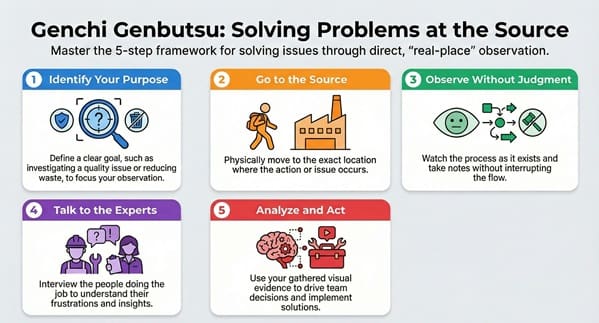
Implementing Genchi Genbutsu involves the following steps:
- Identify the Purpose: Don’t just walk for the sake of walking. Are you investigating a quality issue? Or perhaps you’re looking for ways to reduce waste? Having a clear goal focuses your eyes.
- Go to the Source: Physically move to the location where the action happens. If it’s a software bug, sit with the user. If it’s a shipping delay, go to the loading dock.
- Observe Without Judgment: Watch the process as it currently exists. Take notes. Don’t interrupt the flow immediately. You need to see the “normal” state before you can fix the “abnormal” state.
- Talk to the Experts: The people doing the job are the real experts. Ask them what’s difficult or what frustrates them. They usually know the solution but might lack the authority to implement it.
- Analyze and Act: Take what you saw back to your team. Use the visual evidence to drive a decision.
Also Read: How Lean Leadership Can Transform Your Team Performance?
Advantages of Genchi Genbutsu
Genchi Genbutsu offers several significant benefits to any organization, regardless of the industry:
- Accurate Information: You get the “ground truth.” There is no room for misinterpretation when you see the machine leaking oil with your own eyes.
- Employee Engagement: When leaders show up and actually listen, it builds massive amounts of trust. It shows that you care about the reality of the work, not just the profit margins.
- Faster Root Cause Analysis: You bypass the “meeting about the meeting.” By seeing the problem in its context, you can often identify the root cause much faster than through remote analysis.
- Elimination of Waste: It is much easier to see “Muda” (waste) in person. You might notice a worker walking twenty feet to grab a tool they use every minute—something a report would never show.
Disadvantages of Genchi Genbutsu
While powerful, it is noteworthy that this approach has some limitations:
- Time-Consuming: For global executives, it is physically impossible to “go and see” everything. Traveling to a factory halfway across the world for every problem isn’t feasible.
- Observer Bias: Sometimes, the presence of a leader causes people to work differently (the Hawthorne Effect). This can result in an inaccurate view of the standard process.
- Potential for Micromanagement: If not handled with “Show Respect,” it can feel like management is hovering. This can stifle creativity and make employees nervous.
Case Study: The Sienna Development
Here’s a great example of Genchi Genbutsu in action. When Toyota was developing the 2004 Sienna minivan for the North American market, the chief engineer, Yuji Yokoya, didn’t just look at market research.
He drove a current Sienna through every state in the US, every province in Canada, and parts of Mexico. He drove over 50,000 miles. Why? Because he wanted to understand how Americans actually used their vans.
He discovered that Americans eat in their cars much more than Japanese drivers do. He realized that long-distance highway driving was more common, requiring better seat comfort. Because he “went and saw,” the 2004 Sienna became a massive success. He didn’t just read about the market; he experienced it.
Key Takeaways
- Genchi Genbutsu is the practice of going to the actual place to see the actual thing.
- It is a mindset, not just a one-time event.
- It builds trust between management and workers.
- It is essential for finding the “Root Cause” of problems.
- It must be practiced with respect to avoid being seen as micromanagement.
FAQ on Genchi Genbutsu
1. Does Genchi Genbutsu only apply to manufacturing?
To be honest, no. It applies everywhere. If you are a software manager, sit with a customer using your app. If you run a hospital, spend time in the waiting room. Any place where a “process” happens is a “Genba.”
2. How often should a manager “Go and See”?
In my experience, it should be a daily or weekly habit. It shouldn’t only happen when something breaks. Routine observation helps you spot “weak signals” before they become “big fires.”
3. Is “Genchi Genbutsu” the same as “Management by Wandering Around” (MBWA)?
They are similar, but Genchi Genbutsu is more focused. While MBWA is about being visible and approachable, Genchi Genbutsu is specifically about gathering facts to solve problems or improve processes.
4. Can I do Genchi Genbutsu virtually?
With modern technology like Zoom or AR glasses, you can get close. However, there is no substitute for physical presence. You can’t “smell” a factory or feel the tension in a room through a screen.
Final Words
So, this is how Genchi Genbutsu changes the way we lead. It moves us away from being “spreadsheet managers” and turns us into “problem solvers.” It’s about getting your boots dirty and your hands on the actual work.
To be honest, the most successful leaders I know aren’t the ones with the cleanest offices. They are the ones who know the names of the people on the floor and the quirks of the machines they run.
At our core, we believe that understanding the human element of any process is the only way to achieve excellence. We are dedicated to helping our clients see the truth in their own operations, one “Genba” at a time. Are you ready to step out of the office and see what’s really happening?