
Current state analysis is the practice of documenting how a process actually performs today, using real data and direct observation, rather than relying on assumptions, outdated documentation, or how the process is supposed to work on paper. It matters because most process problems trace back to a gap between what people believe is happening and what’s actually happening, and no improvement can be reliably designed until that gap is closed with real facts.
In practice, teams use one or more specific tools, a process map, a SIPOC, a value stream map, or a direct Gemba walk, to capture the real sequence of steps, real cycle times, and real data, before ever moving into root cause analysis. This baseline is what a later future state design gets measured against, and what proves whether an improvement actually worked.
Quick Reference Table
| Tool | What It Captures | Best For |
| Process Map | The sequence of steps in a process | Understanding workflow and decision points |
| SIPOC | Suppliers, Inputs, Process, Outputs, Customers at a high level | Scoping a project before detailed mapping begins |
| Value Stream Map (Current State) | Process steps plus cycle times, wait times, and inventory | Manufacturing or high-volume processes where flow and waste matter |
| Gemba Walk | Direct, on-the-floor observation | Catching gaps between documented process and actual practice |
| Baseline Capability Data | Quantitative performance (defect rate, Cp/Cpk, cycle time) | Establishing a measurable starting point for comparison later |
Table of contents
Key Takeaways
- Current state analysis is about facts, not assumptions. Its entire value comes from replacing what people believe is happening with what’s actually happening, confirmed through data and direct observation.
- There is no single tool called “current state analysis.” It’s an umbrella activity conducted using one or more specific tools: process mapping, SIPOC, value stream mapping, Gemba walks, and baseline data collection.
- A current state analysis sits in the Measure phase of DMAIC, providing the factual foundation the Analyze phase needs before root causes can be reliably identified.
- The gap between documented process and actual practice is often the finding itself. Teams frequently discover that what’s written in the standard operating procedure isn’t what’s actually happening on the floor.
- Skipping current state analysis and jumping straight to solutions is one of the most common project failures. A solution designed against an assumed process, rather than the real one, often solves the wrong problem.
- A current state analysis needs a quantitative baseline, not just a visual map. Without baseline numbers (defect rate, cycle time, capability), there’s no way to later prove an improvement actually worked.
- Value stream mapping’s “current state map” is one specific technique for conducting a current state analysis, most suited to processes where flow, wait time, and inventory are central concerns; it isn’t the only tool available, and other processes call for a simpler process map or direct observation instead.
What Is Current State Analysis?
Current state analysis is the disciplined practice of documenting exactly how a process performs right now, based on real, verifiable evidence, before attempting to diagnose its problems or design an improvement. It’s a foundational activity in the Measure phase of DMAIC, and its core principle is simple but frequently ignored under project time pressure: you cannot reliably improve a process you don’t actually, factually understand.
The discipline behind current state analysis is what separates it from a quick assumption-based summary. A team that writes down “the process takes about three days” based on general impression has not conducted a current state analysis. A team that walks the actual process, times each step, and confirms the real sequence with the people doing the work has.

Public, Onsite, Virtual, and Online Six Sigma Certification Training!
- We are accredited by the IASSC.
- Live Public Training at 52 Sites.
- Live Virtual Training.
- Onsite Training (at your organization).
- Interactive Online (self-paced) training,
Why Does Current State Analysis Matter?
The central problem current state analysis exists to solve is the gap between assumed process behavior and actual process behavior. This gap is remarkably common and remarkably consequential: management’s mental model of how a process works, documented procedures, and what employees are actually doing day to day frequently diverge in ways no one has noticed, simply because no one has recently checked.
This matters for a specific, practical reason: a Six Sigma project’s entire Analyze phase depends on accurate current-state data. Root cause analysis conducted against an assumed, idealized version of a process routinely points to the wrong cause, since the real defect driver is often a workaround, an undocumented step, or a variation from procedure that current state analysis is specifically designed to surface.
The Lean principle of “going to Gemba,” the actual place where the work happens, exists precisely because of this gap. Data pulled from a system report or a process document, without direct observation, can miss the specific, real-world detail that explains why a process actually behaves the way it does.
Also Read: What is Attribute Agreement Analysis?
Current State vs. Future State: What’s the Difference?
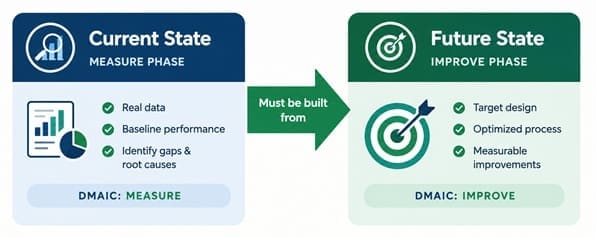
| Factor | Current State | Future State |
| What it represents | How the process actually performs today | How the process should perform after improvement |
| Based on | Real, observed data | Analysis and proposed changes |
| When it’s built | Measure phase | Improve phase |
| Purpose | Establishes the factual baseline | Serves as the target and implementation blueprint |
How do these connect?
A future state design is only as credible as the current state it’s built from. A future state map built without an accurate current state baseline is essentially a wish list, not a data-driven plan, since there’s no confirmed starting point to measure the proposed improvement against.
Tools Used to Conduct a Current State Analysis
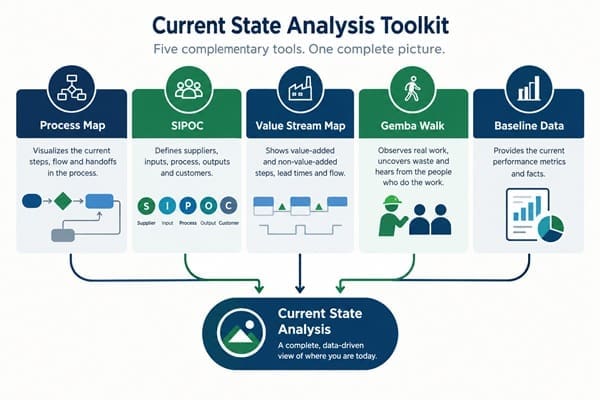
This is the section most generic content collapses into a single tool, when in practice several distinct techniques serve this purpose, each suited to a different situation.
Process Mapping
A straightforward, sequential diagram of the steps in a process, including decision points and handoffs. Best used when the primary question is “what actually happens, in what order,” without needing to capture detailed timing or inventory data.
SIPOC
A high-level view of Suppliers, Inputs, Process, Outputs, and Customers, typically used earlier than detailed mapping, to properly scope a project before the team commits to documenting every specific step in detail.
Value Stream Mapping (Current State Map)
A more detailed technique capturing not just the sequence of steps but cycle times, wait times, inventory levels, and information flow, most valuable in manufacturing or high-volume processes where flow and waste are central concerns. SSDSI’s own Value Stream Map guide covers this specific technique in full detail; it’s the right choice when timing and flow, not just sequence, are what the project needs to understand.
Gemba Walk
Direct, in-person observation of the process as it actually runs, rather than working from documentation or secondhand description alone. A Gemba walk is often what actually surfaces the gap between documented procedure and real practice that other tools, relying on reported information, can miss entirely.
Baseline Capability Data
Quantitative performance data, defect rate, cycle time, process capability indices (Cp/Cpk), collected specifically to give the team a measurable starting point. Without this, a team has a visual understanding of the process but no numerical baseline to prove whether a later improvement actually worked.
How do you decide which combination to use?
Most real current state analyses combine more than one of these tools rather than relying on just one. A common, practical sequence: a SIPOC to scope the project, a detailed process map or value stream map to document the actual flow, a Gemba walk to confirm the map reflects real practice, and baseline capability data to quantify current performance.
How Do You Conduct a Current State Analysis?
1. Define the Scope
Determine exactly which process, and which specific boundaries (start point and end point), the analysis will cover. A SIPOC is often the fastest way to confirm this scope before detailed work begins.
2. Walk the Actual Process
Physically observe the process being performed, rather than working only from documentation or a manager’s description of how it’s supposed to run. This is the step most likely to surface the gap between assumed and actual practice.
3. Document the Real Sequence and Collect Real Data
Build the process map (or value stream map, if flow and timing are central) based on what was actually observed, including real cycle times, wait times, and any undocumented workarounds discovered along the way.
4. Establish a Quantitative Baseline
Collect or calculate the current performance data, defect rate, cycle time, capability, needed to later prove whether an improvement actually moved the needle.
5. Validate the Findings With the People Doing the Work
Review the completed current state documentation with the actual process operators, confirming it accurately reflects reality rather than an outsider’s interpretation of what was observed.
Also Read: Multi-Criteria Decision Analysis (MCDA)
Real-World Example (Hypothetical)
Problem: A hospital’s billing department believes claims processing takes an average of two days, based on the department’s documented standard procedure, but is experiencing a persistent backlog no one can explain.
Analysis: A Black Belt begins the Measure phase with a current state analysis rather than accepting the assumed two-day figure. A Gemba walk reveals that claims are actually routed through an undocumented manual review step whenever a specific insurance code appears, a workaround introduced months earlier that was never added to the official procedure.
Six Sigma approach: The team builds a current state process map reflecting the real, observed sequence, including the undocumented review step, and collects actual cycle time data showing the true average is closer to four days, not two.
Action: With an accurate current state now documented, the Analyze phase can correctly investigate why the undocumented review step exists and whether it’s still necessary, rather than analyzing a two-day process that was never the real one.
Result (hypothetical): The team identifies that the manual review step, originally a temporary fix, had never been reconciled with a system update that made it unnecessary, and removing it (once confirmed safe) closes most of the gap between the assumed and real cycle time. This is a hypothetical illustration of current state analysis surfacing a real gap, not a documented case study.
Common Mistakes When Conducting a Current State Analysis
- Relying on documentation instead of direct observation. A standard operating procedure describes how a process is supposed to work, not necessarily how it actually runs today.
- Skipping the quantitative baseline. A visual process map without real performance data leaves no way to later prove whether an improvement actually worked.
- Rushing through current state to get to “the real work” of improving. Skipping or rushing this phase is one of the most common reasons a later solution ends up solving the wrong problem.
- Using outdated data instead of freshly collected information. A process can change meaningfully in the months since the last time anyone documented it; old data can be as misleading as no data.
- Failing to validate findings with the people who actually do the work. An outsider’s interpretation of an observed process can miss context only the actual operators would recognize as significant.
When Should You Use Value Stream Mapping vs. a Simpler Process Map?
Use a full Value Stream Map when:
- Cycle time, wait time, and inventory levels are central to the problem you’re investigating.
- The process is manufacturing-style or high-volume, where flow and waste are the primary concern.
Use a simpler process map or SIPOC when:
- The main question is the sequence and decision points in the process, not detailed timing data.
- You’re still scoping the project and need a fast, high-level view before committing to a more detailed mapping effort.
Frequently Asked Questions (FAQs) on Current State Analysis
Q: What is current state analysis?
A: Current state analysis is the practice of documenting how a process actually performs today, using real data and direct observation, before analyzing its problems or designing an improvement. It’s a foundational Measure-phase activity in DMAIC.
Q: What is the difference between current state and future state?
A: Current state represents how a process actually performs today, based on real, observed data. Future state represents how the process should perform after a proposed improvement, and is only credible if it’s built from an accurate current state baseline.
Q: What tools are used for current state analysis?
A: Common tools include process mapping, SIPOC, value stream mapping (current state map), Gemba walks (direct observation), and baseline capability data collection. Most real analyses combine more than one of these.
Q: What is the difference between current state analysis and value stream mapping?
A: Current state analysis is the broader activity of establishing an accurate baseline; value stream mapping’s current state map is one specific technique for doing that, particularly suited to processes where cycle time, wait time, and flow are central concerns.
Q: Why is current state analysis important in Six Sigma?
A: Because root cause analysis conducted against an assumed or outdated version of a process often points to the wrong cause. Current state analysis closes the gap between what people believe is happening and what’s actually happening, which the Analyze phase depends on.
Q: What is a Gemba walk?
A: A Gemba walk is direct, in-person observation of a process as it actually runs, rather than relying on documentation or secondhand descriptions. It’s often what surfaces the specific gap between documented procedure and real practice.
Final Words
Current state analysis exists to answer one deceptively simple question honestly: what is actually happening in this process right now?
Teams that skip this step, relying on assumptions, outdated documentation, or a manager’s mental model of how things are supposed to work, routinely end up analyzing and improving the wrong process entirely. Whether the right tool for a given situation is a simple process map, a full value stream map, a Gemba walk, or some combination, the underlying discipline is the same: replace belief with verified fact before moving one step further into the project.
Building an accurate current state baseline, rather than working from assumptions, is what keeps the rest of a DMAIC project pointed at the real problem.
Six Sigma Development Solutions, Inc. (SSDSI) is IASSC-accredited and 5-star rated on Google Reviews, having certified 5,322+ professionals across 600+ organizations in 52 cities.
Our onsite, live virtual, public, and online Green Belt and Black Belt training covers process mapping, value stream mapping, and Measure-phase data collection in the depth needed to build a baseline you can actually trust. Explore SSDSI’s Green Belt certification to build that foundation.
About Six Sigma Development Solutions, Inc.
Six Sigma Development Solutions, Inc. offers onsite, public, and virtual Lean Six Sigma certification training. We are an Accredited Training Organization by the IASSC (International Association of Six Sigma Certification). We offer Lean Six Sigma Green Belt, Black Belt, and Yellow Belt, as well as LEAN certifications.
Book a Call and Let us know how we can help meet your training needs.


