
Every Six Sigma Black Belt reaches a point in the Improve phase where a two-level factorial design is no longer enough. The team has identified the key factors. They know the direction of improvement. But the relationship between inputs and outputs is curved, not linear. A two-level design cannot model curvature. That is exactly where Central Composite Design enters.
Central Composite Design (CCD) is the most widely used design type in Response Surface Methodology. It lets practitioners build a second-order model — one that includes squared terms and interaction terms — without running a full three-level factorial experiment. The result is a design that maps the response surface, locates the optimum, and does so with fewer runs than a full factorial at three levels.
This article explains what CCD is, how it works, the three types you will encounter, where it sits in DMAIC, and when to use it instead of simpler designs.
Table of contents
What is a Central Composite Design in Six Sigma?
A Central Composite Design is an experimental design used in Response Surface Methodology (RSM). It builds a second-order (quadratic) model for the response variable without requiring a full three-level factorial experiment.
It consists of three components: factorial points at the corners of the design space, axial (star) points outside or on the face of the factorial space, and center points at the midpoint of all factors. CCD appears in the Improve phase of DMAIC when teams have identified key factors and need to optimize rather than simply improve them.
Key Takeaways
- CCD is an optimization DOE. It models curvature in the response surface. Two-level factorial designs model only linear effects. CCD adds squared and interaction terms.
- CCD consists of three point types: factorial points (corners), axial or star points (extending beyond the factorial space), and center points (at the midpoint of all factor levels).
- Three CCD types exist: circumscribed (CCC), inscribed (CCI), and face-centered (CCF). Each places axial points differently. The choice depends on whether factor levels can go beyond the factorial range.
- CCD belongs in the Improve phase of DMAIC. It follows screening and factorial experiments. Use it after identifying two to five key factors where curvature is suspected.
- CCD supports sequential experimentation. It extends a two-level factorial design already run. Teams add star and center points rather than starting over.
- CCD is the most commonly used fractional factorial design in response surface modeling. IntechOpen confirms this in its peer-reviewed chapter on RSM applications in pharmaceutical development.
- CCD appears in the IASSC Black Belt Body of Knowledge under Improve phase advanced DOE and Response Surface Methodology content.
- Use CCD when optimization is the goal, not just direction of improvement. It finds the operating window that maximizes or minimizes the response.

Public, Onsite, Virtual, and Online Six Sigma Certification Training!
- We are accredited by the IASSC.
- Live Public Training at 52 Sites.
- Live Virtual Training.
- Onsite Training (at your organization).
- Interactive Online (self-paced) training,
What Is a Central Composite Design?
A Central Composite Design is an experimental design used in Response Surface Methodology.
The existing SSDSI glossary page defines it accurately: “In statistics, a central composite design is an experimental design, useful in response surface methodology, for building a second order (quadratic) model for the response variable without needing to use a complete three-level factorial experiment.”
Wikipedia confirms the same definition directly: “A central composite design is an experimental design, useful in response surface methodology, for building a second order (quadratic) model for the response variable without needing to use a complete three-level factorial experiment. After the designed experiment is performed, linear regression is used, sometimes iteratively, to obtain results.”
Lean Outside the Box frames the Six Sigma purpose precisely: “Central Composite Designs are a type of DOE used to model curvature. It extends a two-level factorial or fractional factorial design. Instead of stopping at linear effects, it adds points that estimate quadratic terms. As a result, CCDs support second-order models.
These models include squared terms and interaction terms. Therefore, teams can locate optimal settings rather than just directions for improvement.”
This is the core distinction. A two-level factorial tells you which factors matter and in which direction. CCD tells you exactly where to set those factors to hit the optimal response.
Also Read: How to Design a Six Sigma Performance Dashboard Aligned with Strategic Goals?
Why Two-Level Factorial Designs Are Not Enough
Two-level factorial designs estimate linear effects and interactions. They assume the relationship between each factor and the response is a straight line.
That assumption breaks down when the response surface is curved.
Minitab’s official support documentation explains: “Response surface design methodology is often used to refine models after you have determined important factors using screening designs or factorial designs; especially if you suspect curvature in the response surface.
The difference between a response surface equation and the equation for a factorial design is the addition of the squared (or quadratic) terms that lets you model curvature in the response.”
The signal that curvature exists is a significant center point test result. When center points added to a factorial design show the response at the midpoint differs significantly from the linear model prediction, curvature is present. A two-level design cannot quantify that curvature. CCD can.
The Three Components of a Central Composite Design

Every CCD contains the same three sets of experimental runs.
Factorial Points
Factorial points sit at the corners of the design space. Each factor is set at its low level or its high level. These points estimate main effects and two-factor interactions.
Axial (Star) Points
Axial points extend the design beyond the factorial cube. Each axial point sets one factor at an extreme value (called alpha, or α) while all other factors sit at their center values.
The position of axial points defines which CCD type you are using. When axial points sit outside the factorial cube, the design is circumscribed. When they sit on the face of the cube, the design is face-centered. Also, when the entire factorial cube shrinks to fit inside the original factor range, the design is inscribed.
Center Points
Center points set every factor at its midpoint. They serve two purposes. First, they provide an estimate of pure error for statistical testing. Second, they allow detection of curvature before the full CCD is run.
Also Read: Design Verification Plan and Report (DVP&R)
The Three Types of Central Composite Design

The position of the axial points determines the CCD type. Each type has a specific use case.
Circumscribed CCD (CCC)
Axial points sit outside the factorial cube at a distance α from the center. This is the original, most powerful CCD type.
Use CCC when: factor levels can be extended beyond the factorial design range without violating physical constraints or safety limits.
Advantage: Highest statistical power. Best estimation of quadratic effects.
Disadvantage: Requires five distinct levels for each factor. Factor settings may exceed feasible operating ranges.
Face-Centered CCD (CCF)
Axial points sit on the face of the factorial cube. Alpha equals 1.0. This means axial points are at the same levels as the factorial high and low settings.
Use CCF when: factor levels cannot be extended beyond the factorial range. The design uses only three levels per factor instead of five.
Advantage: Only three levels required. Feasible when factor ranges are fixed.
Disadvantage: Lower estimation accuracy for quadratic effects compared to CCC.
Inscribed CCD (CCI)
The inscribed design shrinks the factorial cube so the entire design fits within the original factor constraints. The axial points become the new extreme values. The factorial points move inward.
Use CCI when: operating near the suspected optimum and the center of the design space is the most important region to estimate precisely.
CCD Type Comparison
| Feature | Circumscribed (CCC) | Face-Centered (CCF) | Inscribed (CCI) |
| Axial point location | Outside the cube | On the cube face | Inside the cube |
| Factor levels required | 5 | 3 | 5 |
| Rotatable | Yes | No | Yes |
| Best for | Maximum statistical power | Fixed factor ranges | Near-optimum region |
| Alpha value | Greater than 1 | Equal to 1 | Less than 1 |
Central Composite Design vs Box-Behnken Design
CCD is not the only response surface design. The Box-Behnken design is the primary alternative.
Minitab’s support page explains the distinction: “A response surface design is a set of advanced design of experiments techniques that help you better understand and optimize your response.” Both CCD and Box-Behnken achieve this. They differ in structure and application.
| Feature | CCD | Box-Behnken |
| Factor levels | 3 or 5 | 3 |
| Tests extreme combinations | Yes (CCC) | No |
| Runs required (3 factors) | 15–20 | 15 |
| Supports sequential experimentation | Yes | No |
| Includes corner points | Yes | No |
Use CCD when you need to extend a factorial design sequentially. Use Box-Behnken when corner combinations are physically impossible or dangerous to test.
Where CCD Sits in DMAIC
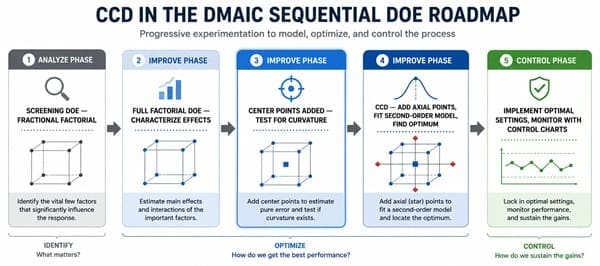
CCD belongs in the Improve phase of DMAIC. It does not appear in the Analyze phase.
The DMAIC sequence that leads to CCD looks like this:
Analyze phase: Screening DOE (fractional factorial) identifies which of many factors are significant. Most factors are eliminated.
Early Improve phase: A two-level factorial DOE characterizes the main effects and interactions of the remaining two to five factors. Center points reveal curvature.
Late Improve phase: CCD extends the factorial design by adding star points and additional center points. The team fits a second-order model and identifies the optimal factor settings.
Control phase: The optimal settings become the new process standards. A control plan monitors factor levels to hold the process at the optimum.
Worked Example: CCD in a Manufacturing Optimization Project
A Black Belt is optimizing a chemical coating process. The goal is to maximize coating adhesion strength.
Screening DOE identified three key factors: curing temperature (°C), coating thickness (µm), and drying time (minutes).
A two-level factorial with center points showed a significant center point effect. Curvature is present. The linear model is insufficient.
The Black Belt runs a circumscribed CCD with three factors.
Run structure:
- Factorial points: 8 runs (2³ full factorial)
- Axial points: 6 runs (2 per factor, at ±α)
- Center points: 6 runs (for error estimation)
- Total: 20 runs
Factor levels used:
| Factor | Low (−1) | Center (0) | High (+1) | Axial Low (−α) | Axial High (+α) |
| Temperature (°C) | 150 | 165 | 180 | 144 | 186 |
| Thickness (µm) | 20 | 30 | 40 | 17 | 43 |
| Drying time (min) | 10 | 15 | 20 | 13 | 22 |
The team runs all 20 experiments in random order. They fit a second-order model using regression. The model includes main effects, two-factor interactions, and squared terms.
The response surface contour plot shows the adhesion strength peaks at 172°C, 34 µm, and 17 minutes. The team confirms this optimal setting with three confirmation runs. Mean adhesion strength increases from 48 N/cm² to 67 N/cm².
These optimal settings become the new process standards. The control plan monitors temperature, thickness, and drying time at their optimal values using control charts.
Frequently Asked Questions: Central Composite Design in Six Sigma
Q: What is a Central Composite Design in Six Sigma?
A: A Central Composite Design (CCD) is an experimental design used in Response Surface Methodology. It builds a second-order (quadratic) model for a response variable. This model captures both linear and curved relationships between factors and the response. CCD does this without running a full three-level factorial experiment. It consists of three components: factorial points at the corners of the design space, axial (star) points extending the design beyond the factorial cube, and center points at the midpoint of all factor levels.
Q: What are the three types of Central Composite Design?
A: The three types are circumscribed (CCC), face-centered (CCF), and inscribed (CCI). CCC places axial points outside the factorial cube and requires five factor levels. It provides the highest statistical power. CCF places axial points on the face of the cube and requires only three factor levels. It is used when factor levels cannot be extended beyond the factorial range. CCI shrinks the factorial cube so the entire design fits within the original factor range. It is best when testing near the suspected optimum.
Q: When should you use CCD instead of a two-level factorial design?
A: Use CCD when three conditions are present. First, a screening or factorial experiment has already identified two to five key factors. Second, center points added to the factorial design show a significant curvature effect, meaning the linear model is not sufficient. Third, the project goal is optimization, not just identifying directions for improvement. Lean Outside the Box confirms: use CCD after screening is complete, when curvature is evident and when factor ranges are adjustable.
Q: What is the difference between CCD and Box-Behnken design?
A: Both are response surface designs that fit second-order models. CCD tests extreme corner combinations and supports sequential experimentation by extending a prior factorial design. Box-Behnken avoids extreme corners and uses only three levels per factor. Box-Behnken is preferred when extreme factor combinations are physically impossible or unsafe. CCD is preferred when sequential experimentation from a prior factorial design is the approach.
Q: Where does CCD appear in the DMAIC cycle?
A: CCD appears in the Improve phase of DMAIC. It follows screening DOE in the Analyze phase and a full factorial design in the early Improve phase. When center points in the factorial reveal significant curvature, the team extends the design by adding axial and center points to create the CCD. The second-order model produced identifies the optimal factor settings. Those settings become the new process standards implemented in the Control phase.
Q: What is the IASSC connection for Central Composite Design?
A: Central Composite Design appears in the IASSC Lean Six Sigma Black Belt Body of Knowledge under Improve phase advanced DOE and Response Surface Methodology content. It is Black Belt-level content. Green Belt candidates study two-level factorials and screening designs. Black Belts extend that knowledge to include second-order models, CCD types, and response surface optimization.
How SSDSI Teaches Response Surface Methodology and CCD
At Six Sigma Development Solutions, we cover Response Surface Methodology and Central Composite Design in our Black Belt programs.
Students learn when to use screening designs, when to transition to full factorial designs, and when CCD is the correct next step. They learn all three CCD types, the role of alpha, and how to interpret contour plots and surface plots in Minitab.
We deliver training in three formats:
- Onsite training — delivered at your facility, using real process contexts as examples.
- Live virtual training — instructor-led sessions in real time online with problem-solving exercises.
- Online self-paced training — full Black Belt certification content at your own schedule.
Every format prepares you for the IASSC Lean Six Sigma Black Belt certification exam. SSDSI is an IASSC Accredited Training Organization.
Explore our Six Sigma training programs or contact our team to find the right program for your goals.
About Six Sigma Development Solutions, Inc.
Six Sigma Development Solutions, Inc. offers onsite, public, and virtual Lean Six Sigma certification training. We are an Accredited Training Organization by the IASSC (International Association of Six Sigma Certification). We offer Lean Six Sigma Green Belt, Black Belt, and Yellow Belt, as well as LEAN certifications.
Book a Call and Let us know how we can help meet your training needs.


