
Brown paper mapping is a hands-on process mapping technique where a team documents a real workflow on a large roll of paper, typically taped to a wall, using sticky notes to represent individual steps, decisions, and handoffs.
It gets its name from the low-cost butcher paper originally used for the exercise, long before process mapping software existed. What most explanations miss is why it still outperforms digital tools for a specific job: surfacing the undocumented, “tribal knowledge” steps that live only in employees’ heads, because the physical, moveable format lets people correct and reorder the map in real time as memories surface out of sequence.
This guide covers what brown paper mapping actually is, how to run a session that produces a usable map instead of a wall of confused sticky notes, and where it fits inside a Six Sigma DMAIC project.
| Aspect | Brown Paper Mapping | Digital Process Mapping Software |
| Format | Physical paper, sticky notes, markers | Flowchart software (Visio, Lucidchart, and similar) |
| Best for | Uncovering undocumented, real-world process steps | Documenting an already-understood process cleanly |
| Team engagement | High; physical movement keeps participants active | Lower; one person often drives the screen |
| Editing speed | Instant, move a sticky note by hand | Requires software fluency to rearrange |
| Output | A working draft that needs to be digitized afterward | A finished, shareable document |
| Ideal setting | In-person or live virtual workshop with a shared digital whiteboard | Any setting, including fully asynchronous work |
Table of contents
Key Takeaways
- Brown paper mapping is a facilitation technique, not a fixed notation system like SIPOC. It captures a process as a team physically remembers and reconstructs it, using paper and sticky notes rather than software.
- The technique’s real advantage over digital tools is psychological, not just practical: physically moving a sticky note lets a team member correct a step’s position the moment they realize they remembered it out of order, which digital tools make slower and more intimidating to do live.
- Brown paper sessions are most valuable for surfacing undocumented process steps, the workarounds, manual fixes, and informal handoffs that never made it into an official procedure document.
- A brown paper map is a working draft, not a finished deliverable. It should be photographed and digitized into a clean process map, SIPOC, or value stream map after the session, not left as the final artifact.
- Live virtual Six Sigma training now recreates this exact exercise using shared digital whiteboards, preserving the collaborative, move-it-yourself dynamic of a physical brown paper session for remote and distributed teams.
What Is Brown Paper Mapping, Really?
Brown paper mapping is a Lean Six Sigma process mapping technique in which a team documents an existing workflow by hand, in real time, on a long roll of paper (traditionally brown butcher paper) taped to a wall or laid across a table. Steps, decisions, delays, and handoffs are written on sticky notes and placed in sequence, giving the entire team a single, shared, physically manipulable view of how a process actually works.
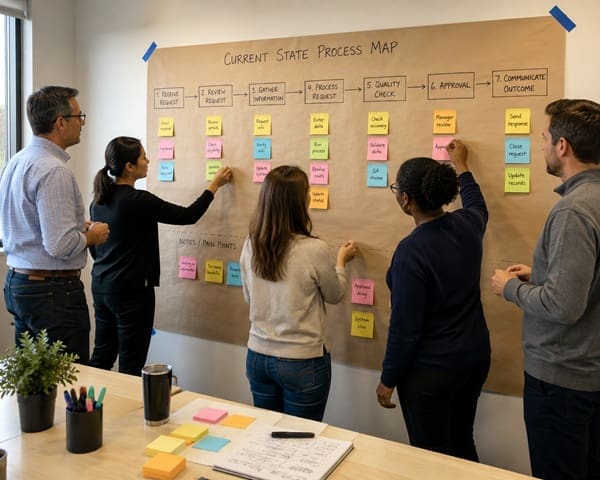
The name comes directly from the material. Long before flowchart software existed, teams used inexpensive butcher paper because it was cheap, came in long continuous rolls, and could be cut to whatever length a process required. That practical origin still shapes how the technique is used today: brown paper mapping remains most valuable as a fast, low-barrier way to get a process out of people’s heads and onto a wall, not as a way to produce a polished final document.
Brown paper mapping is frequently the facilitation method used to build a Value Stream Map, one of Lean’s core tools for visualizing material and information flow through a process. According to guidance from Lean Six Sigma Group, a Value Stream Map is often carried out through a brown paper session, where the details of work processes are mapped out by describing activities and process steps directly onto the shared paper.

Public, Onsite, Virtual, and Online Six Sigma Certification Training!
- We are accredited by the IASSC.
- Live Public Training at 52 Sites.
- Live Virtual Training.
- Onsite Training (at your organization).
- Interactive Online (self-paced) training,
Why Brown Paper Still Beats Software for This Specific Job
This is the detail almost every competing article treats as a footnote rather than the actual point. Digital process mapping tools are unquestionably better for producing a clean, shareable, final document. They are worse, often significantly worse, at the specific job a brown paper session is designed to do: getting an accurate first draft of a process out of a group of people who remember it imperfectly and out of order.
When a process is mapped digitally in real time, one person typically controls the screen while others watch and call out corrections verbally. This creates a bottleneck: only one person can edit at a time, corrections require the group to interrupt the driver, and quieter team members are less likely to speak up than to simply walk over and move a sticky note themselves.
A physical brown paper session removes that bottleneck entirely. Multiple people can write and place sticky notes simultaneously. A team member who suddenly remembers a step happens earlier than where it currently sits can walk over and move it themselves, without interrupting anyone.
This matters because the most valuable information in a mapping session often surfaces mid-conversation, after someone else’s comment jogs a memory, and a physical format captures that moment instantly instead of losing it while someone fumbles with software.
Also Read: How Six Sigma Suffers from “Paper Belts”?
The Real Purpose: Surfacing Tribal Knowledge
The single most important reason to run a brown paper session instead of jumping straight into a clean digital map is to surface undocumented process knowledge, the informal workarounds, manual double-checks, and unofficial handoffs that exist in practice but were never written into an official standard operating procedure.
Every process has a version that exists on paper and a version that exists in reality, and the gap between them is frequently where defects, delays, and rework actually live.
A brown paper session, run with front-line participants rather than only supervisors and managers, is specifically designed to expose that gap. When a machine operator says “well, actually, I always check this twice because it jammed once and nobody fixed the root cause,” that comment belongs on the wall, and a physical session makes it far easier to capture than a formal digital document that implicitly signals “this is the official version” and discourages admitting to workarounds.
How to Run a Brown Paper Mapping Session

1. Gather the Right Materials and the Right People
The best tools for a mapping session are a whiteboard or brown paper, sticky notes, and markers, sometimes supplemented with easel-pad paper taped together when a dedicated roll isn’t available.
Equally important is inviting the people who actually perform the work, not just the supervisors who think they know how it works. The two groups frequently disagree, and that disagreement is valuable data.
2. Set a Clear, Narrow Goal Before Starting
A session without a defined scope sprawls quickly. State clearly at the outset what process boundary the map will cover, where it starts and ends, so the team doesn’t drift into mapping three adjacent processes at once.
3. Capture Steps as They’re Remembered, Not in Forced Order
Encourage participants to write down steps as they recall them rather than waiting for a strict chronological turn. Sticky notes exist specifically so the group can reorder the sequence physically once more of the process has surfaced.
4. Use Facilitator Questions to Keep Momentum
Simple, repeated prompts, what happens next, is this always the sequence, what happens when something goes wrong here, keep the session moving and surface the exception-handling steps formal documentation usually skips.
5. Mark Waste, Delays, and Handoffs Distinctly
Use a different color of sticky note or a simple symbol to flag waiting time, rework loops, and handoffs between departments. These marked points are usually where a Six Sigma team focuses improvement work later.
6. Photograph and Digitize the Map Immediately After
A brown paper map is a working draft, not the final artifact. Photograph it in sections before it comes off the wall, and transfer it into a clean digital process map, SIPOC, or value stream map while the context is still fresh.
Also Read: Best Live Virtual Lean Six Sigma Training
Where Brown Paper Mapping Fits Inside DMAIC
Brown paper mapping is primarily a Measure phase tool, used to establish an accurate picture of the current state before any root cause analysis begins. A team cannot reliably measure cycle time, identify bottlenecks, or spot non-value-added steps until they have an honest map of what the process actually does, not what the official documentation claims it does.
It also frequently supports the Define phase during project scoping, when a team needs a rough sense of process boundaries before committing to a formal charter, and can resurface in the Improve phase when mapping a proposed future-state process using the same collaborative technique.
Real Examples of Brown Paper Mapping in Practice
Manufacturing: Uncovering an Unofficial Inspection Step
A production team runs a brown paper session to map a packaging line and discovers two shifts have quietly developed different manual inspection routines, neither in the official work instructions, explaining a defect pattern that had puzzled the quality team for months.
Healthcare: Mapping a Patient Intake Process
A clinic maps its patient intake process on brown paper and discovers front-desk staff have created an informal workaround for insurance verification delays that never made it into any training material, revealing a bottleneck the electronic health record system’s official workflow diagram never showed.
Financial Services: Exposing a Manual Reconciliation Step
A bank’s operations team maps its loan processing workflow and finds a reconciliation step, officially described as automated, is actually being manually double-checked by one experienced employee who never told anyone, after a past error broke her trust in the automated version.
Retail: Documenting a Warehouse Picking Process
A distribution center runs a brown paper session with pickers and supervisors together and discovers the two groups have meaningfully different understandings of the correct picking sequence, a disagreement a supervisor-only digital map would never have surfaced.
Common Mistakes When Running a Brown Paper Session
- Only inviting managers and supervisors. The entire point is to surface what front-line employees actually do, not what leadership assumes they do.
- Treating the brown paper map as the finished deliverable. It should always be digitized into a clean, shareable format afterward.
- Rushing the session to fit a tight meeting slot. Undocumented steps surface gradually as people build on each other’s memories; a rushed session produces an incomplete map.
- Skipping the waste and handoff markers. A map that only shows sequence, without flagging delays and rework loops, gives the team far less to work with in the Analyze phase.
- Assuming remote teams can’t do this. A shared digital whiteboard, used live during a virtual session, can preserve most of the collaborative benefit of a physical brown paper wall.
Brown Paper Mapping for Remote and Distributed Teams
A common misconception is that brown paper mapping only works in person. Live virtual Six Sigma training has adapted the technique using shared digital whiteboard platforms that let every participant place and move virtual sticky notes simultaneously, preserving the core advantage of the physical version: correcting and reordering the map instantly, without waiting for a single person to drive the screen.
Teams learning this technique in a live virtual classroom practice the same real-time, collaborative mapping dynamic as an in-person session, just without needing everyone in the same room.
Frequently Asked Questions (FAQs) on Brown Paper Mapping
What is the difference between brown paper mapping and a Value Stream Map?
Brown paper mapping is a facilitation technique, physically mapping a process on paper with sticky notes. A Value Stream Map is a specific type of process map, often built using a brown paper session as the method for capturing the initial data.
Why is it called “brown paper” mapping?
The name comes from the inexpensive brown butcher paper originally used for the exercise, chosen because it came in long, continuous, low-cost rolls that could cover an entire wall.
Is brown paper mapping still useful now that digital tools exist?
Yes. Digital tools are better for producing a clean final document, but brown paper mapping remains more effective for surfacing undocumented process knowledge in real time, because the physical, moveable format removes the bottleneck of a single person controlling the screen.
Who should be included in a brown paper mapping session?
The people who actually perform the work, not only supervisors and managers. Front-line participants frequently reveal workarounds and informal steps that leadership is unaware of.
Can a brown paper mapping session be run remotely?
Yes. Shared digital whiteboard tools now replicate the collaborative, move-it-yourself dynamic of a physical brown paper session for remote and distributed teams, which is how the technique is taught in live virtual Six Sigma training.
Final Words
Brown paper mapping earns its place in Six Sigma not because it produces a polished document, it doesn’t, but because it is still one of the fastest ways to get an honest, complete picture of how a process actually works, workarounds and all. The physical, moveable format surfaces details a digital tool quietly discourages people from admitting to.
Six Sigma Development Solutions Inc. teaches brown paper mapping and the full process mapping toolkit as part of a hands-on Measure phase curriculum, across onsite, live virtual, public, and online formats, IASSC accredited, rated 5 stars on Google Reviews, with 5,322+ professionals certified across 600+ organizations in 52 cities. View our upcoming Green Belt and Black Belt training schedule and learn to run a mapping session that actually surfaces the truth.
About Six Sigma Development Solutions, Inc.
Six Sigma Development Solutions, Inc. offers onsite, public, and virtual Lean Six Sigma certification training. We are an Accredited Training Organization by the IASSC (International Association of Six Sigma Certification). We offer Lean Six Sigma Green Belt, Black Belt, and Yellow Belt, as well as LEAN certifications.
Book a Call and Let us know how we can help meet your training needs.


