Attribute sampling acts as a vital gatekeeper in the world of quality control and auditing. Imagine you’re overseeing a massive shipment of 50,000 electronic components. You can’t possibly test every single one without slowing down production to a crawl, right? That’s where this statistical method steps in to save your sanity. To be honest, we’ve all faced that moment of panic wondering if a small batch truly represents the whole pile.
Here is the thing: attribute sampling doesn’t measure “how much” or “how heavy.” Instead, it focuses on a simple “yes” or “no” logic. Does the product meet the standard? Is the invoice signed? It’s a binary world where an item is either conforming or non-conforming. But how do you know how many items to pick to be sure?
In my experience, many professionals confuse this with variable sampling. While variable sampling looks at measurements like millimeters or grams, attribute sampling looks at characteristics. It is about presence or absence. Why does this matter for your business? Because it determines whether you accept or reject an entire lot based on a small, manageable sample.
Table of contents
What is Attribute Sampling and Why Does It Matter?
At its core, attribute sampling is a statistical process used by auditors and quality engineers to estimate the rate of occurrence of a specific trait. We use it when we want to know the proportion of “defects” in a population. For example, in a financial audit, we might look for missing signatures on purchase orders.
This method relies heavily on the Binomial Distribution. Don’t let the math scare you; it just means there are only two possible outcomes for every test. You either find what you’re looking for, or you don’t. Have you ever wondered why some companies have fewer recalls than others? Usually, it’s because they have mastered the art of choosing the right sample size.
We use this approach because testing 100% of a population is often too expensive or even impossible. If you are testing the “burst strength” of a balloon, testing it means destroying it. In those cases, you must rely on a sample. It’s roughly the best way to maintain high standards without breaking the bank.

Public, Onsite, Virtual, and Online Six Sigma Certification Training!
- We are accredited by the IASSC.
- Live Public Training at 52 Sites.
- Live Virtual Training.
- Onsite Training (at your organization).
- Interactive Online (self-paced) training,
How Attribute Sampling Plans Work?
When we talk about a sampling plan, we’re looking at a specific set of rules. It tells you how many items to inspect (the sample size, n) and the maximum number of defects allowed (the acceptance number, c). If the defects in your sample are less than or equal to c, you accept the whole lot. If not, you reject it.
The Single Sampling Plan
This is the most straightforward approach. You take one sample of size n from a lot of size N. For instance, you might pull 80 units from a batch of 2,000. If you find more than 2 defects, the batch fails. It’s clean, simple, and easy for teams to follow on the floor.
Double and Multiple Sampling
Sometimes, the first sample doesn’t give a clear answer. Picture this: you find a “maybe” amount of defects. A double sampling plan allows for a second round of testing if the first results are borderline. It can save a lot of money because you often reach a decision with a much smaller initial sample.
But is it worth the extra complexity? Usually, yes, if your testing costs are high. However, for most day-to-day auditing, the single plan remains the king of efficiency.
Also Read: Systematic Sampling
Key Components of an Attribute Sampling Plan
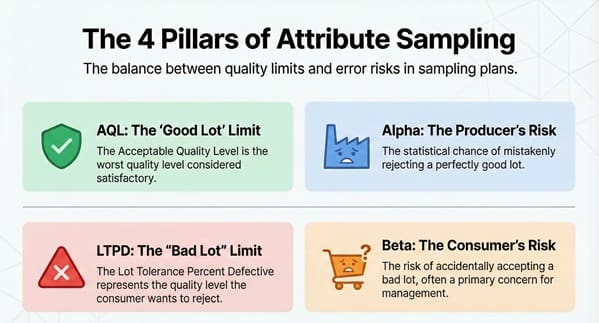
To build a plan that actually works, we need to define a few specific parameters. This is where the technical side meets practical application.
- AQL (Acceptable Quality Level): This is the worst quality level that we consider satisfactory. It’s the “good” lot limit.
- LTPD (Lot Tolerance Percent Defective): This represents the “bad” lot limit. It is the level of quality that the consumer wants to reject.
- Producer’s Risk (Alpha): The chance that we reject a perfectly good lot. We’ve all felt that frustration of throwing away good work by mistake.
- Consumer’s Risk (Beta): The chance that we accidentally accept a bad lot. This is the risk that keeps managers up at night.
We must balance these risks. If you make your testing too strict, you waste money rejecting good products. If you make it too loose, you ship junk to your customers.
The Role of the OC Curve
The Operating Characteristic (OC) curve is the heart of attribute sampling. It’s a graph that shows how well a sampling plan discriminates between good and bad lots. It plots the probability of accepting a lot against the actual percent defective in that lot.
An “ideal” OC curve would be a vertical line, but in the real world, it’s always a curve. The steeper the curve, the better the plan is at telling the difference between high and low quality. To get a steeper curve, you usually need a larger sample size.
Does a larger sample always mean better results? Not necessarily. There is a point of diminishing returns where the cost of testing more items outweighs the extra certainty you gain. We always aim for that “sweet spot” where the risk is low but the cost is manageable.
Practical Steps to Perform Attribute Sampling
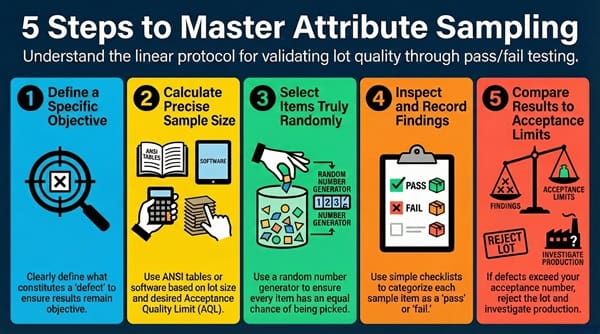
If you’re ready to start testing, follow these steps to ensure your data is valid.
Step 1: Define the Objective
What are you trying to find? Are you looking for clerical errors in tax forms or physical dents in a car door? You must be specific. If your definition of a “defect” is vague, your results will be useless.
Step 2: Determine the Sample Size
We use tables like the ANSI/ASQ Z1.4 to find the right number. You’ll need to know your lot size and your desired AQL. To be honest, most people just use software now, but understanding the tables is a great skill for any pro.
Step 3: Select Items Randomly
This is the most critical part. Every item in the lot must have an equal chance of being picked. If you only pick the items on the top of the box, you’re cheating the math. Use a random number generator to stay honest.
Step 4: Inspect and Record
Look at each item in your sample. Is it a pass or a fail? Record your findings clearly. In my view, simple checklists work best here to avoid human error.
Step 5: Make the Decision
Compare your count of defects to your acceptance number (c). If you’re under the limit, the lot passes. If you’re over, it’s time to investigate what went wrong in production.
Attribute vs. Variable Sampling: Which is Better?
People often ask me which method they should choose. The answer depends on your goals. Attribute sampling is great because it’s fast and requires less training for the inspectors. You don’t need expensive calipers or scales; you just need a clear eye and a set of standards.
On the other hand, variable sampling provides more data. It tells you how close you are to failing. However, it also requires larger samples and more complex math. For most high-volume manufacturing and general auditing, attributes are the way to go. They provide a clear “Go/No-Go” signal that everyone on the team can understand.
Common Pitfalls in Sampling
Even with a great plan, things can go sideways. One common mistake is “cherry-picking” the sample. We’ve all been tempted to skip a difficult-to-reach box, but that ruins the statistical validity of the whole test.
Another issue is ignoring the “non-sampling risk.” This happens when an inspector misses a defect that was actually in the sample. It doesn’t matter how good your math is if the person doing the looking is tired or poorly trained. That’s why we emphasize simplicity in the testing criteria.
Statistical Tools and Distributions
Most attribute sampling plans are based on the Hypergeometric distribution when the lot is small. However, when the lot is large, we switch to the Binomial or Poisson distribution. These models help us predict how often defects will appear.
Don’t worry about calculating these by hand. Most quality management software handles the heavy lifting. The important part is knowing that these distributions assume that the production process is stable. If your machines are breaking down every ten minutes, sampling won’t save you—you need to fix the process first!
Also Read: Random Sampling
Why This Matters for Your Business Values
At our company, we believe that quality isn’t just a department; it’s a promise. Using rigorous methods like attribute sampling shows your clients that you care about the details. It builds trust. When a client knows that your “passed” label is backed by statistical science, they feel confident in their purchase.
We have seen businesses transform their reputation simply by moving from “guessing” to “sampling.” It’s about moving from reactive fire-fighting to proactive quality management.
Key Takeaways
- Attribute sampling focuses on binary outcomes (Pass/Fail or Yes/No).
- It is more cost-effective than testing 100% of a population.
- The OC Curve is the primary tool for measuring a plan’s effectiveness.
- Randomness is non-negotiable for the results to be valid.
- Balancing Producer’s Risk and Consumer’s Risk is the goal of any good plan.
Frequently Asked Questions About Attribute Sampling
What is the difference between an attribute and a variable?
An attribute is a characteristic you can count (like a scratch or a missing part). A variable is something you can measure on a continuous scale (like weight, length, or temperature).
When should I use a double sampling plan?
Use a double plan when you want to reduce the average number of items inspected. It’s perfect when your first sample is likely to be very “clean” or very “dirty,” allowing for a quick decision.
Can attribute sampling be used in service industries?
Absolutely! We use it to check for errors in data entry, the presence of required disclosures in contracts, or whether customer service calls met specific protocol points.
What happens if a lot is rejected?
Usually, the lot undergoes 100% inspection to remove all defects, or it is returned to the supplier. The goal is to ensure no bad products reach the end user.
Is AQL the same as “zero defects”?
No. AQL acknowledges that in mass production, a tiny percentage of defects is often unavoidable and economically acceptable.
Final Words
Mastering attribute sampling is a game-changer for anyone in quality or auditing. It allows you to make big decisions with small, smart steps. By understanding the risks and using the right tools, you can ensure your products meet the high standards your customers expect. We’re dedicated to helping our partners achieve this level of precision. Our team believes that your success is built on the integrity of your data and the quality of your output. Let’s work together to make “excellence” your new baseline.