
Have you ever wondered how a product changes after the design is finished? Imagine a team building a new smartphone. They find a small flaw in the battery case during the final test. They cannot just fix one phone and ignore the rest. Also, they need a formal plan to update the design for every unit. This plan is what experts call an Engineering Change Order (ECO).
Table of contents
What is an Engineering Change Order (ECO)?
An Engineering Change Order is a document that describes a needed change to a product design. It acts as a bridge between finding a problem and fixing it. You can think of it as a formal instruction manual for updates. It tells the team what to change, why to change it, and how to do it without causing new issues.

Public, Onsite, Virtual, and Online Six Sigma Certification Training!
- We are accredited by the IASSC.
- Live Public Training at 52 Sites.
- Live Virtual Training.
- Onsite Training (at your organization).
- Interactive Online (self-paced) training,
The ECO process helps companies stay organized. Without it, different teams might use different versions of the same part. This lead to waste and mistakes. By using a central record, everyone stays on the same page. Are you ready to see how this system keeps manufacturing running smoothly?
Comparison of Change Management Terms
Understanding the ECO requires knowing its related documents. Often, people confuse the ECO with the Engineering Change Request (ECR) or the Engineering Change Notice (ECN). The table below breaks down these differences.
| Basis for Comparison | Engineering Change Request (ECR) | Engineering Change Order (ECO) | Engineering Change Notice (ECN) |
| Purpose | To propose a potential change or highlight a problem. | To outline the specific technical details of the approved change. | To notify all departments that the change is now live. |
| Stage | Pre-approval / Discovery phase. | Design and implementation phase. | Final notification / Execution phase. |
| Primary Actor | Anyone (customer, shop floor, engineer). | Design Engineers and Change Board. | Production and Supply Chain Managers. |
| Content | Description of the issue and suggested fix. | Updated drawings, bill of materials (BOM), and costs. | Instructions for implementation and “use up” rules. |
Also Read: Change Control Board (CCB)
What is an ECR and How Does It Start?
What is an ECR in the grand scheme of things? An ECR is the starting point of the engineering change management cycle. It is a form used to report a problem or suggest an improvement. You might find a part that is too expensive or a design that breaks too easily. When you document this, you create an ECR.
Engineering change request forms gather input from various sources. For example, a customer might report a safety concern. Or, a worker on the assembly line might find that two parts do not fit together well. The ECR documents these observations. It does not mean the change will happen yet. It simply asks the experts to look into the matter.
Once an ECR is filed, a committee reviews it. They look at the cost, the risk, and the benefits. If they agree that the change is necessary, the ECR moves forward. At this point, it transforms into an Engineering Change Order.
Understanding the Engineering Change Order Process
Engineering change management relies on a strict flow of information. The ECO is the heart of this flow. It contains the technical roadmap for the modification. It lists every part, drawing, and document that needs an update.
The ECO typically includes several key sections:
- Identification: The ECO number and the names of the engineers involved.
- Description: A clear explanation of what is changing.
- Reason: Why the change is happening (e.g., safety, cost reduction, or part obsolescence).
- Impact Analysis: Which other parts or systems will this change affect?
- Bill of Materials (BOM): A list of the old parts being replaced and the new parts being added.
Engineering change orders ensure that the “paper trail” matches the physical product. If a company builds a bridge, they must record every bolt change. If they do not, future repairs become impossible. The ECO provides this vital record.
Defining the Engineering Change Notice
Engineering change notice (ECN) is the final step in the communication chain. After the engineers finish the ECO, the company must tell the rest of the world. The ECN is the “announcement” phase.
Engineering change notice documents go to the purchasing department, the warehouse, and the factory floor. It tells the purchasing team to stop buying the old part. It tells the warehouse to mark the old stock as “obsolete.” Most importantly, it tells the factory workers to start using the new design on a specific date.
Without a clear ECN, the ECO remains just a set of drawings. The ECN puts the plan into action. It ensures that the transition from the old version to the new version happens at the right time.
Also Read: Common Barriers and Risks to a Successful Six Sigma Change Project
Key Steps in Engineering Change Management
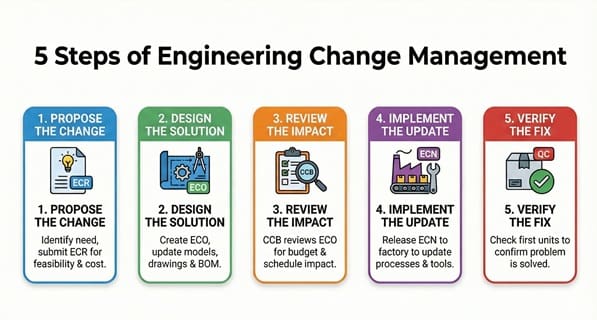
Engineering change management involves several distinct phases. Let us look at how a change moves through a typical organization.
1. Proposal and Evaluation
First, someone identifies a need. They submit an ECR. The engineering team evaluates the proposal to see if it is feasible. They ask: “Will this fix the problem?” and “Can we afford it?”
2. Design and Documentation
If the change is approved, the ECO is created. Engineers update the 3D models and the 2D drawings. They also update the Bill of Materials (BOM). This is the most technical part of the process.
3. Review and Approval
A Change Control Board (CCB) usually reviews the ECO. This board includes people from engineering, manufacturing, and finance. They make sure the change does not break the budget or the production schedule.
4. Implementation
Once the ECO is signed, the ECN is released. The factory begins to update its processes. This might involve changing the programming on a robotic arm or buying new tools.
5. Verification
Finally, the team checks the first few units produced under the new ECO. They must confirm that the change actually fixed the original problem.
Why Do Companies Use Engineering Change Orders?
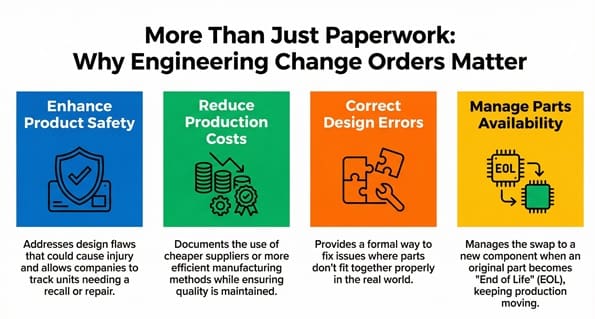
Engineering change management might seem like a lot of paperwork. However, it is essential for safety and quality. Let us explore the primary reasons why companies use this system.
Improving Product Safety
Sometimes, a design flaw only appears after a product is in the hands of customers. If a part might fail and cause injury, an ECO is mandatory. It allows the company to track which units need a recall or a repair.
Reducing Costs
As a product matures, engineers often find cheaper ways to build it. They might find a new supplier or a more efficient manufacturing method. An ECO documents these changes to ensure quality remains high while costs go down.
Correcting Design Errors
No design is perfect. Sometimes, two parts have a “tolerance stack-up” issue where they don’t fit together in the real world. An ECO provides a formal way to adjust the dimensions and fix the fit.
Managing Parts Availability
Suppliers often stop making certain electronic components. When a chip becomes “End of Life” (EOL), the engineer must find a replacement. The ECO manages the swap to a new component to keep the production line moving.
Role of the Bill of Materials in ECOs
Engineering change management revolves around the Bill of Materials (BOM). The BOM is a list of every single component needed to build a product. When you change one part, you must update the BOM.
The ECO specifies exactly which line in the BOM is changing. It might say: “Remove Part A and Replace with Part B.” This seems simple, but in a product with 10,000 parts, accuracy is vital. If the BOM is wrong, the factory will order the wrong parts. This leads to expensive delays.
Common Challenges in Change Management
Engineering change management is not always easy. Many companies struggle with the speed of changes. If the process takes too long, the factory might keep building “bad” parts for weeks. This is called “scrap and rework” cost.
Another challenge is communication. If the engineering team updates a drawing but forgets to tell the quality inspectors, the inspectors might reject good parts. This is why the engineering change notice is so important. It acts as the “alarm clock” that wakes up every department to the new reality of the design.
Also Read: ADKAR Change Model
Best Practices for Effective ECOs
Engineering change management works best when it follows a standard routine. Here are a few ways to make the process better:
- Be Clear: Use simple language in the ECO. Do not assume everyone knows the technical jargon.
- Use Visuals: Include “Before and After” photos or drawings. This helps the shop floor workers understand the change instantly.
- Track Everything: Use software to track who signed the ECO and when. This creates accountability.
- Assess Impact: Always check how a change in one part affects the rest of the assembly.
How Software Helps with ECOs?
In the past, engineering change management was done with paper folders. Today, most companies use Product Lifecycle Management (PLM) software. This software automates the workflow.
When an engineer finishes an ECO, the software automatically emails the reviewers. Once they click “approve,” the software updates the BOM across the entire company database. This reduces human error and speeds up the implementation of the engineering change notice.
Frequently Asked Questions (FAQs) on ECO
What is the difference between an ECR and an ECO?
An ECR is a request for a change, while an ECO is the actual instruction to make the change. Think of the ECR as the “Why” and the ECO as the “How.”
Who approves an Engineering Change Order?
Approval usually comes from a Change Control Board (CCB). This group includes leaders from engineering, quality, manufacturing, and sometimes procurement.
Can an ECO be canceled?
Yes. If the team finds that the change is too expensive or creates new problems, they can cancel the ECO before it is fully implemented.
How long does an ECO take?
The time varies. A simple part swap might take a few days. A major structural change in an airplane design could take months of testing and approval.
Why is an Engineering Change Notice important?
The ECN is the signal to the factory and supply chain. Without it, the engineering changes never leave the computer and never reach the physical product.
Key Takeaways on Engineering Change Orders
- Engineering change management is a structured process for modifying product designs.
- What is an ECR? It is the initial request that identifies a problem or improvement.
- The Engineering Change Order (ECO) provides the technical details and updated drawings for the change.
- The Engineering Change Notice (ECN) informs all departments that the change is ready for production.
- Maintaining an accurate Bill of Materials (BOM) is the most critical part of any ECO.
- Using formal ECOs reduces waste, improves safety, and ensures all products meet the latest standards.
Final Words
Engineering change management is the backbone of modern manufacturing. It ensures that products evolve safely and efficiently. By following a clear path from request to notice, your team can avoid costly mistakes and keep quality high.
Our company believes in the power of precision. We focus on helping our clients master their workflows so they can build better products. We value your time and your need for accuracy in every design. If you need help streamlining your documentation, we are here to support your journey toward engineering excellence.

About Six Sigma Development Solutions, Inc.
Six Sigma Development Solutions, Inc. offers onsite, public, and virtual Lean Six Sigma certification training. We are an Accredited Training Organization by the IASSC (International Association of Six Sigma Certification). We offer Lean Six Sigma Green Belt, Black Belt, and Yellow Belt, as well as LEAN certifications.
Book a Call and Let us know how we can help meet your training needs.