
Customer lifetime value helps you figure out exactly how much a single buyer is worth to your business over time. Have you ever wondered why some companies spend a fortune to get one new customer? It’s because they aren’t just looking at the first sale; they’re looking at the long game.
In my experience, many small business owners focus too much on daily sales. While daily cash flow matters, the real magic happens when you understand the total profit a person brings from their first purchase to their last. To be honest, if you don’t know this number, you might be overspending to find people who only buy once and never come back.
Would you rather have one hundred customers who spend $10 once, or ten customers who spend $50 every year for a decade? The answer seems easy, but calculating it requires a bit of focus. Let’s look at why this metric, often called CLV, changes the way you run your shop.
Table of contents
What is Customer Lifetime Value (CLV)?
The term customer lifetime value refers to the total net profit a company expects to get from a person during their entire relationship. It is not just the revenue; it is the profit left over after you pay for the products and the service.
Think of it like a long-term friendship. You don’t just count the first coffee your friend bought you. You count every coffee, lunch, and birthday gift over twenty years. In business, we use math to predict this “friendship” value. This helps us decide how much we can afford to spend on marketing.
Here is the thing: not all customers are equal. Some people are “high value” because they buy often and stay loyal. Others might cost you more in support and returns than they ever spend. By using CLV, you can spot the “keepers” early on.

Public, Onsite, Virtual, and Online Six Sigma Certification Training!
- We are accredited by the IASSC.
- Live Public Training at 52 Sites.
- Live Virtual Training.
- Onsite Training (at your organization).
- Interactive Online (self-paced) training,
Why Customer Lifetime Value Matters for Your Growth
Why should you care about a long-term number when you have bills to pay today? Well, tracking customer lifetime value allows you to make smarter choices with your limited budget. If you know a customer is worth $1,000 over five years, spending $50 to get them into your store is a great deal.
In contrast, if you spend $50 to get someone who only spends $30 once, you are losing money. We have all been there, chasing every lead without realizing we’re actually shrinking our bank accounts. Focusing on CLV shifts your mind from “selling” to “retaining.”
Better Marketing Decisions
When you understand your CLV, you stop guessing. You can bid more on ads for the right people. You can also ignore the “cheap” leads that never turn into loyal fans.
Improved Customer Support
If you know who your most valuable buyers are, you can give them extra love. Maybe they get a dedicated support line or early access to sales. This keeps them happy and keeps that lifetime value growing.
Also Read: Measuring and Improving Customer Satisfaction with Six Sigma
How to Calculate Customer Lifetime Value Simply
Calculating customer lifetime value can feel like a scary math class, but we can break it down. You don’t need a PhD to get a rough idea of your numbers.
To start, you need three basic pieces of data:
- Average Purchase Value: How much does a customer spend on one visit?
- Purchase Frequency: How many times a year do they buy from you?
- Customer Lifespan: How many years do they stay with your brand?
Let’s look at a simple formula:
CLV = Average Purchase Value × Average Purchase Frequency × Average Customer Lifespan
Suppose you run a car wash. A customer spends $20 per wash. They come 10 times a year. They usually stay with your car wash for 5 years.
$20 x 10 x 5 = $1,000.
That is your gross CLV. To get the net value, you would subtract the costs of the soap, water, and labor. Is it starting to make sense why that one customer is so important?
Core Components of Customer Lifetime Value
To truly master customer lifetime value, we must look at what makes it go up or down. There are several moving parts here. If you change one, the whole number moves.
Retention Rate
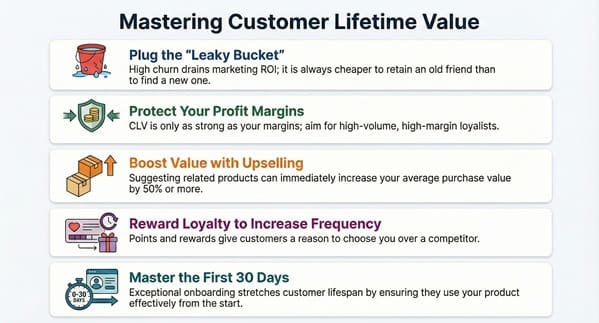
This is the percentage of customers who keep buying from you over a set period. If your retention rate is high, your CLV will naturally jump. It is much cheaper to keep an old friend than to make a new one.
Churn Rate
This is the opposite of retention. It is the rate at which people stop doing business with you. High churn is a “bucket with a hole.” You can pour in as much marketing money as you want, but the value keeps leaking out.
Profit Margin
Your customer lifetime value is only as good as your margins. If you sell a lot of stuff but your costs are too high, your lifetime value stays low. We want high-volume, high-margin loyalists.
Strategies to Increase Your Customer Lifetime Value
Now that we know what it is, how do we make it bigger? Increasing customer lifetime value is the fastest way to grow a healthy company.
Upselling and Cross-selling
“Would you like fries with that?” is the most famous CLV booster in history. When you suggest related products, you increase the average purchase value. If they were going to spend $10 but now spend $15, your lifetime value just grew by 50%.
Loyalty Programs
People love feeling special. A simple points system or a “buy 10 get 1 free” card encourages them to come back. This increases the purchase frequency. You’re giving them a reason not to go to your competitor across the street.
Exceptional Onboarding
In my experience, the first 30 days are vital. If you teach a customer how to use your product effectively, they are less likely to quit. This stretches the “lifespan” part of the formula.
Common Mistakes When Measuring CLV
Even experts get customer lifetime value wrong sometimes. To be honest, it’s easy to get lost in the data. Here are a few things to watch out for.
- Ignoring Costs: Don’t just look at revenue. If it costs you $90 in service to make $100 in sales, your value is only $10.
- Averaging Everyone: Your “VIP” customers and “one-time” discount hunters are different. If you lump them together, your data will be blurry.
- Forgetting the Discount Rate: In formal finance, a dollar today is worth more than a dollar in five years. For a basic blog or small shop, you don’t always need this, but big companies use it to be precise.
Advanced Metrics Related to Customer Lifetime Value
Once you get comfortable, you might hear about CAC. This stands for Customer Acquisition Cost. The most important ratio in business is CLV to CAC.
Roughly speaking, you want your CLV to be at least 3 times higher than your CAC. If it costs you $100 to get a customer, they better bring in $300 of profit over their life. If the ratio is 1:1, you are just breaking even and likely losing money after overhead.
How often do you check your marketing spend against your actual returns? It is a question every owner should ask monthly.
Also Read: Customer Journey Map vs. Process Map: Key Differences
Customer Lifetime Value in Different Industries
The way we look at customer lifetime value changes depending on what you sell.
| Industry | Lifespan | Frequency | Focus |
| Subscription (SaaS) | Long | Monthly | Reducing Churn |
| Retail | Medium | Occasional | Increasing Basket Size |
| Coffee Shop | Short | Daily | Building Habits |
| Real Estate | Very Long | Very Rare | Referrals |
In a subscription business, the goal is to keep you paying that monthly fee forever. In retail, the goal is to get you to buy shoes, then socks, then a hat. Each path leads to a higher CLV.
Key Takeaways
- CLV measures the total profit from a customer’s entire journey.
- It helps you decide how much you can spend on ads without losing money.
- Increasing retention and purchase frequency are the best ways to boost the number.
- Compare your lifetime value to your acquisition cost to see if your business is healthy.
Frequently Asked Questions on CLV
What is a good customer lifetime value?
A good value depends on your industry, but generally, it should be at least three times what you spent to get the customer.
How do I find my customer lifespan?
Look at your historical data. On average, how many months or years pass between a customer’s first purchase and their last one?
Can a small business calculate CLV?
Yes! Even if you just use a spreadsheet with your average sale price and how often regulars come in, you will have a huge advantage over competitors.
Does CLV include referrals?
Technically, “Customer Referral Value” is a separate metric, but many people include it in a broader view of lifetime value because loyal fans bring in new business for free.
Final Words
Understanding customer lifetime value is the difference between a business that struggles and one that thrives. When you stop looking at customers as one-time transactions and start seeing them as long-term partners, everything changes. Your marketing becomes sharper, your service becomes better, and your profits become more predictable.
At our core, we believe that every client deserves a strategy that respects their bottom line. We don’t just chase clicks; we build systems that find and keep high-value customers for years to come. Your success is our primary metric, and we’re here to help you master the numbers that matter most.

About Six Sigma Development Solutions, Inc.
Six Sigma Development Solutions, Inc. offers onsite, public, and virtual Lean Six Sigma certification training. We are an Accredited Training Organization by the IASSC (International Association of Six Sigma Certification). We offer Lean Six Sigma Green Belt, Black Belt, and Yellow Belt, as well as LEAN certifications.
Book a Call and Let us know how we can help meet your training needs.