

A communication matrix is a simple table that documents who needs to communicate what, to whom, through which channel, and how often during a project. It matters because most project failures trace back to a communication breakdown, not a technical one; PMI’s own research found that ineffective communication puts more than half of project dollars at risk.
In practice, a project lead lists every key stakeholder, decides what information each one needs, picks the right channel (email, meeting, dashboard) and frequency for each, and assigns a clear owner for delivering it.
The matrix is the operational tool; the broader communication plan it lives inside is the strategic document explaining why that communication matters in the first place.
Quick Reference Table
| Element | What It Means | Why It Matters | Example |
| Communication Matrix | A table listing who communicates what, to whom, how, and when | Turns a communication strategy into a concrete, actionable plan | A single-page table used throughout a project |
| Communication Plan | The broader strategic document the matrix supports | Explains the goals and reasoning behind the communication | A multi-section document covering audience, goals, and strategy |
| Stakeholder | Anyone affected by, or with influence over, the project | Defines who needs to appear in the matrix at all | A department head, a frontline team, an executive sponsor |
| Communication Channel | The medium used to deliver a message | Different audiences need different channels to actually receive information | Email, status meeting, dashboard, one-on-one conversation |
| Frequency | How often a specific communication happens | Prevents both under-communication and unnecessary noise | Weekly status update, one-time kickoff announcement |
Table of contents
Key Takeaways
- A communication matrix is the operational half of a communication plan. The plan explains the strategy and goals; the matrix turns that strategy into a concrete, actionable table.
- Every row in a matrix answers the same five questions: who is the audience, what do they need to know, how will it reach them, how often, and who’s responsible for sending it.
- Poor communication is a leading cause of project failure, not a soft-skill afterthought. PMI’s research found ineffective communication puts more than half of project spending at risk.
- A communication matrix should be built once and revisited regularly, not written at kickoff and forgotten. Stakeholder needs and project phases both change.
- Different stakeholders need different channels and frequencies. A weekly email might work for a project team but be far too much, or far too little, for an executive sponsor.
- In a Six Sigma project, the communication matrix is a Define-phase deliverable, closely tied to stakeholder analysis and the change management work a Champion or Black Belt leads throughout the project.
- A one-size-fits-all communication approach is a common failure point. Sending every stakeholder the same message at the same frequency usually means most of them are getting either too much or too little.
What Is a Communication Matrix?
A communication matrix is a table-based tool that documents a project’s complete communication plan in one place: who needs information, what they need to know, how it will reach them, and how often. It’s often described as the operational engine of project communication, the specific tool that turns a general strategy into a concrete, day-to-day action plan.
The matrix typically lives inside a broader communication plan and gets used throughout the life of a project: at kickoff, during status reporting, at key milestones, and whenever a major change needs to reach the right people quickly.

Public, Onsite, Virtual, and Online Six Sigma Certification Training!
- We are accredited by the IASSC.
- Live Public Training at 52 Sites.
- Live Virtual Training.
- Onsite Training (at your organization).
- Interactive Online (self-paced) training,
Communication Matrix vs. Communication Plan: What’s the Difference?
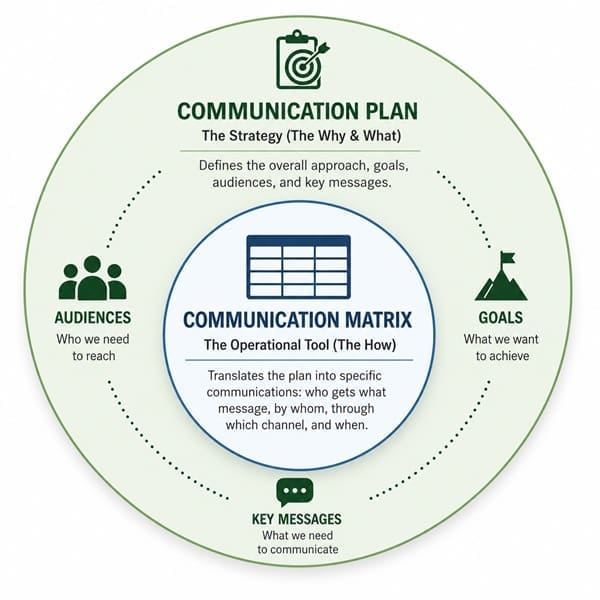
This is the distinction most competing content, and SSDSI’s own existing Communication Plan page, doesn’t fully spell out, and it’s worth being precise about.
| Factor | Communication Plan | Communication Matrix |
| What it is | The overarching strategic document | The concrete, operational table within it |
| Answers the question | “Why are we communicating, and what are our goals?” | “Who, what, how, and when, specifically?” |
| Format | Narrative sections: goals, audiences, strategy | A structured table with defined columns |
| Level of detail | Broad guidelines and objectives | Specific, actionable, row-by-row detail |
How do the two work together?
The communication plan sets the “why” and the “what” in broad terms, the goals, the audiences, the overall approach. The communication matrix is the specific, operational tool inside that plan; it translates the strategy into an action-oriented table defining exactly who communicates what, when, and how.
A project can technically have a plan without a formal matrix, but without the matrix, the plan’s good intentions rarely turn into consistent, actual practice.
Also Read: Six Sigma in Telecommunication and ISPs: A Guide to Perfect Service
Why Does a Communication Matrix Matter?
Communication failures are one of the most well-documented, and most preventable, causes of project trouble. PMI’s Pulse of the Profession research on communications found that highly effective communicators are more than five times more likely to run high-performing organizations than those with minimally effective communication, and that ineffective communication puts more than half of every project dollar spent at risk.
The same research found that high-performing organizations create formal communication plans for nearly twice as many of their projects as lower-performing organizations do.
A communication matrix matters specifically because it turns “we should communicate better” from a vague intention into a concrete, trackable commitment. Without one, communication tends to happen informally and unevenly, some stakeholders get flooded with updates, others get left out entirely, and there’s no clear record of who was supposed to communicate what in the first place.
What Goes Into a Communication Matrix?
A well-built communication matrix typically includes the following columns:
| Column | What It Captures |
| Stakeholder / Audience | Who needs this specific communication |
| Information / Purpose | What they need to know, and why (inform, request feedback, get approval) |
| Channel | How it will reach them (email, meeting, dashboard, one-on-one) |
| Frequency | How often this communication happens (daily, weekly, at milestones, as needed) |
| Owner | Who is responsible for actually sending or delivering it |
| Deliverable / Format | What the output looks like (a status report, a slide deck, a short update) |
How do you decide frequency for each stakeholder?
A useful rule of thumb: match frequency to how directly and immediately a stakeholder is affected by day-to-day project decisions. A project team working in the process daily often needs frequent, detailed updates (weekly or even daily); an executive sponsor typically needs less frequent, higher-level updates (at milestones or monthly), since more frequent detail would be noise rather than useful information for their role.
How Do You Build a Communication Matrix?
1. List Every Key Stakeholder
Identify everyone with a real stake in the project’s outcome or process: team members, the process owner, affected departments, the sponsor, and any external stakeholders like customers or suppliers if relevant.
2. Define What Each Stakeholder Actually Needs to Know
Avoid defaulting to sending everyone the same update. A frontline team needs different information than an executive sponsor; be specific about what each audience actually needs to make their own decisions or stay appropriately informed.
3. Choose the Right Channel for Each Audience
Match the channel to how each stakeholder actually prefers to receive information, and to the urgency of the message. A quick daily huddle works for an active project team; a formal milestone report works better for leadership.
4. Set a Realistic Frequency
Decide how often each specific communication needs to happen, and be honest about what’s sustainable. An overly ambitious frequency that gets skipped after two weeks does more damage to trust than a modest, consistently kept one.
5. Assign a Clear Owner to Every Row
Every communication needs one specific person responsible for it, not a vague “the team” designation. Clear ownership is what actually gets a matrix followed instead of ignored.
How Does a Communication Matrix Fit Into a Six Sigma Project?

In a DMAIC project, a communication matrix is most naturally built during the Define phase, alongside stakeholder analysis and the project charter. It becomes one of the practical tools a Champion, Sponsor, or Black Belt uses to manage the human side of the project, closely tied to the change management work covered under concepts like the change agent role.
The matrix matters at several specific points in a Six Sigma project:
- At project kickoff, to make sure every affected department understands the scope and timeline before work begins.
- At each DMAIC tollgate review, to make sure the right leaders receive the right level of detail to make a go/no-go decision.
- During the Improve phase, when a process change needs to reach the people whose daily work is actually changing, tying directly into change management and resistance planning.
- During the Control phase, to make sure whoever inherits the process (often the process owner) knows exactly how monitoring and escalation will work going forward.
A Six Sigma project’s communication matrix doesn’t need to be complicated. A single-page table, reviewed and updated at each phase transition, is usually enough to keep a project’s stakeholders genuinely informed rather than either overwhelmed or left in the dark.
Real-World Example (Hypothetical)
Problem: A hospital’s Black Belt is leading a project to redesign the patient discharge process, involving nursing staff, IT, hospital administration, and an external software vendor.
Analysis: Early informal updates have already caused confusion: nursing staff heard about the change secondhand from a manager, while administration felt they weren’t getting updates frequent enough to track progress.
Six Sigma approach: The Black Belt builds a communication matrix during the Define phase. Nursing staff get a brief, plain-language update at each major milestone, delivered by their direct supervisor. Administration gets a monthly one-page status report. The IT team and vendor get a weekly working-session call, since they’re actively building the new workflow together.
Action: The matrix is reviewed and adjusted slightly at each DMAIC tollgate, adding a specific “go-live” communication to nursing staff two weeks before launch.
Result (hypothetical): Stakeholders report feeling appropriately informed for their role, rather than either overwhelmed with detail or left finding out about changes secondhand. This is a hypothetical illustration of a communication matrix in practice, not a documented case study.
Common Mistakes When Building a Communication Matrix
- Sending every stakeholder the same message at the same frequency. This usually means most stakeholders are getting either too much detail or not enough.
- Building the matrix once and never revisiting it. Stakeholder needs shift as a project moves through phases; a matrix built at kickoff and never updated stops reflecting reality.
- Leaving ownership vague. A row without a clearly assigned, specific owner tends to simply not happen once the project gets busy.
- Confusing the matrix with the full communication plan. A matrix without any strategic reasoning behind it can end up mechanically checking boxes without actually serving stakeholder needs.
- Overloading the matrix with too many rows to actually maintain. A matrix so detailed it becomes a burden to update tends to get abandoned; simpler and consistently followed beats comprehensive and ignored.
Frequently Asked Questions (FAQs) on Communication Matrix
Q: What is a communication matrix?
A: A communication matrix is a table that documents a project’s communication plan in action: who needs information, what they need to know, how it reaches them, how often, and who’s responsible for delivering it.
Q: What is the difference between a communication matrix and a communication plan?
A: A communication plan is the broader strategic document explaining the goals and reasoning behind project communication. A communication matrix is the specific, operational table inside that plan, translating the strategy into concrete, row-by-row detail.
Q: What columns should a communication matrix include?
A: Common columns include the stakeholder or audience, the information or purpose, the communication channel, the frequency, the owner responsible for delivering it, and the deliverable or format.
Q: Why is a communication matrix important?
A: Poor communication is one of the most common causes of project trouble; PMI’s research found ineffective communication puts more than half of project spending at risk. A matrix turns a vague intention to “communicate better” into a specific, trackable commitment.
Q: How do you create a communication matrix?
A: List every key stakeholder, define what each one actually needs to know, choose the right channel for each audience, set a realistic frequency, and assign a clear, specific owner to every row.
Q: What is a communication matrix in Six Sigma?
A: In a DMAIC project, a communication matrix is typically built during the Define phase alongside stakeholder analysis, and used throughout the project to keep tollgate reviews, process changes, and Control-phase handoffs properly communicated to the right people.
Final Words
A communication matrix is what turns good intentions about project communication into something that actually happens, consistently, for the right people, at the right level of detail. Built alongside a broader communication plan, and revisited as a project moves through its phases, a simple, well-owned matrix does far more to keep a project on track than any amount of good communication intent left informal and unstructured.
Building a communication matrix that actually gets followed is a practical Define-phase skill that keeps a Six Sigma project’s stakeholders genuinely informed, not overwhelmed or left out.
Six Sigma Development Solutions, Inc. (SSDSI) is IASSC-accredited and 5-star rated on Google Reviews, having certified 5,322+ professionals across 600+ organizations in 52 cities. Our onsite, live virtual, public, and online Green Belt and Black Belt training covers stakeholder analysis, communication planning, and change management in the depth needed to keep a project’s people, not just its process, on track. Explore SSDSI’s Green Belt certification to build that foundation.
About Six Sigma Development Solutions, Inc.
Six Sigma Development Solutions, Inc. offers onsite, public, and virtual Lean Six Sigma certification training. We are an Accredited Training Organization by the IASSC (International Association of Six Sigma Certification). We offer Lean Six Sigma Green Belt, Black Belt, and Yellow Belt, as well as LEAN certifications.
Book a Call and Let us know how we can help meet your training needs.


