
Can Six Sigma help with software development when most coders feel like their work is an art rather than a factory line? It’s a fair question. If you’ve ever sat through a grueling sprint retrospective where the same bugs kept appearing, you know the frustration.
We often treat software errors as “just part of the process,” but Six Sigma suggests we can actually predict and prevent them. By applying data-driven methods, teams can trim the fat from their workflows and deliver cleaner code faster.
Table of contents
Why Consider Six Sigma for Software Engineering?
To be honest, I used to think Six Sigma was only for people in hard hats making car parts. It felt too rigid for the fast-paced world of Agile or DevOps. However, after seeing how much time developers spend on rework—sometimes up to 50% of a project—my perspective changed. We’re essentially talking about a toolkit that finds where your process is leaking money and time.
In my view, the “Sigma” in software isn’t about stifling creativity. It’s about removing the “noise” that stops you from being creative. Have you ever wondered why some modules always fail during integration? Or why your deployment pipeline hits a snag every Tuesday? That is where these statistical tools shine. They help you move from guessing why things go wrong to knowing exactly where the bottleneck sits.

Public, Onsite, Virtual, and Online Six Sigma Certification Training!
- We are accredited by the IASSC.
- Live Public Training at 52 Sites.
- Live Virtual Training.
- Onsite Training (at your organization).
- Interactive Online (self-paced) training,
The Core of Lean Six Sigma in Software Industry
When we talk about Six Sigma, we’re aiming for near-perfection—specifically, 3.4 defects per million opportunities. In a software context, an “opportunity” could be a line of code, a function call, or a user interaction. While hitting 99.9996% perfection in a creative environment is tough, the journey toward it yields massive gains.
We often use the DMAIC framework to structure this improvement. It stands for:
- Define: What is the specific problem with the software?
- Measure: How many bugs are we actually seeing?
- Analyze: What is the root cause of these crashes?
- Improve: How do we fix the process to stop the bugs?
- Control: How do we make sure the fix sticks?
Also Read: Manual Testing Tools and the Software Testing Process
Can Six Sigma Help With Software Development Efficiency?
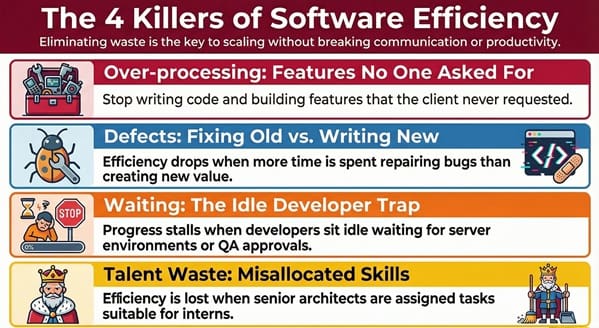
Efficiency is usually the first thing to suffer when a project scales. We’ve all been there: a small team of three works great, but once you hit twenty people, communication breaks down. Six Sigma helps by identifying “waste” (or Muda, as the pros call it).
In software, waste looks like:
- Over-processing: Writing features the client never asked for.
- Defects: Spending more time fixing old code than writing new code.
- Waiting: Developers sitting idle while waiting for server environments or QA approvals.
- Talent Waste: Giving a senior architect tasks that an intern could handle.
By measuring these gaps, we can streamline the flow. It’s not about working harder; it’s about making the path from “idea” to “production” as straight as possible.
Measuring Code Quality with Statistics
How do you measure a “feeling” that the code is bad? You don’t. You use metrics. However, you might look at Cyclomatic Complexity or Defect Density. If you notice that your Defect Density spikes every time you use a specific third-party API, you’ve found your “root cause.” This is much better than just telling the team to “be more careful,” right?
Integrating Six Sigma with Agile and Scrum
One of the biggest myths is that you have to choose between Six Sigma and Agile. That is simply not true. In fact, they work quite well together. Agile provides the speed and flexibility, while SS (Six Sigma) provides the analytical rigor to solve deep-seated issues that a simple Stand-up meeting can’t fix.
Think of it this way: Agile tells you how to organize your work, and Six Sigma tells you how well that work is performing. For example, during a Sprint Review, you might notice the velocity is dropping. An Agile coach might suggest more “focus time.” A Six Sigma practitioner would pull the data, run a Pareto chart, and realize that 80% of the delays come from one specific legacy database.
Also Read: Minitab Integration with Six Sigma Tools and Software
Real-World Gains: A Case Example
Consider a mid-sized SaaS company I worked with. They were losing customers because their mobile app crashed frequently. The devs were burnt out from “firefighting.” We applied a simplified Six Sigma approach.
First, we Measured the crashes and found they happened mostly on Android 12 devices. Then, we Analyzed the logs and saw a memory leak in the image-rendering library. We Improved the app by swapping the library and Controlled the situation by adding an automated test for memory usage in the CI/CD pipeline.
The result? Crashes dropped by 70% in two months. They didn’t need “magic”; they needed a method.
Common Challenges in Implementation
Now, it isn’t all sunshine and rainbows. Implementing Six Sigma in a dev shop has its hurdles.
- Resistance to Data: Developers sometimes hate being “tracked.” You have to frame it as “fixing the system,” not “grading the person.”
- Over-documentation: If you spend more time filling out forms than coding, you’re doing it wrong.
- Tooling: You need good telemetry. If you don’t have logs, you don’t have data.
Key Takeaways
- Six Sigma focuses on reducing defects and variability in the software lifecycle.
- The DMAIC method provides a roadmap for solving persistent technical debt.
- It identifies waste like over-processing and waiting times to boost efficiency.
- You can use it alongside Agile to add a layer of statistical proof to your improvements.
- Success requires a culture that values data over “gut feelings.”
Frequently Asked Questions About Six Sigma Help With Software Development
Is Six Sigma too slow for modern software startups?
Not if you use it correctly. You don’t need a six-month project for every bug. You can apply “Lean” principles daily to keep the team fast and focused.
What is the difference between Lean and Six Sigma in tech?
Lean focuses on speed and removing waste. Six Sigma focuses on quality and removing defects. Most tech firms use a hybrid called Lean Six Sigma (LSS).
Do developers need to be “Belts” to participate?
No. While having a Green Belt or Black Belt lead the project helps, the average dev just needs to understand the basic concepts of measuring quality and finding root causes.
How does Six Sigma impact the User Experience (UX)?
By reducing errors and improving load times, you create a more reliable product. A stable app is the foundation of a good user experience.
Can Six Sigma help with software development costs?
Absolutely. Fixing a bug in production is roughly 10 to 100 times more expensive than fixing it during the design phase. Preventing defects saves massive amounts of money.
Final Words
At the end of the day, Six Sigma is about making life easier for everyone involved. It’s about building a world where “deployment day” isn’t a source of anxiety. We believe that every developer deserves a process that supports their best work, not one that creates unnecessary hurdles.
Our focus is always on your success and the quality of the solutions you provide to your clients. We’re here to help you turn data into your most powerful development tool.
Talk to our Specialist for Six Sigma Training.

About Six Sigma Development Solutions, Inc.
Six Sigma Development Solutions, Inc. offers onsite, public, and virtual Lean Six Sigma certification training. We are an Accredited Training Organization by the IASSC (International Association of Six Sigma Certification). We offer Lean Six Sigma Green Belt, Black Belt, and Yellow Belt, as well as LEAN certifications.
Book a Call and Let us know how we can help meet your training needs.