Can Six Sigma be used in a restaurant to fix slow service or cold food? Most people think of huge car factories when they hear about Lean or DMAIC. They picture robots and assembly lines, not a busy kitchen during a Friday night rush. But here is the thing: a restaurant is just a tasty factory. You take raw materials, put them through a process, and deliver a finished product to a customer. If that process has “bugs,” your profit walks out the door.
In my experience, the food industry is actually the perfect place for these tools. Why? Because the margins are thin. You don’t have room for waste. To be honest, we’ve all been to that one place where the food is great but the wait time is a nightmare. That is a process problem, not a cooking problem. By the end of this, you’ll see how these “factory tools” can actually save your bistro or café.
Table of contents
Why Can Six Sigma Be Used In a Restaurant Today?
You might wonder if a methodology created by engineers can handle a grumpy chef or a picky eater. The answer is a loud yes. At its core, Six Sigma is about reducing mistakes. In a kitchen, a mistake is a burnt steak or a wrong side dish. Every time a server sends a dish back, you lose money.
Cutting Down the Chaos
Running a kitchen is about timing. If the appetizer comes out with the main course, the customer is unhappy. If the soup is cold, they won’t come back. We call these “defects.” Six Sigma helps you find exactly where the timing breaks down. Is the stove too small? Is the communication between the front of house and the kitchen broken?
Saving Your Budget
Food waste is a silent killer for small businesses. When you use Six Sigma (SS) in your eatery, you look at your inventory. You stop buying what you don’t need. You also stop throwing away money through overproduction. It’s about making sure every dollar you spend on ingredients actually ends up on a paid check.

Public, Onsite, Virtual, and Online Six Sigma Certification Training!
- We are accredited by the IASSC.
- Live Public Training at 52 Sites.
- Live Virtual Training.
- Onsite Training (at your organization).
- Interactive Online (self-paced) training,
The DMAIC Method in the Kitchen
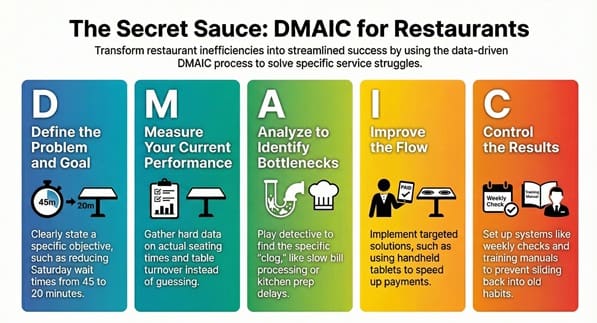
To really understand how can Six Sigma be used in a restaurant, we have to look at the DMAIC phases. This is the “secret sauce” of the methodology. It stands for Define, Measure, Analyze, Improve, and Control.
1. Define the Problem
First, you need to pick a struggle. Let’s say your guests complain that the wait for a table is too long. In this phase, we don’t guess. We state the goal clearly: “Reduce Saturday night wait times from 45 minutes to 20 minutes.”
2. Measure the Current State
Now, we gather data. How long does a guest actually sit? How fast does the busboy clear the table? You can’t fix what you don’t track. We’ve all been there—thinking a shift went well just because it was busy, but the data might show you lost five tables because people got tired of waiting.
3. Analyze the Bottlenecks
This is where you play detective. Why is the wait long? Maybe you realize that the kitchen is fast, but the servers take ten minutes to process the bill. Or perhaps the dishwasher can’t keep up with the silver-ware. This is your “aha!” moment.
4. Improve the Flow
Once you find the “clog” in the pipe, you fix it. If the bill-paying process is slow, maybe you give servers handheld tablets. If the kitchen is slow because of prep work, you change the morning shift’s duties.
5. Control the Results
You don’t want to slide back into old habits. You set up a system to keep things running. This might mean a weekly check on wait times or a new training manual for new hires.
Also Read: Lean Six Sigma in Las Vegas Casinos
Lean Six Sigma: Making the Kitchen Faster
While SS focuses on quality, “Lean” focuses on speed and waste. When you combine them, you get a powerhouse. In the food world, we look for the “Eight Wastes.”
| Type of Waste | Restaurant Example |
| Overproduction | Making too much soup that gets tossed at night. |
| Waiting | A server standing around waiting for a salad. |
| Transport | Walking across the whole kitchen to get a plate. |
| Motion | Reaching too high or too low for common spices. |
| Inventory | Buying 50 lbs of onions when you only use 10. |
| Errors | Putting onions on a burger when the ticket said “no onions.” |
Do you see how these small things add up? If your chef walks ten extra miles a year just to get salt, that is wasted time. By moving the salt closer, you make the job easier and the food faster.
Real-World Benefits for Your Staff
Here’s the thing: happy staff equals happy guests. When a kitchen is chaotic, people quit. When you use a clear system, everyone knows their job. It lowers the heat—literally and figuratively.
- Less Stress: No more screaming because a ticket got lost.
- Better Tips: Faster service means more table turns and happier diners.
- Consistency: The pasta tastes the same on Tuesday as it does on Saturday.
FAQs about Using Six Sigma In a Restaurant
Is Six Sigma too expensive for a small café?
Not at all. While big chains hire expensive consultants, a small owner can learn the basics. Most of it is just using a stopwatch and a notepad to see where time is wasted. It’s more about a change in mindset than a big check.
Does this mean my food will taste “industrial”?
Actually, it’s the opposite. By removing the “noise” and stress, your chefs can focus more on the flavor. It ensures the recipe is followed perfectly every single time.
How long does it take to see results?
You can see small wins in a week. If you reorganize a prep station to save five minutes, you feel that impact during the very next rush. Big culture changes might take a few months.
Also Read: Measuring and Improving Customer Satisfaction with Six Sigma
Key Takeaways for Restaurant Owners
- Data over Guessing: Don’t just “feel” like you’re slow. Measure the minutes.
- Focus on the Guest: Every change should make the customer’s life better.
- Eliminate Waste: Watch your trash cans and your clocks.
- Standardize: Write down the “one right way” to do every task.
- Empower Teams: Let your servers and cooks suggest fixes. They see the problems first.
Final Thoughts on Six Sigma in Food Service
At the end of the day, we’re all in the business of making people happy. Whether you run a high-end steakhouse or a local donut shop, efficiency matters. Using can Six Sigma be used in a restaurant logic isn’t about turning your staff into robots. It’s about giving them the tools to succeed without the burnout.
We believe that every plate tells a story of hard work and precision. Our team is dedicated to helping you refine that story. We focus on your success so you can focus on your craft. Ready to cut the waste and grow your brand? Let’s get to work.
Talk to our Specialist for Lean Six Sigma Training

About Six Sigma Development Solutions, Inc.
Six Sigma Development Solutions, Inc. offers onsite, public, and virtual Lean Six Sigma certification training. We are an Accredited Training Organization by the IASSC (International Association of Six Sigma Certification). We offer Lean Six Sigma Green Belt, Black Belt, and Yellow Belt, as well as LEAN certifications.
Book a Call and Let us know how we can help meet your training needs.