
Have you ever wondered what truly separates successful projects from those that struggle and fail? It is not just the budget or the timeline. The real secret weapon is often unseen. This crucial tool is the Project Management Communication Plan. This plan does more than just list emails and meeting times. It sets the stage for flawless execution. It is the framework that prevents costly misunderstandings.
The Project Management Communication Plan formally outlines every information exchange. It ensures every stakeholder, from the team member to the chief sponsor, receives the right message. Do you want to eliminate confusion and boost your team’s performance instantly? This detailed guide on the effective project communication strategy holds the answer you need.
Table of contents
What is a Project Management Communication Plan?
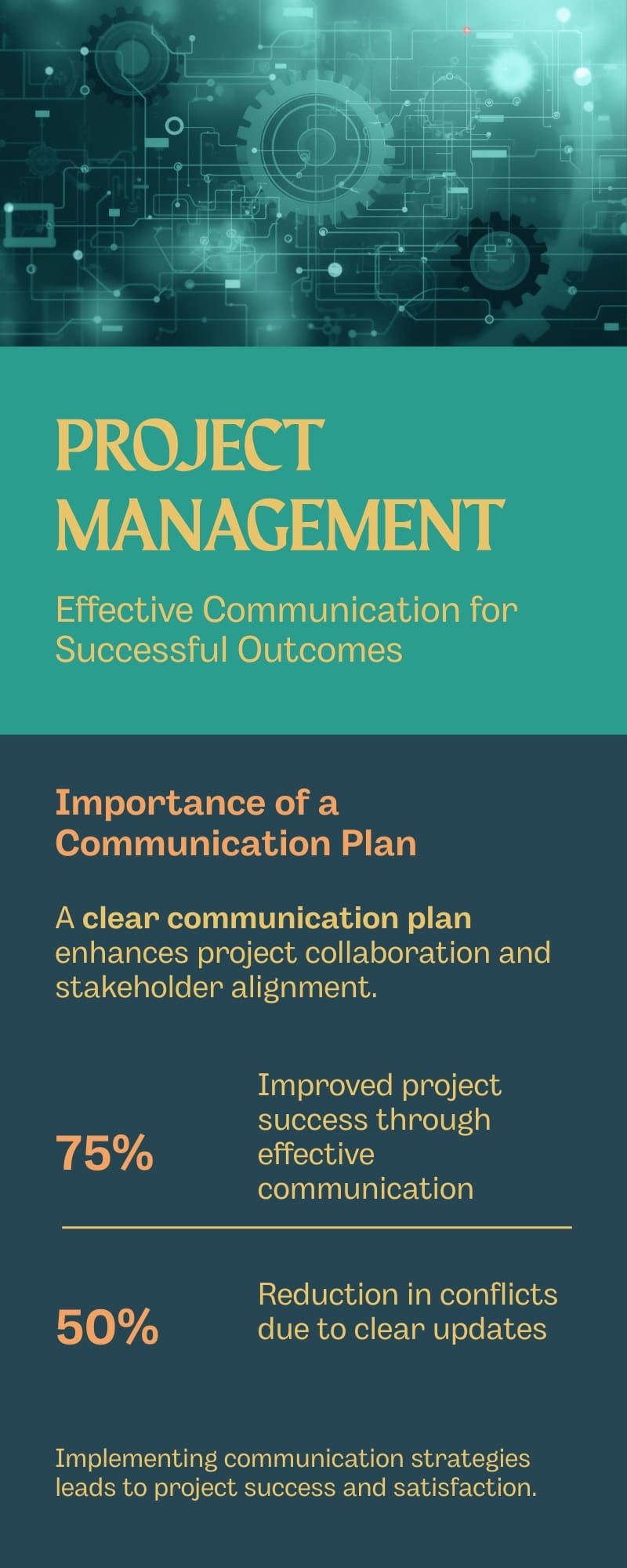
A Project Management Communication Plan is defined as a formal document. This document outlines how, when, and by whom project information will be shared. In simple words, the Project Management Communication Plan creates a clear roadmap for all information exchange.
This roadmap ensures everyone gets the right message at the right time. Furthermore, the plan defines the tools and methods for communication. This focus helps the entire team and all stakeholders stay aligned. A well-crafted plan is a basic requirement for effective project communication strategy.

Public, Onsite, Virtual, and Online Six Sigma Certification Training!
- We are accredited by the IASSC.
- Live Public Training at 52 Sites.
- Live Virtual Training.
- Onsite Training (at your organization).
- Interactive Online (self-paced) training,
Why is a Communication Plan Essential for Every Project?
The Project Management Communication Plan is crucial for many reasons. This plan acts like the nervous system of your project. Without it, confusion and errors can quickly increase. The main goal is to minimize surprises and reduce misunderstandings.
Advantages and Disadvantages of Having a Communication Plan
Having a Project Management Communication Plan offers many advantages. However, overlooking certain aspects can lead to disadvantages.
Advantages of the Project Management Communication Plan
The Project Management Communication Plan brings structure to complex processes.
- Boosts Stakeholder Engagement: The plan clearly defines who needs updates and when. This regular flow of information keeps stakeholders interested and supportive.
- Reduces Conflicts: Clear rules for communication minimize misinterpretations. This helps stop small issues from turning into big problems.
- Saves Time and Money: Team members know exactly where to find information. They spend less time searching and more time working. This makes the project more efficient.
- Improves Decision Making: Quick and accurate information flow helps leaders make smart choices faster.
- Creates a Record: The Project Management Communication Plan documents all planned exchanges. This record is vital for audit and future reference.
Disadvantages of Ignoring the Project Management Communication Plan
Ignoring this crucial step creates significant risks for the project.
- Information Silos: Team members hoard information. This stops the free flow of knowledge needed for success.
- Missed Deadlines: When updates are not sent on time, tasks can stall. This often causes the project to fall behind schedule.
- Scope Creep: Uncontrolled communication with stakeholders can lead to unauthorized changes. These changes expand the project scope unnecessarily.
- Low Morale: Constant confusion and rework frustrate the project team. This results in poor team morale and motivation.
Key Components of an Effective Project Communication Plan
Every strong Project Management Communication Plan contains several vital elements. These components answer the basic questions of “who, what, where, when, and how.” Understanding these parts is essential to build a reliable effective project communication strategy.
Core Components of the Project Management Communication Plan
- Stakeholder Analysis: This involves identifying every person or group affected by the project. The Project Management Communication Plan must know who your audience is. This includes the project team, management, sponsors, and customers.
- Information to be Communicated: What information will you share? This could be status reports, risk updates, meeting minutes, or schedule changes. The plan must list the specific types of content.
- Communication Methods and Channels: How will you send the message? Channels can include email, face-to-face meetings, video conferences, or instant messaging. This section details the technology to be used.
- Frequency: How often does the communication need to happen? The Project Management Communication Plan specifies the timing. For example, status reports might be weekly, while risk meetings are bi-weekly.
- Owner or Sender: Who is responsible for creating and sending the message? Assign a clear owner to ensure accountability. For instance, the Project Manager often owns the weekly status report.
- Recipient: Who needs to receive the message? This is a key part of the Project Management Communication Plan. This list is determined by the stakeholder analysis.
- Format and Detail Level: What will the message look like? The plan specifies if a report needs to be a detailed fifty-page document or a short, one-page summary. The level of detail must suit the recipient.
Also Read: Quantum Communication
How to Create Your Project Communication Plan
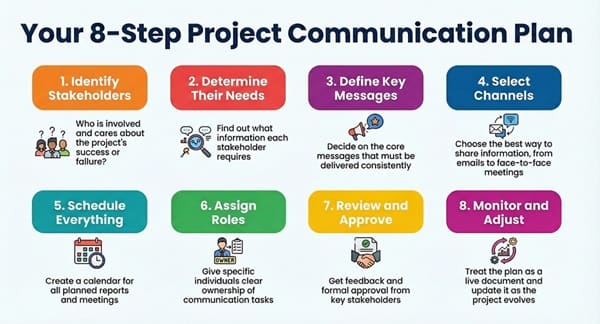
Creating a solid Project Management Communication Plan requires a systematic approach. Follow these clear steps to build a strategy that works for your team. This process ensures all necessary elements are covered from start to finish.
Steps to Build the Project Management Communication Plan
- Identify Stakeholders: First, identify every person or group involved. Ask yourself: “Who cares about this project’s success or failure?”
- Determine Communication Needs: Next, find out what information each stakeholder requires. Some people only need a high-level summary. Other people need deep, technical details.
- Define Key Messages: Decide on the important messages you must deliver. These core messages must be consistent across all updates.
- Select Communication Channels: Choose the best way to share information. Face-to-face meetings are better for sensitive topics. Email works well for routine updates.
- Schedule Communications: Create a calendar for all planned communications. Schedule recurring meetings and report deadlines. This ensures consistent updates.
- Assign Roles and Responsibilities: Name specific individuals for each communication task. Someone must write the report. Someone else must approve it. The Project Management Communication Plan needs clear ownership.
- Review and Approve: Share the draft plan with key stakeholders. Get their feedback and make necessary changes. Formal approval makes the plan official.
- Monitor and Adjust: The Project Management Communication Plan is a live document. Review it regularly to see if it is working. Change it if the project team or needs change.
Types of Project Communication
Not all communication is the same. The Project Management Communication Plan needs to address different types of information exchange. Understanding these types helps project managers choose the right method for the right situation.
Categorizing Information Exchange
- Formal vs. Informal Communication:
- Formal: This is planned, structured, and documented. Examples include official status reports, final contracts, or formal presentations. The Project Management Communication Plan mainly focuses on formal methods.
- Informal: This is spontaneous and casual. Examples include quick phone calls, hallway discussions, or instant messages. Informal communication builds team relationships.
- Internal vs. External Communication:
- Internal: This exchange happens within the project team and the organization. For example, a discussion between team members about a technical bug.
- External: This exchange happens between the project team and outside parties. Examples include talking with vendors, customers, or government regulators. External communication often requires high levels of formality.
- Vertical vs. Horizontal Communication:
- Vertical: This is the flow of information up or down the organizational hierarchy. Upper management sends instructions down. Team members send progress reports up.
- Horizontal: This is the exchange between team members or departments at the same level. For example, a design engineer talking to a testing engineer. This type of communication is key for daily work coordination.
The effective project communication strategy ensures a balance across all these types. Too much informal talk can lead to errors. Too little informal talk can hurt team spirit.
Also Read: Communication Plan
Overcoming Challenges in Project Communication
Even with a strong Project Management Communication Plan, challenges arise. Project managers face hurdles related to distance, culture, and technology. Addressing these issues early improves the entire effective project communication strategy.
Common Communication Challenges
- Geographic Distance: Teams that work in different locations face difficulty. Time zones complicate meeting schedules. The Project Management Communication Plan must plan for virtual tools and clear document storage.
- Cultural Differences: Different cultures have different ways of communicating. What is polite in one country may be rude in another. The plan should include sensitivity training or clear guidelines on tone.
- Language Barriers: When team members speak different first languages, mistakes can happen easily. Simple, direct language must be used in all written documents. Always clarify complex concepts.
- Information Overload: Sending too many emails or reports causes fatigue. People stop paying attention. The Project Management Communication Plan helps by only sending information to those who truly need it. It focuses on quality, not quantity.
Best Practices for Project Communication
- Keep it Simple: Use clear and simple words. Avoid technical jargon when speaking to non-technical stakeholders. This improves the clarity of your message.
- Confirm Understanding: Do not just send a message and assume it was received and understood. Ask open-ended questions to check for clarity. For instance, “What are your key takeaways from this status report?”
- Use Visuals: Diagrams, charts, and graphs explain complex data better than text alone. Add a visual aid to status reports wherever possible.
- Listen Actively: Communication is a two-way street. The project manager must spend time listening to the team’s concerns. This shows respect and helps identify hidden problems.
Final Words
The Project Management Communication Plan is far more than just a document. It is the foundation for project success. Creating a detailed, clear plan helps project teams navigate the complexities of information exchange. By defining the right message, the right sender, and the right recipient, projects move forward smoothly. This systematic approach ensures all team members and stakeholders are on the same page. A robust effective project communication strategy is the key to delivering value.
Key Takeaways
- A Project Management Communication Plan is a formal document. It details how, when, and who will share project information.
- The primary benefit is reducing confusion and boosting stakeholder involvement.
- Key components include defining the audience, the message, the channel, and the frequency.
- Communication should be simple, clear, and consistent across all channels.
- The plan must be a living document that you review and adjust as the project changes.
Frequently Asked Questions (FAQs)
1. What is the main goal of the Project Management Communication Plan?
The main goal is to ensure timely and appropriate generation, collection, distribution, storage, and ultimate disposition of project information. This keeps everyone updated.
2. When should the Project Management Communication Plan be created?
The plan should be created early in the project life cycle. It is often one of the first documents created during the project planning phase.
3. Is the Project Management Communication Plan fixed once it is approved?
No, it is a living document. The plan should be reviewed and updated whenever stakeholders, project needs, or communication methods change.
4. What is a communication channel in project management?
A communication channel is the method used to transmit information. Examples are email, meeting, instant message, or official project reports.
5. How does the communication plan help manage project risks?
The plan ensures risks are reported to the right people quickly. This allows the team to develop mitigation strategies before the risk causes major damage.
6. What is the difference between formal and informal communication?
Formal communication is structured, planned, and often documented (like a status report). Informal communication is casual, spontaneous, and helps build team relationships (like a quick hallway discussion).

About Six Sigma Development Solutions, Inc.
Six Sigma Development Solutions, Inc. offers onsite, public, and virtual Lean Six Sigma certification training. We are an Accredited Training Organization by the IASSC (International Association of Six Sigma Certification). We offer Lean Six Sigma Green Belt, Black Belt, and Yellow Belt, as well as LEAN certifications.
Book a Call and Let us know how we can help meet your training needs.