What is Lean Leadership and Why Does It Matter?
Lean leadership is the backbone of any successful lean transformation because it moves away from traditional “command and control” styles. Have you ever felt like your boss just gives orders without knowing how the work actually happens? We’ve all been there, and it’s frustrating. To be honest, most traditional managers focus on results but ignore the process.
In my experience, the magic happens when leaders stop acting like judges and start acting like coaches. Lean leadership refers to a system where managers spend time where the work happens. We call this the “Gemba.” This approach isn’t just about cutting costs. It is about growing people. If you want a team that solves its own problems, you need to change how you lead.
But how do you actually start? Does it mean you stop making decisions? Not at all. It means you change how you make them. It involves a mix of personal humility and a relentless drive for improvement. This leadership style ensures that every employee feels responsible for the company’s success.
Table of contents
The Four Pillars of Lean Leadership
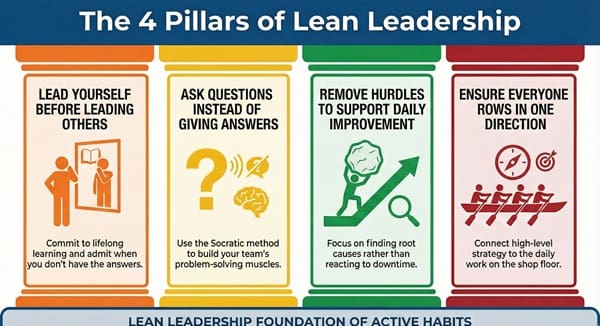
To understand lean leadership, we must look at the four main pillars that support it. These aren’t just theories; they are daily habits. If you ignore one, the whole system might lean the wrong way (pun intended).
1. Self-Development
You cannot lead others if you cannot lead yourself. In a lean environment, you must commit to lifelong learning. Are you willing to admit when you don’t have the answer? Lean leaders constantly work on their own skills before they try to “fix” others.
2. Coaching and Developing Others
This is where the real work happens. Instead of telling people what to do, you ask them what they see. We’re talking about the “Socratic method.” By asking “Why?” and “What if?”, you help your team build their problem-solving muscles. It’s roughly like teaching someone to fish instead of just handing them a tuna sandwich.
3. Supporting Daily Kaizen
Kaizen means “change for the better.” As a leader, your job is to remove the hurdles that stop your team from improving. If a machine breaks every Tuesday, don’t just yell about the downtime. Help the team find the root cause.
4. Creating Vision and Alignment
This pillar ensures everyone rows in the same direction. It’s often called Hoshin Kanri or strategy deployment. You take the big goals and break them down so the person on the shop floor knows exactly how their work helps the company win.

Public, Onsite, Virtual, and Online Six Sigma Certification Training!
- We are accredited by the IASSC.
- Live Public Training at 52 Sites.
- Live Virtual Training.
- Onsite Training (at your organization).
- Interactive Online (self-paced) training,
Why Lean Leadership Focuses on the Gemba?
In the world of lean leadership, the Gemba is the most important place on earth. It’s the “actual place” where value is created. If you’re a software manager, the Gemba is the code. If you run a hospital, it’s the patient’s bedside.
I once worked with a director who spent all day in meetings. He wondered why production was down. We went to the floor together and realized the workers were waiting two hours for parts every morning. He didn’t know because he wasn’t there.
Lean leadership (LL) requires you to go and see, ask why, and show respect. When you show up at the Gemba, you aren’t there to find someone to blame. You are there to understand the process. This builds trust. When employees see you in the trenches, they’re more likely to share the truth with you.
Also Read: Pursue an Exciting Career in Lean Six Sigma
Key Behaviors of a Lean Leader
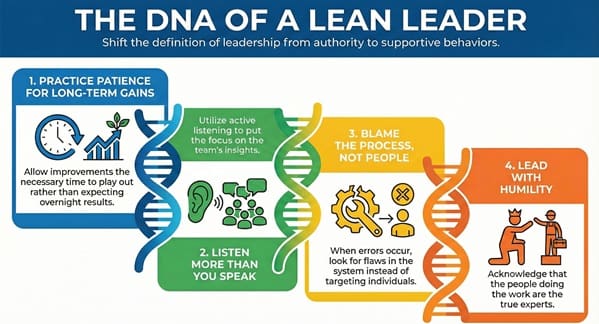
What does a lean leadership pro look like in action? It isn’t about having a fancy title. It’s about how you show up. To be honest, it’s a bit of an ego check. Here are the behaviors you’ll see:
- Patience: Improvements don’t happen overnight. You have to let the process play out.
- Active Listening: You listen more than you speak.
- Focus on Process: If something goes wrong, you blame the process, not the person.
- Humility: You realize that the people doing the work know more about it than you do.
Have you ever noticed how the best coaches in sports rarely run onto the field during the game? They do their work during practice. LL is the same. You prepare your team so well that they can handle the “game” without you hovering over them.
Overcoming the “Command and Control” Habit
Traditional management is a hard habit to break. Most of us were taught that the boss is the smartest person in the room. But in a lean leadership model, that’s rarely true.
The transition is tough. You might feel like you’re losing power. Fast-forward to six months into a lean journey, and you’ll find you actually have more time. Why? Because your team isn’t calling you every five minutes to ask for permission. They know the goal, and they have the tools to solve problems.
“A leader is best when people barely know he exists… when his work is done, his aim fulfilled, they will say: we did it ourselves.” — Lao Tzu
Common Tools for Lean Leadership
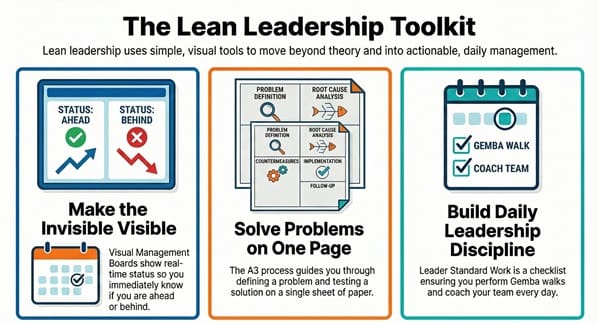
While the mindset is key, some tools make lean leadership easier to track. You don’t need a PhD to use these. They are simple by design.
Visual Management Boards
These boards show the status of work in real-time. Are we ahead or behind? If we’re behind, what’s the plan to catch up? This makes the “invisible” visible.
An A3 is just a sheet of paper. It guides you through the steps of defining a problem, finding the cause, and testing a solution. It keeps everyone on the same page.
Leader Standard Work
This is a checklist for leaders. It ensures you do your Gemba walks, check the visual boards, and coach your team every single day. It keeps you disciplined.
Also Read: Lean Six Sigma Essentials for Effective Sales
The Role of Respect in Lean
You can’t have lean leadership without respect for people. This doesn’t just mean being nice. It means respecting their intelligence. It means giving them a safe environment to fail and learn.
When we treat people like “resources” or “units of labor,” we lose their brains. Lean asks for the whole person. When you respect your team, they give you their best ideas. That is where true innovation comes from.
Case Study: The Lean Turnaround
Picture this: A mid-sized manufacturing plant was failing. Quality was low, and morale was even lower. The new manager didn’t fire anyone. Instead, he started practicing lean leadership principles.
He spent the first two weeks just watching. He asked the workers, “What’s the hardest part of your job?” They told him the tools were always missing. The manager didn’t order a new tool tracking system. He gave them the budget to organize their own workstations.
Within three months, productivity jumped by 20%. Why? Because the leader stopped being a bottleneck. He enabled the experts—the workers—to fix their own space. This is the power of LL in action.
How to Start Your Lean Leadership Journey
Ready to take the plunge? You don’t need a massive corporate rollout. You can start today with these simple steps:
- Stop giving answers. Next time a staff member asks what to do, ask, “What do you think we should do?”
- Go to the Gemba. Spend 30 minutes today just watching the work. Don’t check your phone. Just watch.
- Find a “Waste”. Look for things that don’t add value—like extra movement or waiting. Ask the team how to fix it.
- Admit a mistake. Show your team that it’s okay to be human. It builds a culture of safety.
Key Takeaways
- Lean leadership is about coaching and developing people, not just hitting targets.
- The Gemba is where value happens; spend your time there.
- Focus on the process, not the person, when problems arise.
- Use simple tools like A3s and Visual Boards to keep things clear.
- Respect for people is the foundation of every lean success.
Frequently Asked Questions
Is lean leadership only for manufacturing?
No! It works in healthcare, software, retail, and even at home. If there is a process, there is waste to remove.
How is it different from regular management?
Regular management often focuses on “what” (the result). LL focuses on “how” (the process and the people).
Does lean mean “less employees”?
Definitely not. Lean is about using the employees you have more effectively by removing the “junk” tasks that frustrate them.
Can I be a lean leader in a non-lean company?
Yes, you can. You can lead your specific team using these principles even if the rest of the company hasn’t caught on yet.
Final Words
Transitioning to lean leadership isn’t a quick fix, but it’s the most rewarding shift you can make. It builds a culture where everyone is a problem solver. At our core, we believe that every person wants to do a great job. Our mission is to provide the leadership that makes that possible. We are committed to your growth and the success of your team. Let’s build something better together.

About Six Sigma Development Solutions, Inc.
Six Sigma Development Solutions, Inc. offers onsite, public, and virtual Lean Six Sigma certification training. We are an Accredited Training Organization by the IASSC (International Association of Six Sigma Certification). We offer Lean Six Sigma Green Belt, Black Belt, and Yellow Belt, as well as LEAN certifications.
Book a Call and Let us know how we can help meet your training needs.