A Weighted Decision Matrix (WDM) is a systematic, quantitative approach to evaluating and comparing multiple options based on various criteria. Unlike simple comparison methods where you might just list pros and cons, a weighted decision matrix assigns numerical importance (weights) to different factors and scores each option accordingly.
Think of it as a sophisticated scoring system that helps you make objective decisions when faced with complex choices involving multiple considerations. The matrix transforms subjective opinions into measurable data points, allowing you to see which option truly performs best according to your priorities.
The beauty of a weighted decision matrix lies in its ability to handle situations where not all factors matter equally. For instance, when buying a car, safety might be far more important to you than color options. The WDM lets you mathematically express these priorities and use them to guide your final choice.
Table of contents
Weighted Decision Matrix (WDM)
The Weighted Decision Matrix (WDM), also referred to as a Weighted Criteria Matrix or Decision Matrix, is defined as a powerful analytical tool. Simply put, the WDM helps you make complex choices when you must consider multiple factors or criteria at the same time.
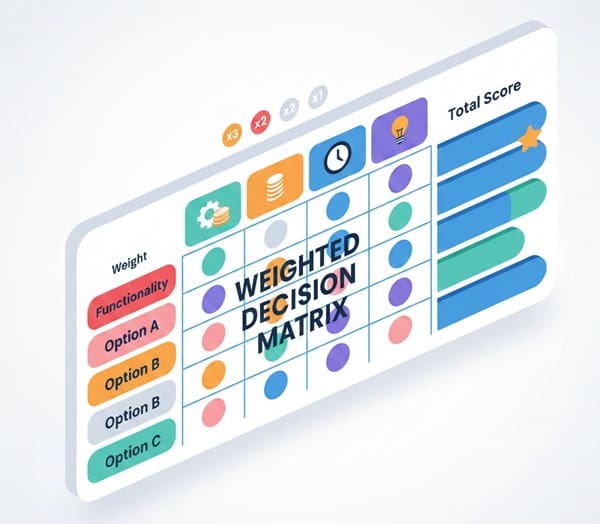
In finer terms, the Weighted Decision Matrix is nothing but a scoring model. It allows you to objectively evaluate different options by assigning importance (weight) to each requirement, thereby leading to a quantifiable, evidence-based final decision. This approach helps reduce bias and subjectivity.

Public, Onsite, Virtual, and Online Six Sigma Certification Training!
- We are accredited by the IASSC.
- Live Public Training at 52 Sites.
- Live Virtual Training.
- Onsite Training (at your organization).
- Interactive Online (self-paced) training,
Why Use a Weighted Decision Matrix?
One must understand that in many situations, choosing the best option is not straightforward. For example, when you select a new supplier or choose a piece of manufacturing equipment, you likely look at price, quality, delivery time, and service reputation. These factors are not equally important.
The Weighted Decision Matrix plays a crucial role here. It allows you to:
Organize your criteria: It provides a clear, structured way to list all factors relevant to your decision.
Prioritize importance: You can assign a specific degree of importance to each criterion, reflecting your strategic priorities.
Generate an objective score: The matrix allows you to convert subjective assessments into an overall numerical score. This clearly shows which option is mathematically superior.
How to Create a Weighted Decision Matrix
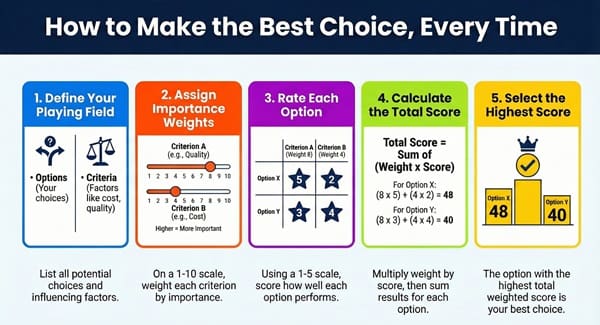
Creating a Weighted Decision Matrix involves a sequence of clear, logical steps. Let us now discuss this step-by-step approach.
Step 1: Define the Options and Criteria
Before you begin the decision matrix calculation, you must clearly identify the elements involved.
Options: List all the alternatives you are considering. These are the items you will score. For example, “Option A: Supplier X” or “Option B: Software Y.”
Criteria: List all the factors that will influence your choice. For example, “Cost,” “Features,” “Reliability,” or “Ease of Use.” It is essential to understand that these criteria must be measurable and relevant.
Step 2: Assign Weight to Each Criterion
This is the most crucial part of the process. You need to assign a weight to each criterion to reflect its importance.
Weighting: Use a scale, typically 1 to 10 or 1 to 5, where a higher number indicates greater importance. For example, if “Reliability” is twice as important as “Cost,” you might assign a weight of 10 to Reliability and 5 to Cost.
Normalization (Optional): Many people prefer that the total of all weights adds up to 100% or 1.0. This makes the final score easier to interpret. You can convert your raw weights into percentage weights by dividing each weight by the total sum of all weights.
Normalization Formula:
Normalized Weight = (Individual Weight) ÷ (Sum of All Weights)
Let us now understand that the weights directly affect the final outcome. A higher weight essentially multiplies the importance of that criterion’s score.
Step 3: Score Each Option Against the Criteria
Here, you evaluate how well each option meets each criterion.
Scoring Scale: Choose a consistent scale, typically 1 to 5 or 1 to 10, where a higher score means the option performs better on that specific criterion. For example, a score of 1 means “poor performance” and a score of 10 means “excellent performance.”
Assessment: Evaluate each option against every criterion, giving it a raw score. It must be noted that this part requires research, data, or expert judgment.
Step 4: Calculate the Total Weighted Score
The decision matrix calculation happens in this step. You perform the calculation for each option.
Weighted Score: For every cell in the matrix, multiply the Criterion Weight by the Option Score.
Weighted Score = Weight × Score
Total Score: Sum up all the Weighted Scores for each option. This provides the final, overall score for that option.
Total Score for Option = Sum of (Weight × Score) for all criteria
Or written in detail:
Total Score = (Weight₁ × Score₁) + (Weight₂ × Score₂) + (Weight₃ × Score₃) + … + (Weightₙ × Scoreₙ)
Step 5: Make Your Decision
The option with the highest Total Weighted Score is the objectively best choice based on the importance you assigned to your criteria.
Decision Matrix Example: Selecting Manufacturing Software
Suppose a manufacturing company must choose one of three new Enterprise Resource Planning (ERP) software options (A, B, or C). The team has agreed on four main criteria.
Step 1 & 2: Define and Weight Criteria
| Criteria | Raw Weight (1-10) | Normalized Weight (W) |
| Data Security | 10 | 10 ÷ 30 = 0.33 |
| Implementation Cost | 5 | 5 ÷ 30 = 0.17 |
| User Friendliness | 8 | 8 ÷ 30 = 0.27 |
| Supplier Support | 7 | 7 ÷ 30 = 0.23 |
| Total | 30 | 1.00 |
Step 3 & 4: Score Options and Calculate WDM
We score each option from 1 (Poor) to 5 (Excellent) against each criterion.
| Criteria | Normalized Weight (W) | Option A Score | Weighted Score (W × A) | Option B Score | Weighted Score (W × B) | Option C Score | Weighted Score (W × C) |
| Data Security | 0.33 | 5 | 1.65 | 4 | 1.32 | 3 | 0.99 |
| Implementation Cost | 0.17 | 3 | 0.51 | 4 | 0.68 | 5 | 0.85 |
| User Friendliness | 0.27 | 4 | 1.08 | 5 | 1.35 | 3 | 0.81 |
| Supplier Support | 0.23 | 5 | 1.15 | 4 | 0.92 | 4 | 0.92 |
| Total Score | 1.00 | 4.39 | 4.27 | 3.57 |
Calculation Breakdown for Option A:
- Data Security: 0.33 × 5 = 1.65
- Implementation Cost: 0.17 × 3 = 0.51
- User Friendliness: 0.27 × 4 = 1.08
- Supplier Support: 0.23 × 5 = 1.15
- Total: 1.65 + 0.51 + 1.08 + 1.15 = 4.39
Step 5: Decision
The results clearly indicate that Option A has the highest total score of 4.39. Thus, we can say that Option A is the optimal choice based on the weighted criteria.
Also Read: PayOff Matrix
Comparison: WDM vs. Simple Decision Matrix
Moving to the comparison, it is essential to understand the difference between a simple, unweighted decision matrix and a Weighted Decision Matrix.
| Feature | Simple Decision Matrix | Weighted Decision Matrix (WDM) |
| Criteria Importance | Assumes all criteria are equally important | Allows you to rank criteria by assigning specific weight (prioritization) |
| Calculation | Simply sums the raw scores: Sum of (Score) | Multiplies Score by Weight, then sums: Sum of (Weight × Score) |
| Best Use | Simple decisions where criteria truly have equal value (e.g., comparing features of a product) | Complex decisions where strategic criteria (e.g., long-term reliability) outweigh simple criteria (e.g., upfront price) |
| Bias Reduction | Lower. A minor criterion can easily overshadow a major one | Higher. Your strategic priorities are built into the math, thereby providing a more objective result |
The key point is that the Weighted Decision Matrix is highly effective because it makes you formalize your priorities before you start scoring.
Advantages and Disadvantages of Using a WDM
The Weighted Decision Matrix is a widely used and highly effective tool, but it has some limitations.
Advantages (The Benefits)
Reduces Subjectivity: The final score is purely mathematical, based on numbers. This greatly minimizes personal bias.
Forces Clarity: It forces the decision-makers to clearly define and agree on the criteria and their relative importance before the evaluation.
Supports Consensus: It provides a common language and objective framework for teams, which aids in building agreement.
Improves Defensibility: You can easily defend your final choice by showing the matrix and the scores used.
Disadvantages (Things to Keep in Mind)
Weighting Bias: The weights you assign are subjective. If you assign incorrect weights, the result will also be flawed.
Scoring Difficulty: It can be quite difficult to assign objective scores for subjective criteria, like “aesthetics” or “ease of maintenance.”
Not for Uncertainty: The WDM does not directly account for uncertainty or probability in the way an Expected Monetary Value (EMV) analysis does. It assumes the scores are certain.
Key Takeaways
Weighting is Critical: The success of your decision matrix depends primarily on accurately defining the weight of each criterion. Take your time during Step 2.
Use Clear Scales: Always use clear, defined scales (e.g., 1-10) for both weighting and scoring, and stick to them.
WDM is an Aid, Not the Master: The matrix provides a final score, but you should not blindly follow it. Use the result as the primary input for your final decision, but consider qualitative factors too.
In complex decisions, the Weighted Decision Matrix is highly preferred over a simple matrix because it integrates your strategic priorities.
Also Read: How to Make a Requirements Traceability Matrix (RTM)?
Frequently Asked Questions (FAQs)
Is the Weighted Decision Matrix the same as a Pugh Matrix?
No, they are not the same. The key point is that a Pugh Matrix (or Selection Matrix) only compares all options against a single baseline option. It uses a relative scoring system (better, worse, or same). In contrast, the Weighted Decision Matrix scores all options absolutely against an objective scale, thereby generating a final total score for each.
How do I choose the scoring scale for my decision matrix?
You can use any scale, but it must be consistent. Generally preferred scales are 1-5 or 1-10. A scale of 1-10 is often better because it offers more granularity, allowing you to clearly distinguish between options that are only slightly different.
Should the weights always add up to 100%?
No, but it is often easier to interpret the final results if they do. You can use raw weights (e.g., 1 to 10 scale) and still get the same ranking of options, as the reason behind this is that the ratios between the weights remain the same. The process of normalizing the weights simply converts the final score into a percentage or a score out of 1.0, which can be easier to read.
Final Words
The Weighted Decision Matrix is a fundamental tool for structured, evidence-based decision-making. Now that you understand how to assign weight, score criteria, and complete the decision matrix calculation, you can apply this method to your next complex choice, whether you are selecting a manufacturing vendor, choosing a project methodology, or simply ranking job applicants.
We believe in empowering you to move from feeling overwhelmed by choices to confidently defending the optimal solution.