Right the first time (RFT) is a quality management principle that emphasizes performing a task, process, or service correctly at the very first attempt without needing rework. It represents a shift from “detecting errors” to “preventing errors” by ensuring all requirements, tools, and skills are perfectly aligned before execution.
This concept is crucial in high-stakes industries like PCB design, software engineering, and corporate leadership, where the cost of a single mistake can lead to catastrophic financial loss or project failure.
To be honest, we’ve all been there—racing against a deadline, cutting corners, and telling ourselves, “I’ll fix it in the next draft.” But here’s the thing: in modern engineering and business, there is rarely a “next time” that doesn’t cost you double. Whether you are designing a complex circuit board or leading a team meeting, doing it right the first time isn’t just a goal; it’s a survival strategy.
One may wonder, is it actually possible to achieve 100% perfection every time? While humans are fallible, the Right the First Time methodology provides a framework to minimize the variables that cause failure.
Table of contents
Comparison Chart: RFT vs. Traditional Rework
| Basis for Comparison | Right the First Time (RFT) | Traditional Rework Model |
| Primary Focus | Prevention of errors and defects. | Detection and correction of errors. |
| Initial Investment | High (time spent on planning and prep). | Low (quick start to “get moving”). |
| Total Project Cost | Lower due to zero waste and rework. | Higher due to repetitive cycles. |
| Quality Control | Integrated into every step of the process. | Performed at the end of the process. |
| Speed to Market | Faster (linear progression). | Slower (looping through fixes). |
| Employee Morale | High (pride in quality work). | Low (frustration with repetitive tasks). |
Core Philosophy of Right the First Time (RFT)
Right the first time is nothing but a commitment to excellence at the point of origin. It suggests that the most efficient way to work is to eliminate the need for a “check-and-fix” cycle. In technical fields, specifically high-speed digital design, this philosophy is often the difference between a product that works and a pile of expensive scrap metal.
In my experience, many teams treat quality as a filter at the end of a funnel. They pour in work, and the “Quality Assurance” team catches the dirt. RFT flips this. It ensures the dirt never enters the funnel in the first place. This requires a deep understanding of the design rules, environmental constraints, and the tools being used.

Public, Onsite, Virtual, and Online Six Sigma Certification Training!
- We are accredited by the IASSC.
- Live Public Training at 52 Sites.
- Live Virtual Training.
- Onsite Training (at your organization).
- Interactive Online (self-paced) training,
The High Cost of the “Fix It Later” Mentality
The Right the First Time approach addresses the “Cost of Quality” (CoQ). When you bypass the RFT principle, you encounter what engineers call “The Rule of Ten.” This rule states that the cost of a mistake increases tenfold at every stage of the product lifecycle.
- Design Phase: Fixing a typo in a requirement costs $1.
- Prototyping: Fixing that same error on a physical board costs $100.
- Production: Fixing it during mass assembly costs $1,000.
- Field Failure: Fixing it after the customer has it costs $10,000+.
Now, the question arises: why do so many companies still rush into production without proper verification? It usually comes down to a false sense of urgency. We think we are saving time by skipping the pre-layout analysis, but we end up spending three months “debugging” a board that should have worked in three weeks.
Also Read: What is an Enterprise Quality Management System (EQMS)?
How to Implement RFT in Technical Design?
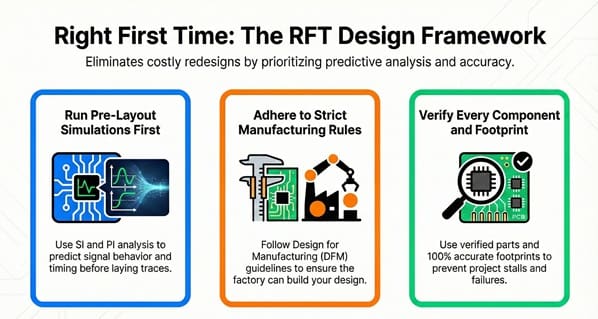
Let us discuss the technical application of RFT, specifically within the context of high-speed PCB design and system architecture.
1. Pre-Layout Simulation
Right the first time design requires that you simulate your circuits before a single trace is laid down. This involves Signal Integrity (SI) and Power Integrity (PI) analysis. By using simulation tools, you can predict how signals will behave, ensuring that timing margins are met and crosstalk is minimized.
2. Adherence to Design Rules
In the world of hardware, “near enough” is never good enough. You must follow strict Design for Manufacturing (DFM) guidelines. These rules ensure that the factory can actually build what you have designed. If you ignore these, you’ll get a call from the fabricator saying your board is “unmanufacturable”—the ultimate failure of the RFT principle.
3. Rigorous Component Selection
Right the first time execution depends on the quality of your parts. Using unverified components or parts with long lead times can stall a project. You must verify the datasheets and ensure the footprints are 100% accurate.
Communicating Right the First Time in Leadership
It isn’t just about machines; it’s about people. In her work, Loretta Malandro emphasizes that “Saying it right the first time” is vital for corporate leadership. How many times have you sent an email, only to spend the next three days explaining what you actually meant?
Right the first time communication involves:
- Clarity of Intent: Knowing exactly what you want to achieve before you speak.
- Active Listening: Ensuring you understand the feedback before you respond.
- Precision: Using words that cannot be misinterpreted.
If you don’t say it right the first time, you lose authority. You become the person who is “constantly clarifying,” which is just another form of rework. To be honest, wouldn’t you rather spend ten extra minutes drafting a perfect memo than ten hours fixing a departmental misunderstanding?
Also Read: Quality by Design (QbD): Blueprint for Building Quality
Writing Requirements: The Foundation of RFT
Right the first time projects live or die by their requirements. If the foundation is shaky, the building will fall. According to Telelogic’s standards for requirements engineering, a “right” requirement must be:
- Atomic: It should represent a single, indivisible need.
- Traceable: You must be able to track it from the start to the finished product.
- Verifiable: There must be a way to prove the requirement was met.
The Right the First Time methodology suggests that if you cannot write a clear requirement, you do not understand the problem. And if you don’t understand the problem, you cannot possibly build the right solution.
Advantages of the RFT Approach
The Right the First Time strategy offers several significant benefits:
- Minimized Waste: You don’t waste expensive materials on failed prototypes.
- Reduced Time-to-Market: By avoiding the “debug loop,” you get your product to the customer faster.
- Improved Brand Reputation: Customers trust brands that deliver working products out of the box.
- Enhanced Profitability: Lower rework costs directly increase your bottom line.
- Shift in Culture: It fosters a culture of accountability and pride among employees.
Key Takeaways
- Right the first time is a mindset that prioritizes prevention over correction.
- The “Rule of Ten” shows that errors become exponentially more expensive the longer they go undetected.
- In engineering, pre-layout simulation and DFM are the pillars of RFT.
- In leadership, precision in language prevents the “communication rework” that bogs down teams.
- Requirements must be clear, verifiable, and atomic to ensure the project stays on track.
Frequently Asked Questions (FAQs)
1. Does RFT take more time than traditional methods?
Initially, yes. Right the first time requires more effort in the planning and simulation phases. However, it saves a massive amount of time in the long run by eliminating the weeks or months spent on troubleshooting and redesigning.
2. Is RFT applicable to software development?
Absolutely. In software, this is often called “Test-Driven Development” (TDD) or “Shift Left.” By writing tests and verifying code early, you ensure that the software architecture is sound before you build the entire system.
3. How do I start implementing RFT in my team?
Start by auditing your most recent failures. Ask yourself: “At what point did we know this was wrong, and why didn’t we catch it earlier?” Then, implement a verification step at that specific point in your next project.
4. What is the difference between RFT and Six Sigma?
Right the first time is a philosophy or goal within many quality frameworks. Six Sigma is a specific, data-driven methodology used to achieve RFT by reducing process variation to a level where defects are extremely unlikely ($3.4$ defects per million opportunities).
Final Words
Right the first time is more than just a catchy phrase; it is a fundamental pillar of modern success. Whether you are navigating the complexities of signal integrity in a lab or leading a multi-million dollar corporation, the principle remains the same. If you don’t have time to do it right now, when will you have the time to do it over?
At our core, we believe that quality isn’t an accident. It is the result of deliberate planning, high standards, and a refusal to accept “good enough.” By embracing the RFT mindset, you aren’t just saving money—you are building a legacy of excellence and reliability. Are you ready to stop fixing the past and start building the future?