
Level loading refers to a production method where you distribute work evenly over a specific period to avoid big spikes or drops. Have you ever felt the stress of a “Monday rush” followed by a “Tuesday slump” where everyone sits around waiting for orders? That roller coaster kills your efficiency and burns out your team. To be honest, most businesses think they have to react to every customer whim instantly, but that usually leads to chaos.
What if you could make your workflow feel more like a steady stream and less like a tidal wave? In the world of Lean manufacturing, we call this concept Heijunka. It’s about finding a middle ground where you meet demand without breaking your machines or your people.
We’ve all been there—staring at a pile of backlogged tasks while the clock ticks. Level loading is the tool that helps you stop the madness.
Table of contents
What is Level Loading?
At its heart, level loading is a way to match your production speed with the average customer demand. Instead of making 100 items on Monday because you got 100 orders, and zero on Tuesday because it was quiet, you might make 50 each day. This creates a predictable rhythm.
In my experience, the hardest part for managers to swallow is not reacting to the “now.” But here’s the thing: when you level the load, you reduce waste. You don’t need extra staff for busy days, and you don’t pay people to do nothing on slow days. It is the foundation of a stable system.
Why Do We Need Heijunka?
The term Heijunka comes from Toyota. They realized that “Mura” (unevenness) leads to “Muri” (overburden). If your workflow is bumpy, your quality will eventually drop. People get tired, mistakes happen, and machines break because they’re pushed too hard.
Does your current process feel like a sprint that never ends? By using a level loading strategy, you treat your production like a marathon. You pick a pace you can actually keep up with. This helps you manage inventory better and keeps your lead times short.

Public, Onsite, Virtual, and Online Six Sigma Certification Training!
- We are accredited by the IASSC.
- Live Public Training at 52 Sites.
- Live Virtual Training.
- Onsite Training (at your organization).
- Interactive Online (self-paced) training,
The Two Main Types of Levelling

When we talk about leveling, we usually look at two factors: volume and product mix. You can’t really have one without the other if you want a truly smooth operation.
1. Leveling by Volume
This is the most basic form. You look at your total demand over a month and divide it by the number of working days.
- Total Demand: 1,000 units per month.
- Working Days: 20 days.
- Daily Goal: 50 units.
Even if you get 80 orders on the first day, you stick to the 50. This keeps the pressure steady.
2. Leveling by Product Mix
This is where it gets interesting. Most companies make more than one thing. If you make Product A and Product B, you shouldn’t make all of A in the first week and all of B in the second. Why? Because if a customer wants Product B on Tuesday of week one, they have to wait ten days!
Instead, a level loading approach suggests alternating. You might make A-B-A-B or A-A-B-A-A-B. This ensures you always have a little bit of everything ready for the customer.
How to Implement Level Loading in Your Business
Starting with level loading isn’t just about changing a schedule; it’s about changing how you think about “capacity.” You need to stop looking at what you can do and start looking at what you should do.
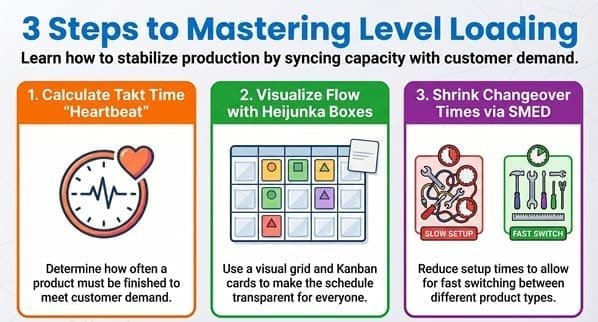
Step 1: Calculate Takt Time
Takt time is the heartbeat of your business. It tells you how often you need to finish a product to meet demand.

If you have 400 minutes of work time and customers want 40 items, your Takt time is 10 minutes. Every 10 minutes, one item must be done.
Step 2: Use a Heijunka Box
A Heijunka box is a visual tool. Picture a grid on a wall with rows for products and columns for time slots. You put “Kanban” cards in the slots to show what needs to be made and when. It makes the level loading process visible to everyone. If a slot is empty, the team knows exactly what to do next without asking a manager.
Step 3: Shrink Your Changeover Times
You can’t switch between Product A and Product B quickly if it takes four hours to set up the machine. This is why “SMED” (Single-Minute Exchange of Die) is so important. To make level loading work, you must be able to switch tasks fast.
Real-World Benefits of a Level Load
I once worked with a small fabrication shop that was struggling with overtime costs. They were constantly “firefighting.” We moved them to a level loading model, and within three months, their overtime dropped by 40%.
- Better Quality: When people aren’t rushing, they don’t miss steps.
- Lower Costs: You don’t need to keep massive amounts of “just in case” stock.
- Happier Staff: Predictable workdays lead to less stress and better morale.
- Predictable Shipping: Customers love knowing exactly when their order will arrive.
Is it perfect? No. Sometimes you might need a small “buffer” of finished goods to handle unexpected spikes. But roughly speaking, it’s much cheaper to hold a tiny bit of stock than to pay for a mountain of idle labor.
Common Challenges You Might Face
It’s not all sunshine and rainbows. Implementing level loading (LL) requires discipline. To be honest, the biggest hurdle is usually sales or upper management. They want to ship everything the second the phone rings.
- The “Urgency” Trap: Someone will always say, “But this client is special!” If you break your level load for every “special” client, you no longer have a system.
- Supplier Issues: Your suppliers need to be on board. If you need parts daily but they only ship once a month, your leveling will fail.
- Rigid Thinking: Some teams hate the idea of making Product B when there are 100 orders for Product A waiting. You have to explain that this prevents a bottleneck later.
Level Loading in Non-Manufacturing Settings
Can you use level loading in an office or a software team? Absolutely. Think about a marketing department. If you try to launch five campaigns in one week, the team will crash.
Instead, you level the work. You plan one launch every two weeks. This ensures the designers, writers, and tech teams have a steady flow of work. It’s the same logic: stop the “feast or famine” cycle.
Key Takeaways for Level Loading
- Level loading creates a predictable “heartbeat” for your operations.
- It reduces the “Mura” (unevenness) that causes stress and waste.
- You must balance both volume and product mix for the best results.
- Short changeover times are the “secret sauce” to making this work.
- A Heijunka box is a great way to make the schedule visual and easy to follow.
Frequently Asked Questions (FAQs) on Level Loading
What is the difference between Level Loading and Just-in-Time?
They work together. Level loading is the schedule that makes Just-in-Time (JIT) possible. JIT is the goal of having what you need exactly when you need it. You can’t achieve JIT if your production is jumping up and down every day.
Do I need special software for this?
Not necessarily. While many ERP systems have leveling modules, many successful companies start with a simple whiteboard or a Heijunka box. The logic is more important than the software.
How much inventory should I keep?
This depends on your “buffer.” Most people keep enough to cover the time it takes to replenish what was sold. If you level your load well, this inventory stays very low.
Is level loading the same as batching?
Actually, it’s the opposite. Batching is making 1,000 of one thing at once. Leveling is breaking those 1,000 into smaller, daily pieces to stay flexible.
Final Words
Switching to a level loading system is one of the best moves a business can make to secure long-term stability. It’s about working smarter, not harder. By smoothing out the bumps in your production, you protect your team, your equipment, and your bottom line.
We believe in creating processes that respect the human element while maximizing output. At our core, we’re dedicated to helping you build a workflow that actually flows.


