
Collecting data from every unit in a population is rarely practical. Sampling solves this by selecting a subset of the population and using it to draw conclusions about the whole. But not all sampling methods work the same way. Some rely on random selection. Others rely on expertise.
Judgement sampling is one of the oldest and most direct sampling approaches. It places the selection decision in the hands of a qualified expert. The expert uses knowledge and experience to pick units most likely to provide useful, representative data. This method suits specific situations well — and creates real risks when applied incorrectly.
In Six Sigma, understanding judgement sampling means knowing when to use it, when to avoid it, and what its limitations mean for the reliability of your data.
Table of contents
Meaning of Judgement Sampling
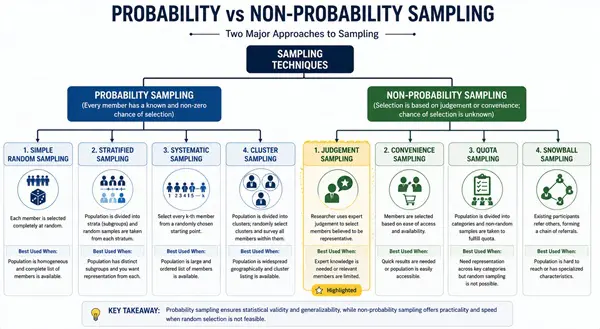
Judgement sampling — also called purposive sampling, expert sampling, or authoritative sampling — is a non-probability sampling technique in which a researcher or subject matter expert selects sample units based on their knowledge and professional judgement rather than random selection. The expert chooses the units they believe will provide the most relevant and useful data for the study’s objective.
Judgement sampling is most effective when the population is small, specialized, or difficult to access, and when only certain individuals or items possess the characteristics needed for the research. Its primary limitation is susceptibility to selection bias, since the sample reflects the expert’s judgement rather than a random draw from the population.
Key Takeaways
- Judgement sampling is a non-probability sampling technique. The researcher selects units based on knowledge and judgement, not random chance.
- It is also called purposive sampling, expert sampling, selective sampling, and authoritative sampling. All terms describe the same method.
- Judgement sampling does not give every unit in the population an equal or known chance of selection. This distinguishes it from probability sampling methods such as simple random sampling.
- The method is most effective when the population is small, specialized, or when only certain units possess the characteristics needed for the study.
- The primary risk is selection bias. The sample reflects the researcher’s judgement rather than the actual distribution of the population.
- In Six Sigma’s Measure phase, judgement sampling is sometimes used in the early stages of data collection. However, random sampling or stratified sampling is preferred for producing statistically valid baseline data.
- According to the Six Sigma Study Guide, judgement sampling selects items of special significance and is flexible — but it cannot support statistically generalizable conclusions in the same way that probability sampling can.
- Judgement sampling should always be combined with documented criteria for unit selection. Undocumented judgement selections introduce unverifiable bias.

Public, Onsite, Virtual, and Online Six Sigma Certification Training!
- We are accredited by the IASSC.
- Live Public Training at 52 Sites.
- Live Virtual Training.
- Onsite Training (at your organization).
- Interactive Online (self-paced) training,
What Is Judgement Sampling?
Judgement sampling is a non-probability sampling technique. The researcher deliberately selects specific units from the population based on their expert knowledge. The selection is not random. Each unit chosen reflects a deliberate decision by the researcher.
QuestionPro defines judgement sampling as a technique “in which the sample members are chosen only on the basis of the researcher’s knowledge and judgment.” The researcher’s expertise drives the entire selection process.
The method goes by several names in the sampling and research literature:
- Purposive sampling — units are selected “on purpose” based on defined characteristics
- Expert sampling — an acknowledged authority makes the selection
- Authoritative sampling — the selection rests on the authority of the researcher’s knowledge
- Selective sampling — the researcher selects specific units, not a random draw
All four terms describe the same fundamental approach. The researcher decides which units best represent the population for the study’s specific purpose.
Also Read: Acceptance Sampling: Quality Control Without Testing Everything
How Judgement Sampling Works?

Judgement sampling follows a straightforward process. The researcher or expert identifies the research objective first. They then define the specific characteristics or criteria that qualify a unit for inclusion in the sample. Finally, they deliberately select units that meet those criteria.
The process has five stages.
Stage 1: Define the research objective clearly. The researcher identifies exactly what information the study needs to produce. A vague objective produces poor sample selection. A precise objective gives the researcher clear criteria for inclusion.
Stage 2: Identify the characteristics that define a relevant unit. The researcher specifies what makes a unit valuable for the study. In a quality audit, this might be production runs that occurred during a specific time window, used a specific material lot, or ran on a specific machine.
Stage 3: Apply expert knowledge to identify qualifying units. The researcher uses their knowledge of the population to identify which units meet the criteria. This step requires genuine expertise. A poor judge produces a biased sample even with a clear objective.
Stage 4: Select the units and collect data. The researcher collects data from the selected units. This data reflects the characteristics the researcher identified as relevant.
Stage 5: Document the selection criteria explicitly. Documenting why each unit was selected makes the sampling decision auditable and reproducible. Without documentation, the judgement cannot be reviewed or challenged.
When to Use Judgement Sampling
Judgement sampling is most effective under specific conditions. Using it outside these conditions increases the risk of selection bias without gaining meaningful benefit.
Use judgement sampling when the population is highly specialized. Some populations contain only a small number of units with the relevant characteristic. A study of individuals who have run ultra-marathon races in temperatures above 40°C has a tiny population. Random sampling across the general population would produce almost no relevant units. An expert selects participants who actually qualify.
Use it when the population is difficult to identify or access. Some populations have no complete list or registry. A researcher studying informal supply chain networks cannot draw a random sample from a list that does not exist. Expert judgement identifies the accessible and relevant units.
Use it during early exploratory phases of an investigation. When a Six Sigma team begins a new project, team members may use judgement sampling to select the initial process steps or time periods that appear most likely to contain the root cause. This early focus is then confirmed or adjusted using probability sampling methods during the formal Measure phase.
Use it under time and resource constraints. Formpl.us confirms that judgement sampling is used “where there is a time constraint for sample creation and the authorities involved would prefer relying on their knowledge.” Building a full probability sample takes time. When time is genuinely limited and a rough picture of the population is sufficient, expert selection can provide useful information faster.
Use it when only a few individuals can provide the needed information. Alchemer confirms that judgement sampling is most effective “when only a limited number of individuals possess the trait that a researcher is interested in.” A study requiring participants with highly specific technical experience cannot rely on random selection from the general public.
When Not to Use Judgement Sampling
Judgement sampling has clear limits. Applying it where probability sampling is required produces unreliable results.
Do not use it when statistical generalization is required. Results from a judgement sample describe the units selected, not the full population. Generalizing from a judgement sample to the broader population is statistically unsound. Research-Methodology.net confirms that findings from purposive sampling “may not represent the wider population accurately.”
Do not use it as the primary method for Six Sigma process baseline data. The Measure phase of DMAIC requires baseline data that accurately represents the process under normal operating conditions. If the expert selects only the best-performing production runs or the most visible problem cases, the baseline will be distorted. Random sampling or stratified random sampling produces an unbiased baseline.
Do not use it when the selection criteria cannot be documented. Judgement sampling is only defensible when the researcher can explain why each unit was selected. Selections based on convenience, familiarity, or vague impressions are not judgement sampling — they are convenience sampling with a different label.
Do not use it when the expert’s objectivity is in question. If the researcher has an interest in the outcome of the study, their judgement over unit selection becomes unreliable. Bias in unit selection produces bias in the results.
Advantages of Judgement Sampling
Judgement sampling offers specific, genuine advantages when used in the right context.
Speed. Expert selection is faster than building a probability sample. The researcher does not need a complete population list or a random number generator. They apply their knowledge directly.
Access to hard-to-reach populations. When a population has no complete registry and no straightforward way to draw a random sample, expert judgement is often the only practical way to identify relevant units.
Efficiency with small or specialized populations. When only a small number of units possess the characteristics the study requires, random sampling wastes resources by selecting irrelevant units. Expert selection focuses immediately on relevant ones.
Flexibility. The Six Sigma Study Guide confirms that judgement sampling “is flexible to include those items in the sample that are of special significance.” The researcher can adjust the criteria as understanding of the population deepens.
Cost-effectiveness. Probability sampling methods — particularly systematic or stratified random sampling — require a sampling frame, a defined population, and formal random selection procedures. Judgement sampling requires only an expert. For preliminary studies or resource-constrained environments, this reduces cost significantly.
Also Read: Random Sampling
Disadvantages of Judgement Sampling
Every advantage of judgement sampling comes with a corresponding risk. Understanding these risks is what allows Six Sigma practitioners to use the method appropriately.
Selection bias. This is the primary and most serious risk. Research-Methodology.net identifies selection bias as the key limitation: the method is “vulnerable to selection bias and errors in judgement.” Two experts with different knowledge and different assumptions may select completely different samples from the same population. Two different samples may produce different conclusions — even though the population has not changed.
Lack of statistical generalizability. Results from a judgement sample cannot be projected onto the full population with a known margin of error. Confidence intervals and significance tests assume probability sampling. Applying them to judgement samples produces statistically meaningless figures.
Dependence on expert quality. The entire value of judgement sampling rests on the expertise of the person making selections. QuestionPro states clearly: “the researcher may or may not have the appropriate proficiency to conduct an effective sampling process.” An inexperienced expert or one with blind spots in their knowledge produces a poor sample even when following the method correctly.
Reproducibility problems. A random sample can be reproduced: given the same population and the same random seed, the same sample results. A judgement sample cannot be reproduced by a different expert. This limits the ability to verify findings independently.
Audit difficulty. In regulatory or compliance environments, sampling decisions must be defensible. Judgement samples require documented criteria that justify each selection. Without documentation, the selection cannot be audited or reviewed.
Judgement Sampling vs. Other Sampling Methods
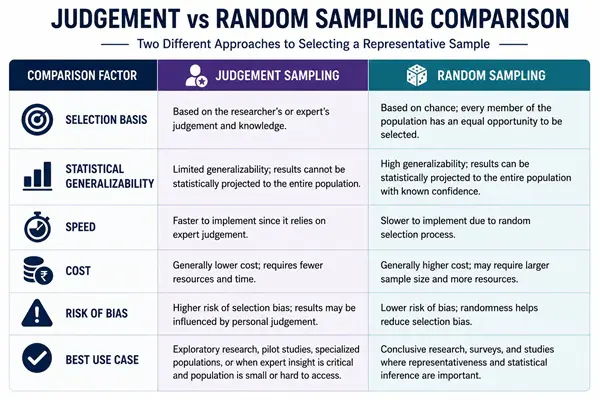
Understanding how judgement sampling compares to other methods helps practitioners choose the right approach for each situation.
| Sampling Method | Selection Basis | Statistical Generalizability | Best Used When |
| Judgement (purposive) | Expert knowledge and criteria | No | Population is specialized or small; exploratory research |
| Simple random | Equal probability for all units | Yes | Population is known and accessible; baseline required |
| Stratified random | Random within defined subgroups | Yes | Population has distinct subgroups; each subgroup must be represented |
| Convenience | Availability and accessibility | No | Preliminary screening; lowest-cost initial data |
| Systematic | Every nth unit from ordered list | Yes (with conditions) | Production line inspection; ordered populations |
| Quota | Set number from each subgroup | No | When stratified random is not feasible |
The critical line is between probability and non-probability methods. Probability methods — random, stratified, systematic — support statistical inference. Non-probability methods — judgement, convenience, quota — do not. Choosing between them depends on what the data will be used to decide.
Judgement Sampling in Six Sigma’s DMAIC Framework
Six Sigma practitioners encounter judgement sampling most often in two DMAIC contexts.
Early in the Define phase: A project team uses expert knowledge to select the process steps, time periods, or product families most likely to contain the problem. This initial focus is a practical use of expert judgement. It guides the team toward the most relevant data collection areas before formal sampling begins.
As a complement to probability sampling in the Measure phase: Sometimes the team needs to understand a specific subset of the process in depth — the highest-volume product family, the most recently changed process step, or the raw material lot associated with a customer complaint. Expert selection directs data collection to these high-priority areas. Random sampling then validates the findings across the broader population.
The Six Sigma Study Guide describes purposive sampling in the Six Sigma data collection context as selecting “those items in the sample that are of special significance.” This selective focus is valuable in early project phases. It becomes a liability if the team relies on it exclusively for capability calculations or hypothesis testing.
The Measure phase demands statistically valid baseline data. That data requires probability sampling to be defensible. Judgement sampling complements the Measure phase. It does not replace its core data collection requirements.
Frequently Asked Questions: Judgement Sampling
Q: What is judgement sampling?
A: Judgement sampling is a non-probability sampling technique where a researcher or expert selects sample units based on their knowledge and professional judgement rather than random selection. The expert chooses the units they believe will best serve the study’s objective. It is also called purposive sampling, expert sampling, authoritative sampling, and selective sampling. Results from judgement samples describe the selected units but cannot be generalized to the full population with a known margin of error.
Q: What is the difference between judgement sampling and random sampling?
A: In random sampling, every unit in the population has an equal or known probability of selection. Selection occurs by chance, not choice. In judgement sampling, the researcher deliberately selects specific units based on expertise and defined criteria. Random sampling supports statistical inference and generalization to the full population. Judgement sampling does not. Random sampling is preferred when statistically valid baseline data is needed. Judgement sampling is preferred when the population is specialized or difficult to access.
Q: What are the advantages of judgement sampling?
A: Judgement sampling is faster than probability sampling because it does not require a complete population list or formal random selection procedures. It provides access to hard-to-reach or specialized populations where random sampling is not practical. It focuses resources on the units most likely to provide relevant information. It is flexible, allowing the researcher to include items of special significance. It is cost-effective when formal sampling infrastructure is unavailable.
Q: What are the disadvantages of judgement sampling?
A: The primary disadvantage is selection bias: the sample reflects the expert’s knowledge and assumptions rather than the actual distribution of the population. Results cannot be generalized to the full population with statistical confidence. The quality of the sample depends entirely on the quality of the expert’s knowledge. Two different experts may select different samples from the same population, potentially reaching different conclusions. The method is difficult to audit without explicit documentation of selection criteria.
Q: Is judgement sampling used in Six Sigma?
A: Yes, judgement sampling appears in Six Sigma, particularly during early project phases. In the Define phase, teams use expert knowledge to focus on the process steps or product families most likely to contain the problem. In the Measure phase, judgement sampling may direct initial data collection to high-priority areas. However, the Measure phase baseline data — used for capability analysis and process improvement targets — requires probability sampling to be statistically valid and defensible.
Q: How is judgement sampling different from convenience sampling?
A: Judgement sampling selects units based on defined criteria and expert knowledge of the population. The selection is deliberate and purposeful. Convenience sampling selects units based on accessibility and availability, without expert criteria. A judgement sample targets units with specific characteristics. A convenience sample targets whatever is easiest to reach. Judgement sampling requires expertise. Convenience sampling requires only access. Both are non-probability methods and neither supports statistical generalization.
Six Sigma Training: Sampling and Data Collection
Understanding when to use judgement sampling versus random sampling is a core competency in Six Sigma’s Measure phase curriculum. The choice of sampling method directly determines the validity of the baseline data. The baseline determines the project’s improvement target. Getting the sampling method wrong undermines every phase that follows.
Green Belt and Black Belt training covers all primary sampling methods — random, stratified, systematic, judgement, and convenience — with guidance on when each applies, how to calculate appropriate sample sizes, and how to document the sampling plan.
At Six Sigma Development Solutions, sampling methods and data collection planning are taught as applied Measure phase skills. Practitioners learn to match the sampling method to the analytical goal, not just to what is convenient.
We offer training in three formats:
- Onsite training — delivered at your facility, using your actual process and your real sampling challenges.
- Live virtual training — instructor-led sessions online covering sampling theory, sample size calculation, and Measure phase data collection planning.
- Online training — self-paced Green Belt and Black Belt certification programs covering all IASSC-testable sampling content.
Explore our Six Sigma training programs or contact our team to find the right program for your goals.
About Six Sigma Development Solutions, Inc.
Six Sigma Development Solutions, Inc. offers onsite, public, and virtual Lean Six Sigma certification training. We are an Accredited Training Organization by the IASSC (International Association of Six Sigma Certification). We offer Lean Six Sigma Green Belt, Black Belt, and Yellow Belt, as well as LEAN certifications.
Book a Call and Let us know how we can help meet your training needs.


