Have you ever finished a big project, felt a brief wave of relief, and then immediately moved on to the next task without a second thought? Most of us do this. We’re so busy chasing the next win that we forget to look back at how we actually got there. But what if I told you that the secret to becoming a powerhouse in your industry isn’t just about moving forward, but about looking backward with brutal honesty?
That is where Hansei comes into play. It is a Japanese concept that goes much deeper than a simple “lessons learned” meeting. In my experience, it’s the emotional and intellectual backbone of the Toyota Production System and any lean organization that actually lasts. It’s about acknowledging your mistakes with a sense of “relentless reflection.”
If you don’t practice this, you’re essentially destined to repeat the same errors while expecting different results. Sounds frustrating, doesn’t if? Let’s dive into how this practice can change your professional and personal life.
Table of contents
Comparison Chart: Hansei vs. Standard Review
To understand this concept, we must see how it differs from the typical Western “Post-Mortem” or project review.
| Basis for Comparison | Hansei | Standard Project Review |
| Focus | Focuses on the process and personal responsibility. | Focuses on the end result and external factors. |
| Emotional Tone | Involves a sense of “regret” (not shame) to drive change. | Usually neutral or celebratory if goals were met. |
| Primary Goal | Continuous improvement of the self and the system. | Closing out a project and checking boxes. |
| Timing | Occurs at milestones and especially after success. | Occurs mostly at the end or when something fails. |
| Responsibility | Deeply personal; “What did I do wrong?” | Often team-based; “What happened to the timeline?” |
Definition of Hansei
Definition: Hansei is a Japanese term that refers to the practice of self-reflection or “shameful reflection.” It is a fundamental mindset in Japanese culture and Lean manufacturing where an individual or team acknowledges their own mistakes and commits to a plan for improvement.
In a business context, it means looking at a process—even a successful one—and identifying the gaps between the ideal state and the actual performance. It is not about wallowing in guilt. Instead, it is about having the integrity to say, “I could have done better,” and then finding the exact path to ensure that “better” happens next time.

Public, Onsite, Virtual, and Online Six Sigma Certification Training!
- We are accredited by the IASSC.
- Live Public Training at 52 Sites.
- Live Virtual Training.
- Onsite Training (at your organization).
- Interactive Online (self-paced) training,
The Core Elements of Self-Reflection
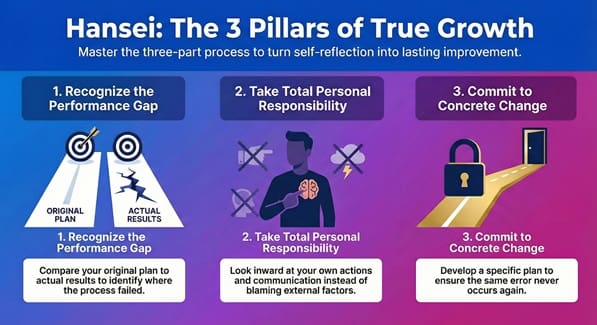
Hansei is not just a fancy word for a meeting; it is a three-part psychological process. To be honest, most people skip the first two parts and jump straight to the fix, which is why the fix never sticks.
Recognition of the Gap
First, you have to admit there is a problem. In a Lean environment, if you say “no problem,” that is actually the biggest problem of all. You must compare what you planned to what actually happened. Did the project take two days longer than expected? Even if the client is happy, that gap is your area for reflection.
Personal Responsibility
This is the hardest part. Hansei requires you to stop pointing fingers at the “market conditions” or “the other department.” You have to look at your own actions. What did you miss? Where was your communication unclear? This internal focus is what makes the practice so transformative.
Commitment to Change
Reflection without action is just daydreaming. The final element is creating a concrete plan. According to research from the University of South Carolina, this involves a sincere desire to improve the process so the same error never occurs again.
Also Read: Continuous Improvement
Why Hansei is Critical for Lean Success?
Hansei acts as the fuel for the Kaizen (continuous improvement) engine. Without it, Kaizen is just a series of random changes. Have you ever wondered why some companies implement Lean tools but never see a change in culture? It’s usually because they lack this reflective core.
In my years of observing organizational growth, I’ve seen that Hansei provides the “why” behind the “how.” It creates a culture where mistakes are seen as opportunities for learning rather than reasons for punishment. This psychological safety allows employees to be honest about failures, which leads to more robust systems.
How to Conduct a Hansei Session?
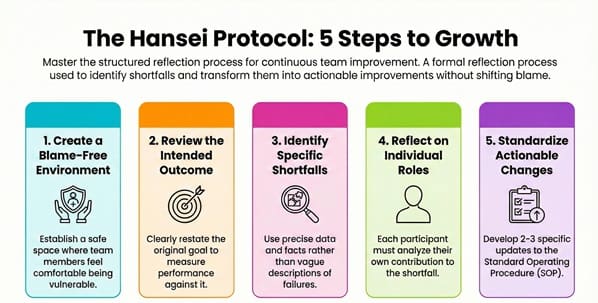
Hansei sessions should be a regular part of your workflow. Here is how you can structure them for your team:
- Set the Stage: Create an environment where people feel safe to be vulnerable. This isn’t a “blame game.”
- Review the Goal: Clearly state what the intended outcome was.
- Identify the Shortfalls: Be specific. Don’t say “we were slow.” Say “we missed the deadline by 4 hours because the QA check took longer than planned.”
- The Reflection Phase: Ask each participant to reflect on their role in that shortfall.
- Actionable Steps: Develop 2-3 specific changes to the standard operating procedure (SOP).
Also Read: What is Continuous Improvement Kaizen?
Hansei and the 5 Whys
Hansei often uses the 5 Whys technique to get to the root of a problem. If you just look at the surface, you’ll only fix the symptom.
For example, if a machine stops:
- Why? The fuse blew.
- Why? The bearing wasn’t lubricated.
- Why? The pump wasn’t working.
- Why? The shaft was worn.
- Why? There was no strainer, and metal scrap got in.
By combining the 5 Whys with a reflective mindset, you don’t just fix the fuse; you install a strainer. You reflect on why the system allowed the scrap to be there in the first place.
Advantages of Constant Reflection
Hansei offers several benefits that go beyond just “fixing things.” When you embrace this mindset, you’ll notice a shift in how you work.
- Increased Self-Awareness: You become more attuned to your strengths and weaknesses.
- Faster Problem Solving: Because you aren’t hiding mistakes, you find and fix them much quicker.
- Higher Quality Standards: You stop settling for “good enough” because you’re always looking for the gap.
- Team Cohesion: When leaders admit their own mistakes through reflection, it builds massive trust within the team.
Common Challenges and Limitations
Hansei is not always easy to implement, especially in cultures that prioritize “saving face.” Here’s the thing: it can feel uncomfortable.
- Cultural Resistance: Many Western business cultures focus on celebrating wins and hiding losses. Admitting a mistake can feel like a weakness.
- Time Constraints: In a fast-paced environment, people often feel they “don’t have time” to sit and reflect.
- The Blame Trap: If not handled correctly, it can devolve into a session where people feel attacked. It is vital to keep the focus on the process while maintaining personal accountability.
Key Takeaways
- Hansei is a continuous process, not a one-time event.
- It requires honest recognition of failures, even when you succeed.
- Personal responsibility is the engine that drives improvement.
- It must result in a concrete plan for change.
- It works best when paired with tools like the 5 Whys.
FAQs
Does Hansei only apply to failures?
No! To be honest, reflecting on a success is just as important. If you succeeded but didn’t follow your process, that’s a “lucky win” that might lead to a future failure. You should reflect on how to make that success repeatable.
How is this different from a Post-Mortem?
A post-mortem is often a clinical look at data. Hansei is more personal. It asks the individual to consider their own contribution to the outcome.
Is Hansei a form of punishment?
Absolutely not. It is a form of respect for the process and the individual’s ability to grow. Punishment stops learning; reflection accelerates it.
Final Words
Hansei is the bridge between where you are and where you want to be. It isn’t about being perfect; it’s about being honest enough to admit you aren’t perfect yet. By incorporating this deep reflection into your daily routine, you aren’t just improving a product or a service—you’re improving yourself.
At our core, we believe that the most successful clients are those who aren’t afraid to look in the mirror. We are committed to helping you build systems that foster this kind of growth. After all, the only real failure is the one you don’t learn from.